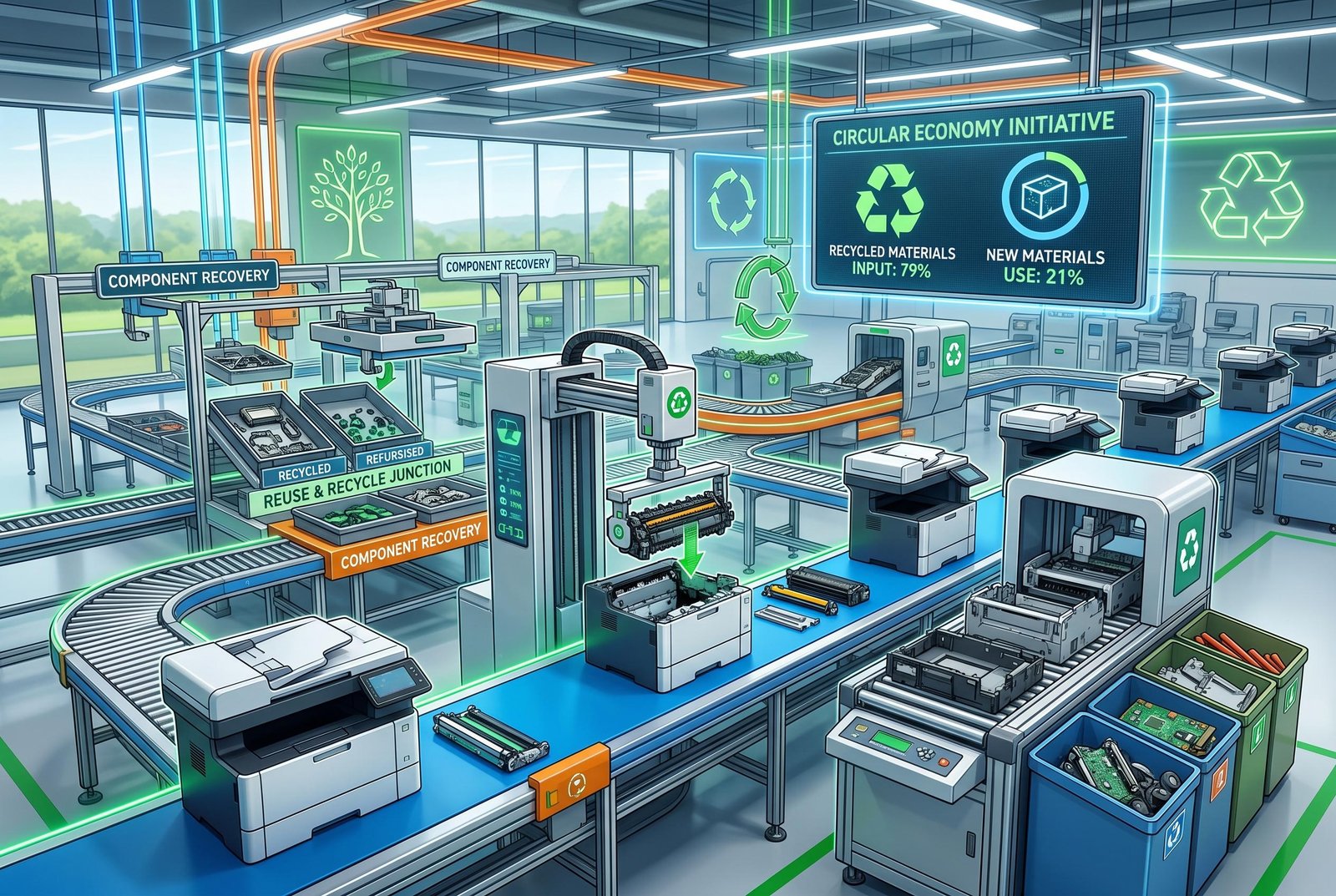
Ricoh and ETRIA have unveiled a manufacturing model they say could reshape how office devices are made, starting with a new circular production line for A3 black-and-white multifunction printers due to be launched in Japan and Europe in the first half of 2027.
The companies said the concept, called “Circular New”, is designed to treat products already in circulation as valuable inputs for future manufacturing rather than as end-of-life waste. In practice, that means...
Continue Reading This Article
Enjoy this article as well as all of our content, including reports, news, tips and more.
By registering or signing into your SRM Today account, you agree to SRM Today's Terms of Use and consent to the processing of your personal information as described in our Privacy Policy.
recovered parts and materials will be assessed, sorted and reused in new machines, while the companies keep the finished products at the same generation, quality level and warranty standard customers would expect from conventionally manufactured equipment.
According to Ricoh, the new approach could cut the share of newly sourced materials in these printers from about 76% to as low as 21%, measured by weight. It also said the product carbon footprint could fall by up to 25%, depending on how many recovered components are used and how far materials must travel. The company added that localised production in Japan and France is intended not only to support circularity but also to improve resilience in supply chains that are increasingly exposed to geopolitical tension, logistics bottlenecks and volatile raw material prices.
The launch marks the latest step in Ricoh’s effort to push what it calls “Evolving Circularity”, a broader strategy that aims to move beyond simply reducing environmental harm. The company’s own materials describe the idea as creating a continuous loop that connects product planning, design, manufacturing, use, collection and reuse. Rather than limiting itself to recycled plastics or steel, Ricoh and ETRIA are seeking to bring back components from existing products and place them directly into new-generation devices.
That ambition depends heavily on design. Ricoh said ETRIA has been working on shared frames and components across model generations, longer-lasting parts and structures that are easier to take apart and replace. Combined with digital information on component condition and more advanced sorting and quality controls, the companies say the system should allow recovered materials to be channelled back into production with sufficient consistency for premium equipment.
James Loginov, Ricoh Asia Pacific’s director of ESG governance, said the move shows sustainability can be measured in concrete terms rather than treated as a vague aspiration. He argued that reducing newly sourced material use in a device from roughly 76% to as low as 21% is a meaningful result that does not compromise quality, while also making the business less dependent on new raw materials and more resilient to disruption.
The initiative is also tied to Ricoh’s commercial targets. In its Mid-Term Management Strategy ’26, announced in March, the group set a goal of reaching a 30% engine market share for ETRIA by fiscal 2030. Ricoh has said Circular New is one of the measures intended to support that target by strengthening ETRIA’s manufacturing competitiveness through circular design and local production.
Katsunori Nakata, who leads Ricoh’s Digital Products Unit and serves as chief executive of ETRIA, said the concept challenges the assumption that manufacturing must follow a one-way path from raw material to disposal. He linked the programme to Ricoh’s wider aim of lowering the share of newly sourced material used across the group to 60% by 2030 and 12% by 2050.
ETRIA itself is relatively new, bringing together manufacturing capabilities from different group companies to supply products to Ricoh, Toshiba Tec and Oki Electric Industry. Its role in Circular New suggests Ricoh sees the enterprise not just as a production partner, but as a platform for re-engineering the economics of manufacturing around reuse.
Ricoh has framed that shift as part of a longer-running environmental philosophy. The company says its Comet Circle model, in place since 1994, has guided its approach to circular economy thinking for decades. Circular New appears to extend that logic into a more industrial form, one that aims to prove circularity can be built into the core of manufacturing rather than layered on afterwards.
The company says the first fruits of the programme will appear in Japan and Europe in 2027, with centrally manufactured and locally produced versions of the same printers to be offered in the same product line-up. If the model works at scale, Ricoh and ETRIA believe it could show that resource circulation is not merely an environmental obligation, but a source of competitive advantage.
Source: Noah Wire Services