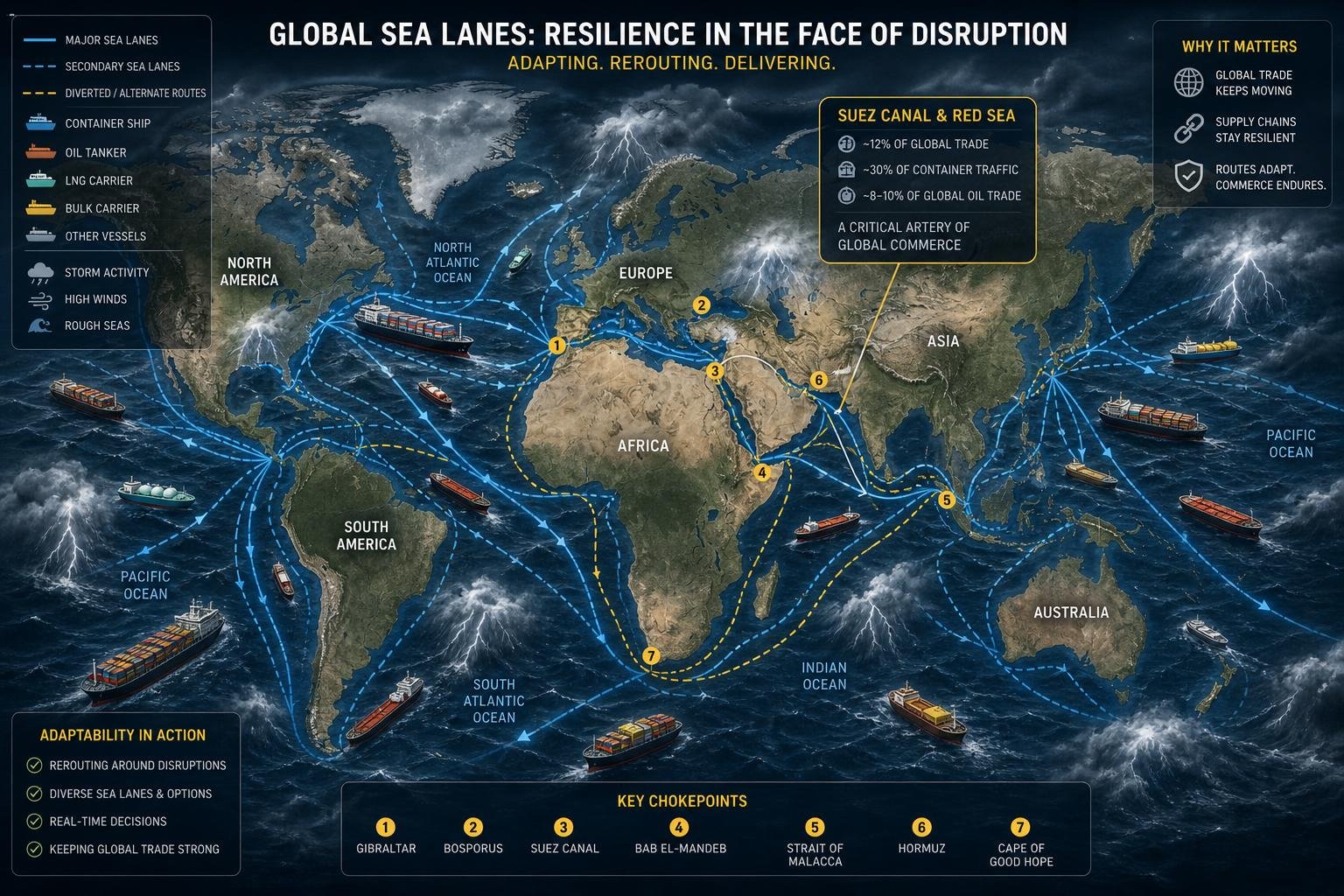
The Red Sea crisis has exposed a weakness in global trade that many importers and exporters long preferred not to confront: the assumption that the fastest shipping lane would remain the safest and most dependable one.
For years, the Red Sea-Suez Canal corridor acted as a cornerstone of intercontinental trade, linking Asia and Europe with speed and relative certainty. That model has now been shaken by Houthi attacks on commercial shipping since late 2023, forcing many operators...
Continue Reading This Article
Enjoy this article as well as all of our content, including reports, news, tips and more.
By registering or signing into your SRM Today account, you agree to SRM Today's Terms of Use and consent to the processing of your personal information as described in our Privacy Policy.
to divert vessels around the Cape of Good Hope. According to supply-chain and insurance commentary, the detour can add roughly 3,000 to 3,500 nautical miles and extend voyages by 10 to 14 days, depending on the trade lane.
That is not simply a transport inconvenience. It is a commercial strain that affects cash flow, stock management and customer commitments. Longer sailings tie up working capital, push back delivery dates and complicate planning for businesses that rely on predictable replenishment. Insurance and freight-linked costs have also moved higher, while the knock-on effects on scheduling have made port planning more difficult.
The wider message, as logistics specialists and trade analysts have argued, is that resilience now matters as much as efficiency. The old logic of minimising transit time at almost any cost looks less convincing when a single chokepoint can disrupt entire supply chains. The Suez Canal typically accounts for a substantial share of world trade and container traffic, and when traffic is interrupted the consequences quickly spread across manufacturing, retail and energy markets.
Industries with tight supply chains are feeling that pressure most sharply. Engineering goods, chemicals, auto components, textiles, pharmaceuticals and consumer products all depend on steady sea links to Europe and other markets. A late vessel may appear to be a routine operational problem, but a delayed shipment of raw materials can interrupt production, while a missed delivery window can weaken customer confidence and upset pricing agreements.
There is also a less visible but equally important effect: vessel capacity is being squeezed. When ships spend more days at sea, they complete fewer round trips over the same period, which reduces effective capacity even if the global fleet itself has not changed. That has implications for sailing frequency, container circulation and the reliability of service across entire routes.
The Red Sea disruption has also come at a time when other maritime routes have faced strain. UN trade analysis has pointed to simultaneous pressure on the Red Sea, the Black Sea and the Panama Canal, with monthly transits at some major passages falling sharply from earlier peaks. In that context, the current crisis is not an isolated event but part of a broader pattern in which geopolitics and climate-related disruptions are repeatedly testing the resilience of global logistics.
For companies, the practical lesson is that visibility alone is no longer enough. Businesses need scenario planning that identifies which customers, inputs and routes are too important to depend on a single logistics path. That may mean using alternative routing, shipping earlier, carrying more strategic inventory near key markets and negotiating contracts that allow more flexibility when conditions change.
This is also encouraging a partial shift away from pure just-in-time thinking towards a more selective just-in-case approach. That does not mean warehousing everything or abandoning cost discipline. It means protecting the parts of the supply chain where disruption would directly affect revenue, reputation or long-term customer relationships.
For Indian exporters in particular, the crisis may create an opening as well as a challenge. As firms expand into global markets, logistics capability is becoming a competitive differentiator. Companies will increasingly need partners who understand route risk, customs processes, multimodal options, port constraints and contingency planning, not just freight movement.
Technology will help, but it will not solve the problem on its own. Real-time tracking, predictive alerts, digital documentation and trade-lane intelligence can improve response times. Yet experienced judgement still matters, because not every shipment carries the same business significance. A standard consignment and a production-critical cargo cannot be managed in exactly the same way.
The Red Sea route may eventually stabilise, and freight rates may ease. But the broader lesson is unlikely to fade. Global trade can no longer rely blindly on a handful of maritime corridors. Logistics has moved from a back-office function to a boardroom issue, and the companies best placed to benefit will be those that treat resilience not as an extra cost, but as a strategic advantage.
Source: Noah Wire Services