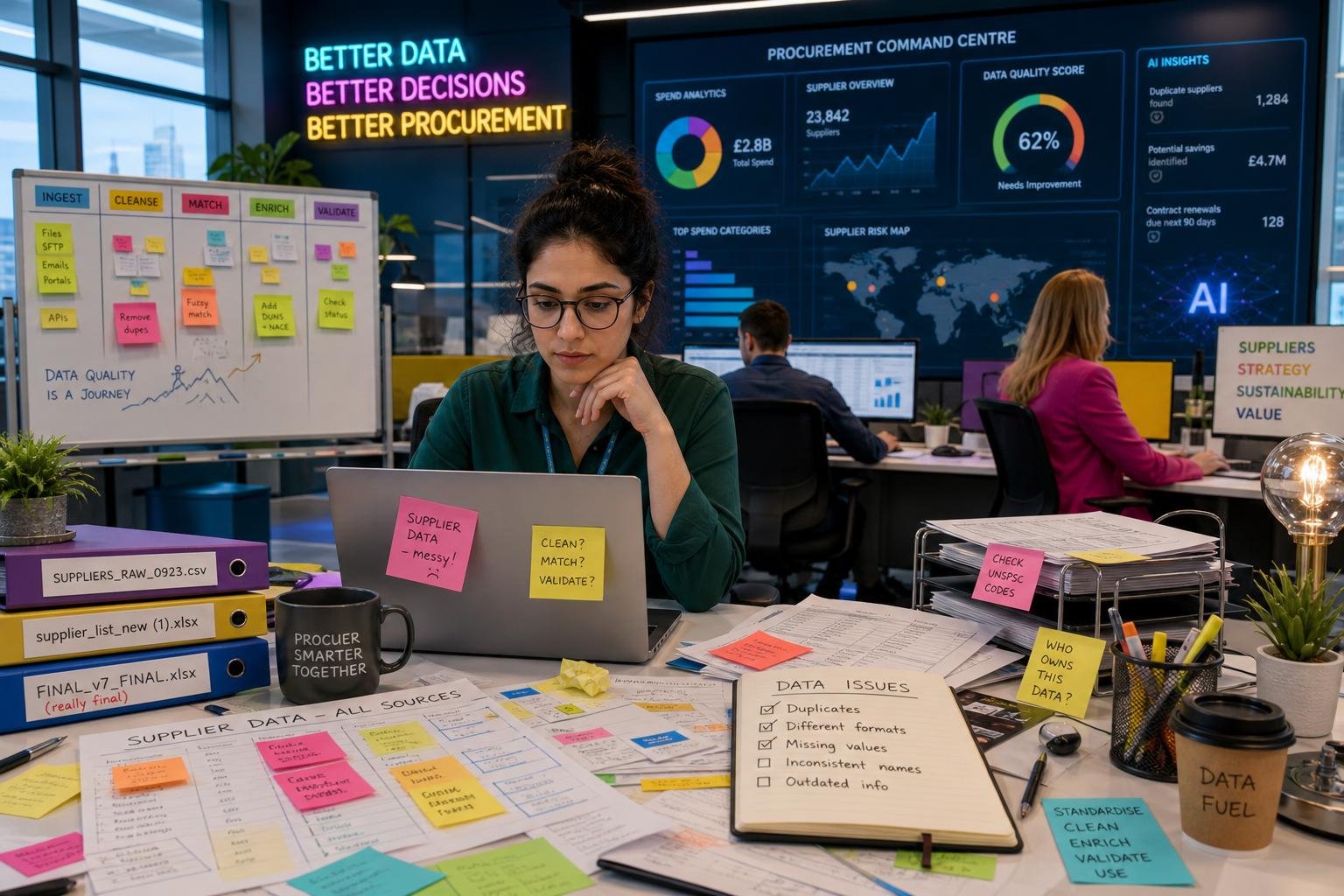
Procurement leaders are increasingly being told to embrace artificial intelligence, even when their underlying data is far from pristine. That tension ran through a recent webinar hosted by Sievo, where panellists from Bain, Hershey’s and Sievo argued that waiting for perfect data is no longer a viable strategy.
The message is becoming more common across the market. ProcureAbility has said weak data governance is a major obstacle to AI adoption, while Deloitte has warned ...
Continue Reading This Article
Enjoy this article as well as all of our content, including reports, news, tips and more.
By registering or signing into your SRM Today account, you agree to SRM Today's Terms of Use and consent to the processing of your personal information as described in our Privacy Policy.
that many chief procurement officers are keen on the technology but only a minority were actively piloting or deploying generative AI. Other industry commentary points to the same bottleneck: AI is spreading, but scaling it across procurement remains difficult because of fragmented systems, poor integration and inconsistent measurement of results.
Against that backdrop, the webinar tackled the practical questions procurement teams are asking most often: whether AI can work with messy data, where to begin, how to win internal support and what the function will look like once automation takes hold.
Brian Murphy, a partner at Bain & Company, said he has yet to meet a client with flawless procurement data. That is not surprising, given the way procurement records are often built up through multiple ERPs, acquisitions, manual inputs and different supplier naming conventions. Syed Naqvi, senior manager of procurement data and technology at Hershey’s, drew a line under the debate by saying data does not need to be perfect to be useful. In his view, if the information is good enough to support category strategy, risk work and project planning, it is already doing the job.
That does not mean AI can simply be switched on and trusted blindly. Murphy argued that procurement still needs a human check on machine output, particularly where the data is incomplete or inconsistent. The value, he suggested, lies in using AI to accelerate analysis while keeping judgment in the loop. At the same time, AI can help improve the data itself by spotting duplicate suppliers, misclassifications, inactive vendors and master-data errors once it is embedded in procurement workflows.
Sievo’s own pitch reflects that broader industry shift. The company says its tools are trained on a large external spend base, allowing customers to compare their own records with market context rather than relying only on internal data. That external benchmarking matters because many procurement teams cannot build a complete spend cube alone, as Naqvi put it.
The panel also pushed the idea that procurement should not start with AI tools in isolation. The better approach, they said, is to build a reliable data foundation first and then connect AI to internal spend information, market benchmarks, price signals and supplier-risk data. That gives teams something more useful than a simple record of historical spend: it gives them a basis for asking whether they are paying competitively and where the next savings opportunity may sit.
Governance remains another stumbling block. A separate ProcureAbility study found that while procurement and IT teams often work together, far fewer collaborate on AI governance itself. That gap is likely to slow adoption unless procurement leaders treat governance as a cross-functional issue rather than a purely technical one.
The webinar’s most practical advice on adoption was to make AI part of day-to-day work rather than an abstract change programme. Naqvi argued that curiosity already exists inside most procurement teams, so the task is to channel that interest into shared prompts, regular check-ins, internal champions and embedded use cases such as RFP drafting, negotiation preparation and contract review.
Murphy went further, suggesting the profession itself is changing. Routine analysis, invoice handling and other tactical tasks are likely to be heavily automated, he said, leaving more room for interpretation, influence, change management and AI oversight. PwC has made a similar argument in its own work on agentic AI, saying the technology is increasingly able to take on execution tasks and free procurement teams for more strategic activity.
The financial case, according to Sievo, is not just about efficiency but about the savings unlocked on external spend. The company points to a benchmark it says shows large returns when procurement improves its ability to identify pricing gaps, renegotiation opportunities and overlooked tail spend. The lesson, the panel suggested, is that AI should not be sold only as a productivity tool. Its bigger promise is as a lever for procurement value.
For now, the message from the webinar was clear: procurement teams should stop waiting for perfect conditions. Those that learn to work with imperfect data, while tightening governance and building AI into core workflows, may be the ones that pull ahead.
Source: Noah Wire Services