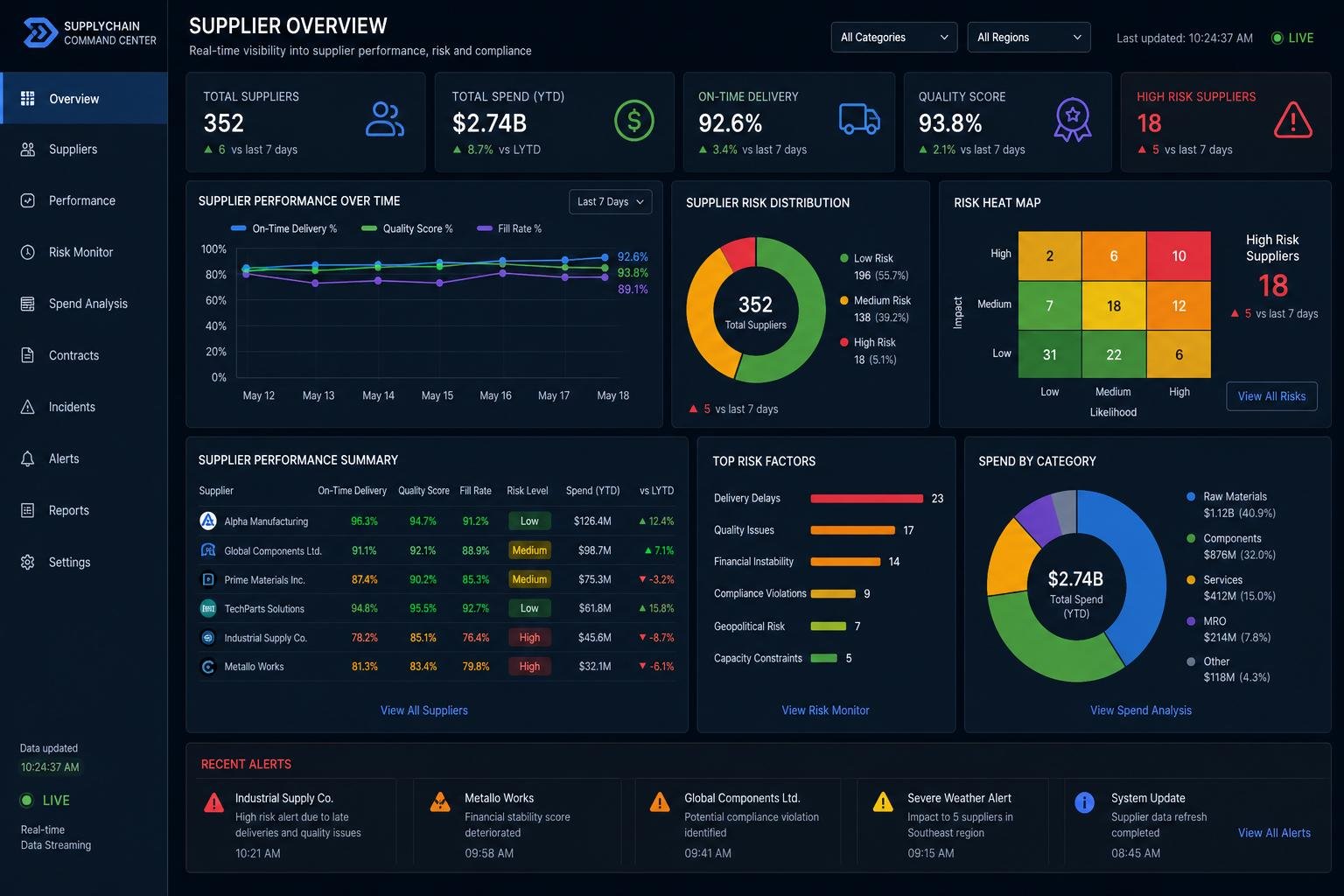
Mid-market manufacturers running Microsoft Dynamics 365 Supply Chain Management already hold much of the raw material they need for supplier oversight in purchase orders, receipts and invoice matching records. The problem is turning that transactional data into a live scorecard that procurement teams can actually use without waiting for IT to build and maintain custom reporting. Microsoft says Dynamics 365 Supply Chain Management is designed to improve visibility, streamline procureme...
Continue Reading This Article
Enjoy this article as well as all of our content, including reports, news, tips and more.
By registering or signing into your SRM Today account, you agree to SRM Today's Terms of Use and consent to the processing of your personal information as described in our Privacy Policy.
nt and connect the supply chain from demand to delivery, while also supporting procurement insights and supply-risk assessment through embedded analytics. (
microsoft.com)
That matters because supplier monitoring is no longer just a back-office reporting exercise. In Microsoft’s own documentation, the Supply risk assessment feature in Dynamics 365 Supply Chain Management is intended to help businesses identify supply risks before they disrupt operations, using a workspace and embedded Power BI reports to analyse vendor performance and possible shortages or delays. The workspace includes views for on-time in-full performance, late confirmations, delivery shortfalls and single-sourced items, giving supply teams a more immediate picture of where risk is building. (learn.microsoft.com)
The central challenge for many manufacturing teams is not the absence of data but the complexity of assembling it. Standard ERP reports can show fragments of the picture, but they often stop short of delivering a flexible supplier scorecard that updates quickly when supplier lists, order volumes or delivery behaviour change. Microsoft’s guidance on the Supply risk assessment workspace shows how much value can be extracted when performance metrics are surfaced directly in the workflow rather than buried in static reporting layers. (learn.microsoft.com)
For procurement leaders, the most useful measures tend to be operational rather than abstract: on-time in-full delivery, lead time, quality defects, invoice accuracy and response speed. Microsoft’s Dynamics 365 pages highlight vendor performance, lead times and quality as key areas that can be tracked in embedded Power BI templates, while the supply-risk workspace turns purchase-order data into practical indicators such as not-on-time and not-in-full outcomes. (microsoft.com)
The appeal of automation is that it removes the need to rebuild reports every time the business changes. Instead of depending on custom development, firms can use connected reporting and analytics layers alongside Dynamics 365 to refresh supplier performance views as new transactions arrive. Microsoft positions the platform as one that can combine procurement insights, AI assistance and embedded analytics, which is consistent with a move away from manual scorecards and towards continuously updated supplier monitoring. (microsoft.com)
There is also a broader resilience angle. Microsoft’s documentation says the supply-risk workspace is meant not only to measure past supplier performance but also to estimate the risk to future planned supply if those patterns continue. That makes supplier tracking more than a retrospective exercise: it becomes a tool for deciding where to diversify sourcing, where to tighten controls and which vendors need closer attention. (learn.microsoft.com)
For manufacturers under pressure to improve delivery performance without expanding IT dependency, the practical takeaway is clear. Dynamics 365 already contains much of the underlying data, and Microsoft has built native risk and performance tooling around it. The opportunity lies in using those capabilities, or compatible automation layers, to move supplier scorecards out of spreadsheets and into a live operating process. (microsoft.com)
Source: Noah Wire Services