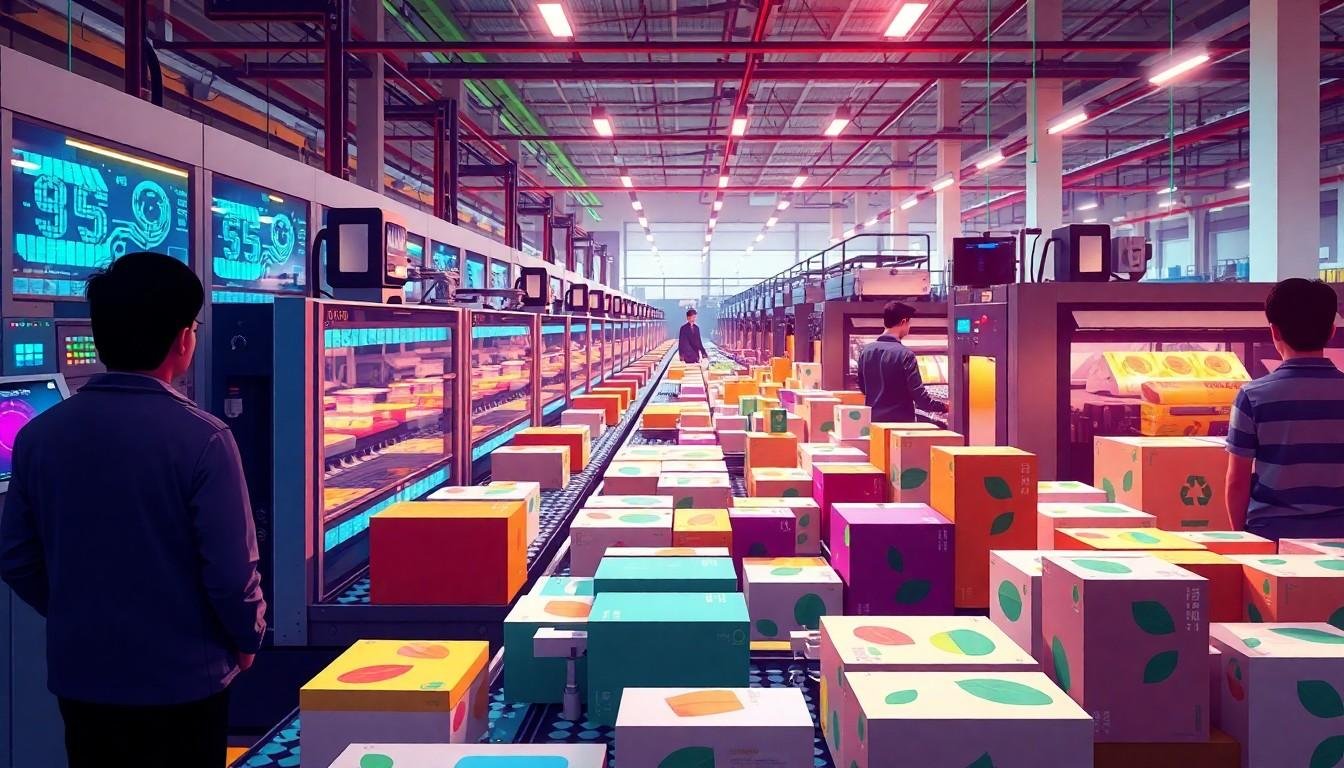
China’s label and packaging printing sector is moving well beyond its old boundaries, as converters respond to brand owners’ demands for fewer suppliers and broader packaging capabilities.
Professor Xu Wencai, chairman of the Packaging Printing and Label Association of the China Packaging Federation, says the industry has shifted in recent years from narrow specialisation towards integration across labels, flexible packaging and cartons. That change is being driven by custo...
Continue Reading This Article
Enjoy this article as well as all of our content, including reports, news, tips and more.
By registering or signing into your SRM Today account, you agree to SRM Today's Terms of Use and consent to the processing of your personal information as described in our Privacy Policy.
mers rather than suppliers: a single food brand may now want bottle labels, snack pouches and folding cartons from companies able to handle all three.
The result is a rapid rethink of what printing businesses actually sell. Instead of asking only what type of work a converter does, clients are increasingly looking at what packaging formats it can deliver. In response, Chinese printers have invested in wider presses, digital equipment and upgraded finishing lines, while machinery makers have expanded their own product ranges to cross over into neighbouring segments.
Industry observers say the wider market is still under pressure. Demand remains uneven, competition is intense, raw materials are volatile and labour costs are rising, leaving many firms caught in a cycle of higher turnover but weak profitability. Xu says the immediate priorities are efficiency and direction: more automated equipment, less waste, faster changeovers, greener materials and a clearer strategy on whether to focus on labels, flexible packaging, RFID smart labels or broader integration.
Market forecasts suggest the structural shift is likely to continue. Grand View Research estimates that China’s packaging printing market will grow from $51.9bn in 2025 to $97.1bn by 2033, with labels still the largest revenue segment and flexible packaging the fastest-growing. Its separate outlook for digital printing packaging in China points to growth from $3.1bn in 2025 to $4.5bn by 2033, with flexible packaging again the biggest category.
At the same time, the broader printing sector remains sizeable. Labels and Labeling reported that China’s printing industry maintained a total output value of 1.5tn yuan in 2025, up 3.9% year on year, while the country’s label converting market has reached a mature stage with 6,888 label converters.
Xu argues that the next phase of growth will be shaped by three forces: greener production, digitalisation and smarter connected packaging. Environmental rules and brand owners’ ESG requirements are pushing firms towards solvent-free processes, lower-impact inks, lightweight formats and carbon tracking. Digital workflows, meanwhile, are bringing automated scheduling, intelligent inspection and AI-supported colour and defect control. Smart packaging is also opening new possibilities through QR codes, invisible codes, RFID and NFC, turning packaging into a tool for traceability, anti-counterfeiting and consumer engagement.
These changes are also reflected in the industry’s trade calendar. LOUPE South China, formerly Labelexpo South China, will take place from December 2 to 4, 2026 at Shenzhen World Exhibition & Convention Center. Organisers say the show is expanding to cover labels, flexible packaging and folding cartons, with live demonstrations and forums intended to bring converters, brand owners and suppliers together around integrated packaging solutions.
For Xu and his association, that kind of platform matters because the industry’s challenge is no longer simply technical. It is strategic. Chinese converters, he suggests, now need practical routes to growth in a market where scale alone is no longer enough, and where green capability, digital competence and cross-sector flexibility are becoming the new baseline.
Source: Noah Wire Services