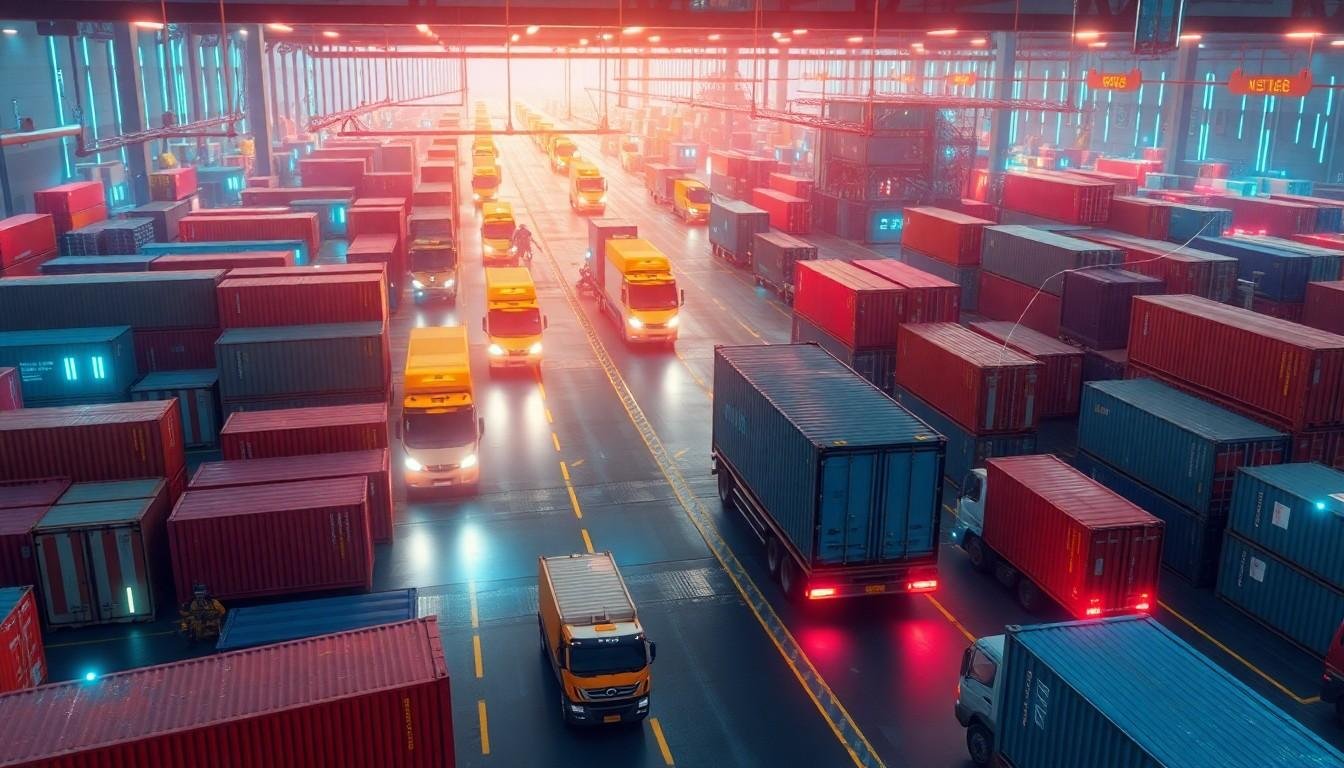
Logistics is moving away from the idea of a fixed network that can be tuned once and left to run. In a world of shifting trade routes, volatile demand and increasingly capable automation, the more useful test is whether a supply chain can be reshaped while it is still in motion.
That change in mindset is visible at the Port of Los Angeles, where planners have been preparing for the possibility of extra cargo arriving on the US West Coast as shippers respond to Red Sea disruptio...
Continue Reading This Article
Enjoy this article as well as all of our content, including reports, news, tips and more.
By registering or signing into your SRM Today account, you agree to SRM Today's Terms of Use and consent to the processing of your personal information as described in our Privacy Policy.
n and uncertainty around the Panama Canal. The port has spoken about a planning case of about 5% annual cargo growth, but the point is less the number than the response. It has been working with terminal operators, ocean carriers, trucking firms and labour groups to assess whether the wider system could absorb a re-routed flow of freight.
The lesson is that resilience on a map is not the same as resilience in practice. A spare route only matters if the destination has berths, chassis, drivers, rail capacity, warehouse space and labour to handle the load. A different gateway can also ripple through the rest of the network, changing lead times, replenishment schedules and service promises.
The same logic is now reaching inside warehouses. Traditional operations were designed around expected order profiles, stable labour plans and known throughput. But order patterns shift, trailers arrive early or late, staffing changes and automation performance moves throughout the day. What looked like the best plan at the start of a shift may be wrong by lunch.
That is where warehouse software is changing. Logistics technology has long been strong at recording what happened; the next step is helping managers intervene before the window closes. Takt, a labour-management and intelligence company, recently raised $9.25 million in Series A funding and says its platform is now used in more than 100 warehouses. Kenco has deployed it across 19 distribution centres, with more expansion planned. The company’s pitch is that AI agents can rebalance labour against live order conditions within limits set by supervisors.
The broader direction is important even where the reported gains are company- and customer-specific. Warehouse control is moving towards orchestration, as Logistics Viewpoints described in April, with software coordinating people, robots and systems in real time rather than simply issuing static commands. Research on reoptimisation in order picking and batching points in the same direction, suggesting that online re-planning can be close to optimal in dynamic environments.
Autonomous systems are also becoming less rigid. TechRadar has reported that AMRs and related tools are increasingly being used with live data capture, digital twins and AI-driven decision-making to make warehouse operations more responsive. A review in ScienceDirect likewise highlights how AI-enhanced digital twins, IoT and machine learning are being combined to improve resource allocation and support proactive warehouse planning.
That matters because automation is only an advantage if it can absorb change. If a facility must be extensively rebuilt every time volumes or product mixes alter, the system may become more brittle rather than more efficient. The newer challenge is to deploy automation that can be retasked, moved or reorchestrated as conditions evolve.
Robotics is also edging further into operational infrastructure. Robot.com and Sodexo have signed a seven-year agreement to expand autonomous delivery across North American campuses, a sign that some forms of autonomy are moving beyond pilot projects. Pudu Robotics has meanwhile introduced the MP2000 autonomous pallet-handling robot, which it says can work with less fixed infrastructure than earlier generations of automated forklifts. The claims still need to be tested in varied settings, but the direction is clear: automation is becoming more adaptable to the warehouse, rather than the other way round.
Inventory strategy is being pulled into the same shift. For years, network design has focused on where stock should sit to balance transport cost, carrying cost and service. Increasingly, the right answer may change too quickly for a one-off design to be enough. A disrupted transport lane can make one site less useful; a sudden demand spike can make another far more valuable; a capacity shortfall in one building can redirect fulfilment elsewhere.
The result is a more dynamic problem in which inventory, transport, warehouse control and order management are beginning to merge into a single decision layer. The question is no longer only where stock should be placed, but which stock should fulfil which order, given the conditions at that moment.
That raises the importance of reoptimisation. The conventional logistics model assumes that the network is known and the task is to find the best answer. The current environment is harder because the constraints themselves keep moving. Ports congest, carriers run short, labour availability changes and automation throughput varies. The operation needs not just a new answer, but one that can be executed before the situation changes again.
This is why the value of optionality is rising. Spare carrier capacity, an alternative port, flexible labour, another fulfilment node or more adaptable automation all cost money. Efficiency programmes often treat that resilience as waste. Yet in a disrupted network, it can be an asset that preserves service when the primary plan fails.
The metric that may matter most, then, is time to reconfigure. How quickly can freight be switched to another mode? How fast can volume be redirected through a different gateway? How rapidly can fulfilment shift between warehouses, labour be rebalanced or automation be redeployed? These are the measures that show whether a logistics network can adjust while the disruption is still unfolding.
In that sense, the next generation of logistics will not be judged only by how well it executes a plan. It will be judged by how well it recognises when the plan no longer fits, and how quickly it can build a better one.
Source: Noah Wire Services