


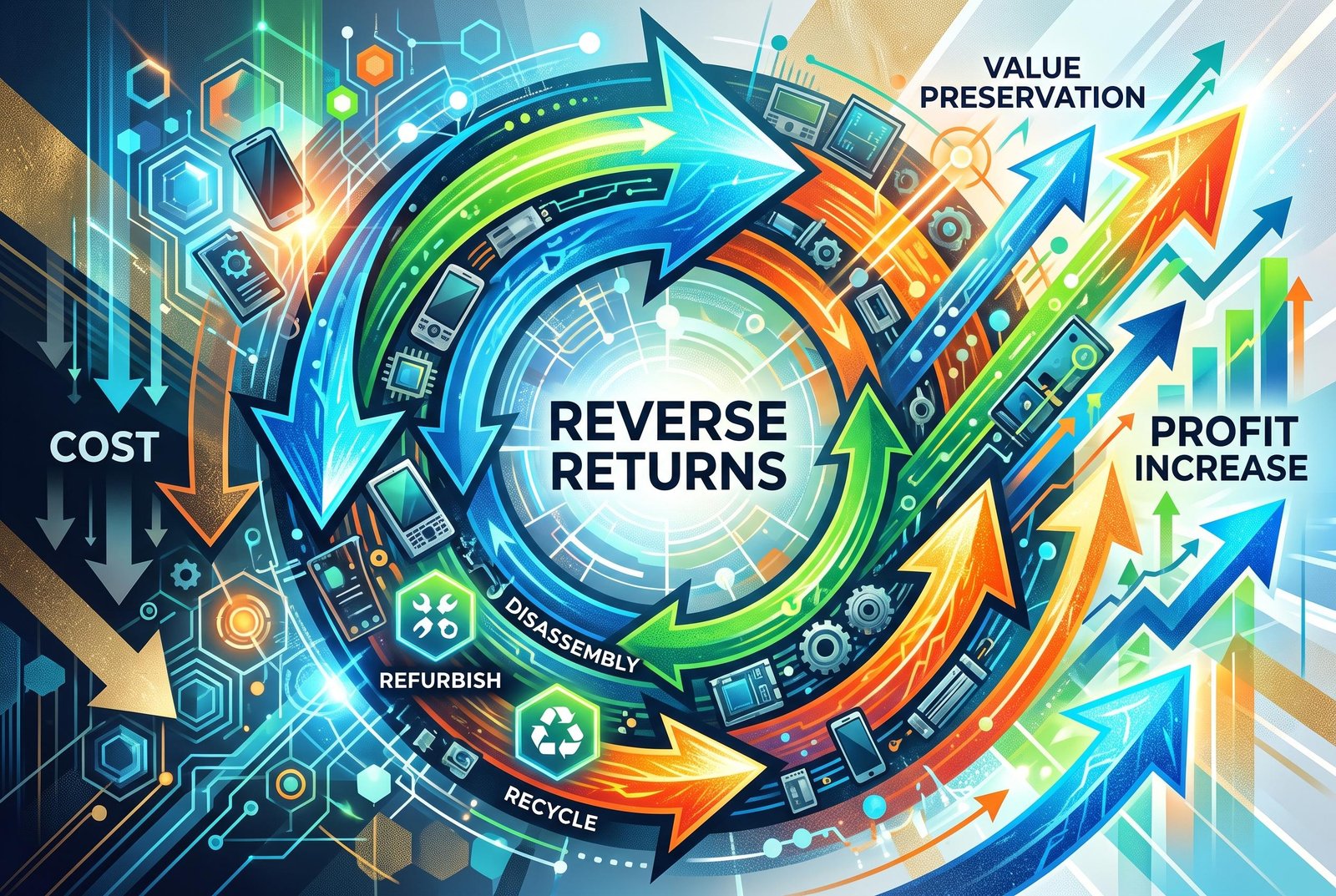
Reverse logistics is moving out of the back office and into the margin discussion.
For years, many businesses treated returns, repairs, refurbishment and asset recovery as a necessary overhead: an operational nuisance to be processed as cheaply as possible. That view is becoming harder to defend. As more technology assets circulate across employees, customers and field operations, the amount of value tied up in returned equipment has risen sharply, making the way companies hand...
Continue Reading This Article
Enjoy this article as well as all of our content, including reports, news, tips and more.

By registering or signing into your SRM Today account, you agree to SRM Today's Terms of Use and consent to the processing of your personal information as described in our Privacy Policy.
The shift is especially visible in sectors that manage large fleets of devices. Phones, laptops, networking equipment and other hardware now return through refresh programmes, lease expiries, warranty repairs and employee offboarding. In each case, the crucial question is no longer simply how much it costs to receive the item back, but how much value survives once it does. A device that is assessed accurately, repaired quickly and routed to the right channel can be redeployed, refurbished or resold. One that is handled slowly or graded poorly can lose value almost immediately.
That is why reverse logistics is increasingly being judged as a commercial discipline rather than a clerical one. A lean returns operation is not automatically a strong one. If assets are classified incorrectly, left waiting too long or sent to the wrong disposition route, a company can save a little on processing while losing far more in recoverable value. In practice, the better measure is not cost per unit handled, but recovery rate: the proportion of original value preserved through repair, redeployment, resale, parts harvesting or secure disposal.
Industry guidance on reverse logistics shows just how many decisions sit behind that figure. The process typically runs from authorisation and collection through inspection, grading, disposition and final recovery or disposal. National Freight Hub’s reverse logistics guide stresses that timing and accurate assessment are central to preserving value. That is echoed across the sector: once an item enters the reverse flow, the clock starts ticking on depreciation, storage expense and the risk of write-down.
The economics can be striking. The National Retail Federation and Happy Returns have said US retailers expected 15.8 per cent of annual sales to be returned in 2025, representing about $849.9 billion in merchandise. While that figure relates to consumer retail, it illustrates the scale at which returns now affect margins across the broader economy. In technology-led businesses, the stakes can be even higher because the residual value of hardware can be substantial, especially when supply constraints and rising replacement costs make used equipment more attractive.
A growing body of industry analysis points to the same conclusion: disposition is where value is either protected or lost. Research cited by the National Retail Federation suggests that businesses with well-optimised reverse logistics can recover as much as 65 per cent of the original value of returned goods in best-case scenarios. Other industry commentary places typical recovery in the 30 to 70 per cent range when organisations treat reverse operations with the same discipline as outbound logistics. The precise figure varies by product category and condition, but the direction is clear: better handling produces better economics.
That makes the first assessment of each returned device the most important moment in the chain. An item that is too conservatively graded may be replaced or scrapped unnecessarily. One that is too optimistically graded may consume repair capacity worth more than the device itself. Accurate evaluation determines whether an asset should be redeployed, repaired, refurbished, liquidated or broken down for parts. Even small cosmetic improvements can alter resale prospects by moving a device into a more valuable channel.
This is where value recovery analytics is beginning to reshape the field. Rather than asking whether an item should simply be kept or discarded, more advanced operators estimate the net return available across multiple channels and route each unit to the best one. That can mean restocking pristine equipment, refurbishing devices with minor defects, liquidating older stock, or recycling equipment that has little remaining commercial life. The central idea is simple: every unit should be matched with the highest-value disposition path available at the time.
For many organisations, that approach is now a procurement issue as much as an operations one. Buyers are increasingly asking vendors not only what they charge to handle returns, but what value they can recover. Industry commentary on IT asset disposition now places security, environmental compliance, certifications and financial recovery on the same shortlist of criteria. Providers are being judged on whether they can maintain documented chain of custody, use tamper-evident transport, work to recognised standards such as R2v3 or NAID AAA, and demonstrate alignment with data sanitisation requirements such as NIST 800-88.
That focus on control reflects the reality that reverse logistics is no longer only about economics. Returned devices often contain sensitive business or customer data, and the consequences of poor handling can far outweigh the hardware value itself. In regulated sectors such as healthcare, finance, government, telecommunications and enterprise technology, the reverse process must therefore satisfy both financial and compliance objectives. A missing asset, a weak audit trail or an unverified handover can create exposure that dwarfs any recovery gain.
This is one reason chain of custody has become so central to modern reverse logistics. It is not enough to know that a device has been returned. Organisations need to know who handled it, where it travelled, how it was stored and what happened at each stage. The better vendors now distinguish themselves through serialised tracking, GPS-monitored transport, secure containers and clear reporting on asset condition and final disposition. In a crowded market, those capabilities are becoming markers of a serious provider rather than optional extras.
There is also a sustainability dimension, though the financial case often leads. Refurbishment and redeployment extend product life, reduce waste and lessen the need for new manufacturing. Certified pre-owned channels in particular are making it easier for companies to monetise recovered assets while serving customers who want lower-cost technology. The result is a circular model in which returns are not merely handled, but captured as part of a broader value chain.
Premier LogiTech chief executive Jay Ford has argued that the next major supply chain gain will come not from moving goods out faster, but from managing what comes back with the same discipline applied to outbound flows. That view is increasingly shared across logistics and IT asset circles. Large-scale deployments, including data centre refreshes and AI infrastructure roll-outs, are generating sizeable volumes of retired equipment. Yet many organisations still lack formal processes for secure recovery and value recapture, even as the sums involved become too large to ignore.
The companies that perform best are usually not those with the lowest nominal processing cost. They are the ones with the clearest grading standards, the shortest intake-to-disposition cycle times and the most rigorous valuation discipline. They measure recovery yield alongside operating expense. They know which assets should be repaired and which should be sold, harvested or recycled. Most importantly, they understand that the cost of reverse logistics cannot be judged in isolation from the value it protects.
That is the central change in the market. Reverse logistics is no longer a peripheral service bought to clean up after the main business. It is part of the business model itself. For organisations with significant technology estates, the question is not whether returns will happen, but whether the company will extract value from them or lose it.
Source: Noah Wire Services
Subscribe to Industry Updates
Get the latest news and updates directly to your inbox.

