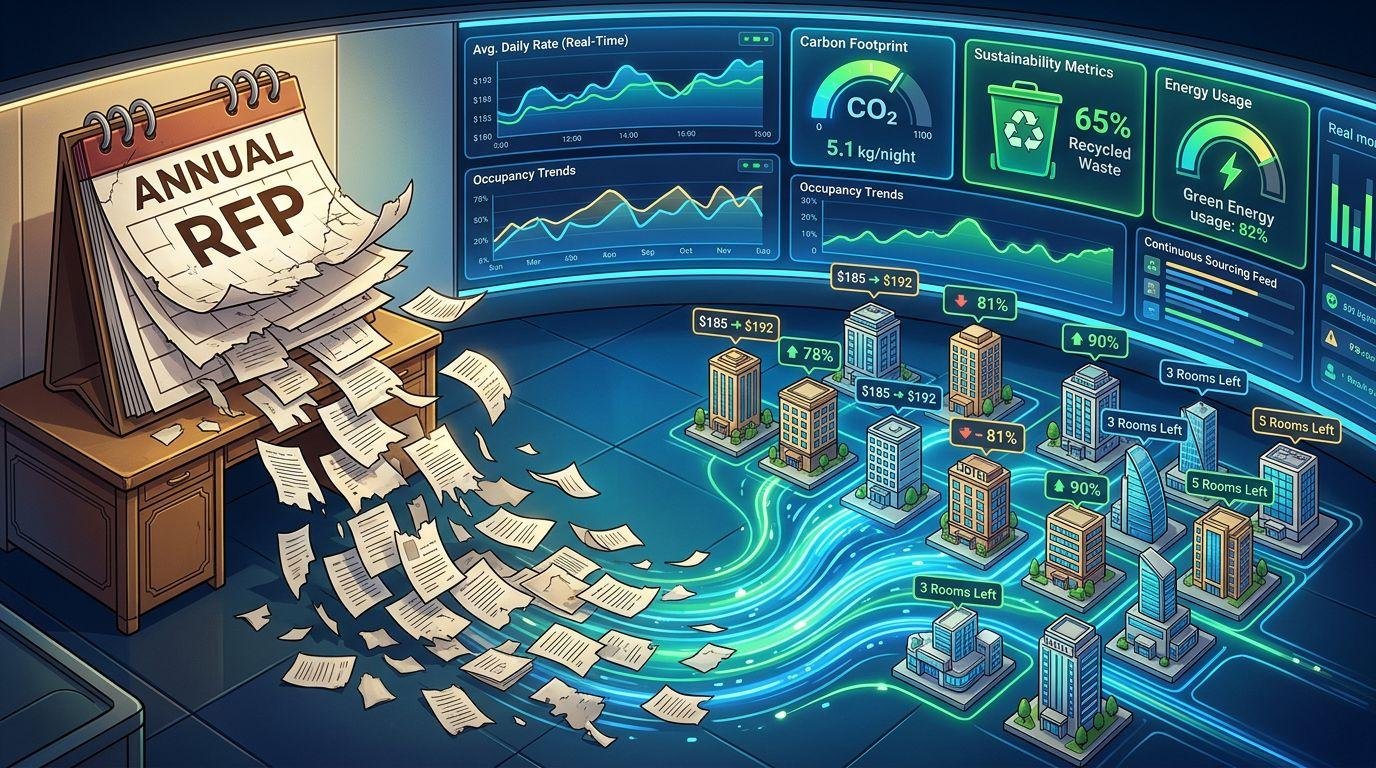
The hotel sourcing process is undergoing a quiet but significant reset as travel buyers question whether the traditional annual request for proposal still fits a market that now changes month by month. For years, corporate hotel programmes have been built around a once-a-year cycle: negotiate rates, sign agreements and then largely wait until the following round. But as traveller demand, hotel pricing and compliance pressures move far more quickly, that approach is looking increasingl...
Continue Reading This Article
Enjoy this article as well as all of our content, including reports, news, tips and more.
By registering or signing into your SRM Today account, you agree to SRM Today's Terms of Use and consent to the processing of your personal information as described in our Privacy Policy.
y blunt.
Daniel Beauchamp, vice president, global venue sourcing and consulting at Amex GBT, said the old rhythm no longer matches the pace of the market. “Sourcing has always been treated as an annual event. You negotiate rates, you sign, and then you wait a year to look again, even as traveller demand, market rates and compliance risk shift every single week”, he said.
His view reflects a broader shift in procurement thinking. Across several categories, from freight to supplier management, annual review models are being challenged by systems that rely on live data, more frequent benchmarking and faster decision-making. In hotel sourcing, that shift is being driven by the same pressures: volatile room rates, changing traveller patterns, sustainability requirements and a growing expectation that programmes should be responsive rather than fixed.
Jeff Urban, co-founder and chief executive of Gazzebo, argued that the real change is structural. “When the buyer’s requirements live as reusable structured data, and suppliers can refresh their content the instant it changes, sourcing becomes a constant, year-round exchange that moves when the programme needs it to”, he said.
That idea is echoed by Leigh Cowlishaw, managing partner at Black Box Partnerships, who said continuous sourcing offers a way to keep programmes aligned with conditions as they evolve. “Continuous sourcing, with annual benchmarking, equips businesses to shift faster and respond dynamically with market conditions changes as they happen, rather than annually during an RFP season”, he said.
The problem, according to Andrew Clarke, commercial director at the Business Travel Association, is not that the corporate RFP has become useless, but that it has become overloaded. “The corporate RFP still works, but it’s buckling under its own weight. Every year brings another data field, another sustainability metric, or approval layer, so the process meant to save time ends up costing it. We don’t need to scrap the RFP, we need to strip it back to what drives a good decision”, he said.
That tension between usefulness and fatigue is at the heart of the debate. For travel managers, the annual cycle has long offered structure, comparability and a clear negotiation window. Yet the burden of collecting ever more information can make the process slower and less relevant by the time decisions are finalised. In practice, some programmes risk locking in assumptions that were already out of date when the ink dried.
Stuart Tandy, head of bid management at Inntel, said the issue goes beyond process design. “There’s a growing disconnect. Organisations are trying to evaluate the future using procurement methods designed for the past”, he said.
The growing interest in continuous sourcing suggests many buyers agree. Rather than treating hotel procurement as a single annual event, they are moving towards a model that allows for ongoing updates, faster refreshes and more frequent market checks, while still retaining periodic benchmarking to ensure rates remain competitive. In an environment where pricing and supply conditions can change quickly, that hybrid approach may prove more practical than a rigid yearly cycle.
The broader lesson is that hotel procurement is no longer just about securing a favourable rate. It is increasingly about maintaining a programme that can adapt, absorb new requirements and respond to risk without waiting for the next formal tender. For many companies, that may mean the annual RFP is not disappearing altogether, but becoming only one part of a more continuous sourcing strategy.
Source: Noah Wire Services