The battle for growth in HVAC is increasingly being decided long after the initial sale. As service contracts evolve, installed equipment becomes more varied and partly connected, and customers demand round-the-clock reliability, the aftermarket is moving from a back-office function to a central commercial capability.
At the Parts & After Sales Business Platform 2026 – Power of 50, Freddy Guerrero Lyons of Bosch Home Comfort argued that profitable equipment sales can ...
Continue Reading This Article
Enjoy this article as well as all of our content, including reports, news, tips and more.
By registering or signing into your SRM Today account, you agree to SRM Today's Terms of Use and consent to the processing of your personal information as described in our Privacy Policy.
no longer be separated from a mature service and parts operation. Spare parts availability, disciplined processes and the intelligent use of data, he suggested, are now fundamental to sustained growth.
That reflects a wider reappraisal across industrial manufacturing. According to the related material, aftermarket activity is increasingly being treated not as an overhead, but as a source of revenue, margin, customer retention and brand strength. Industry analyses from EY and McKinsey have similarly argued that service and spare parts are most valuable when they are embedded in the core business rather than managed as an isolated support function.
The logic is straightforward. Customers judge manufacturers less by the promise made at the point of sale than by what happens when a system fails. Fast access to the right component can mean the difference between a minor inconvenience and a major disruption, especially in climate control, where breakdowns can affect comfort, safety and, in some cases, health. In that environment, the quality of the aftermarket becomes part of the product itself.
That is why the article places so much emphasis on structure before technology. There is no single aftermarket model that works everywhere. Repair remains the default in some markets, while replacement is more common in others. These differences shape inventory strategy, service design and the way organisations plan for installed-base support.
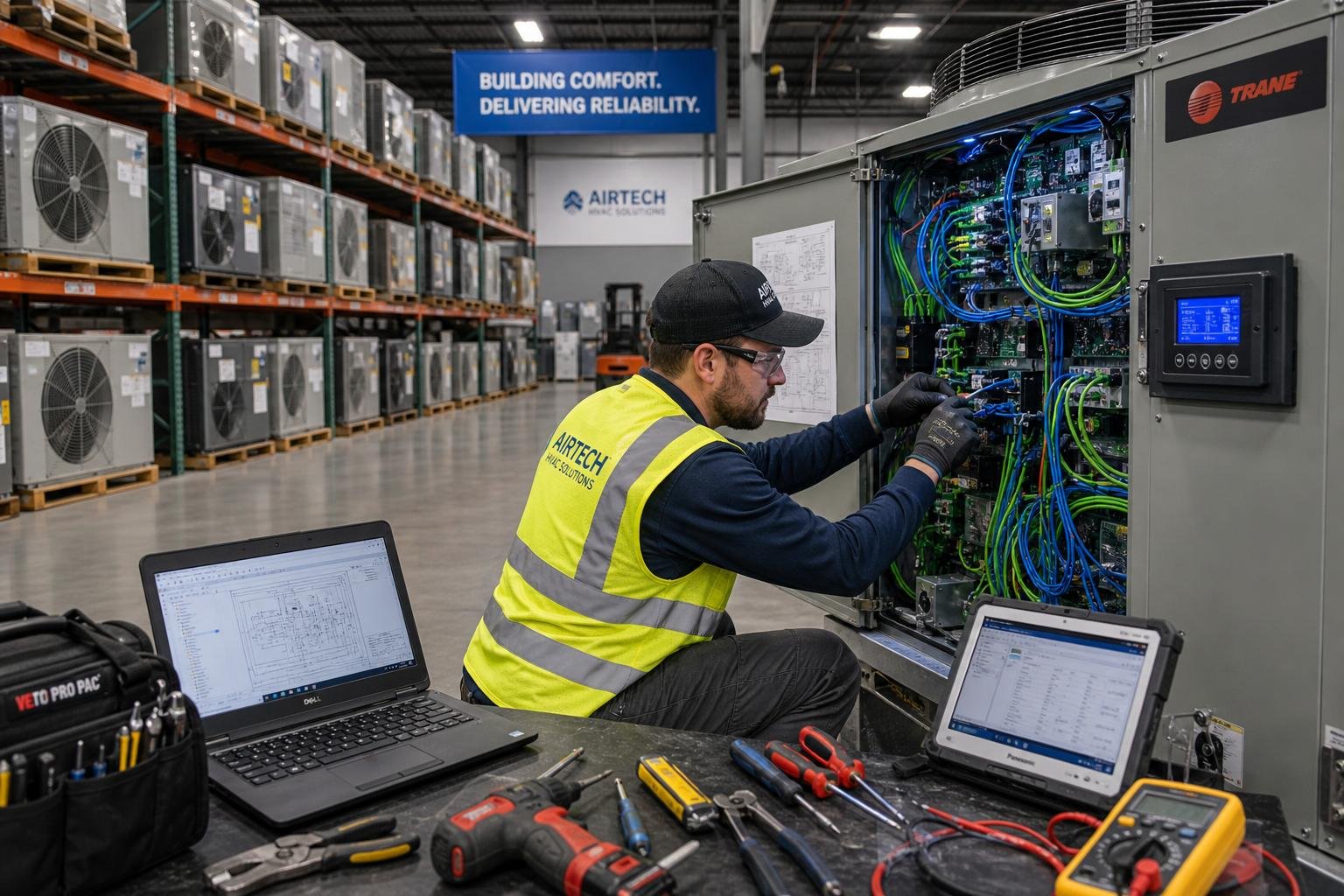
The piece also argues that field technicians should not be treated simply as executors of repair work, but as a vital source of information. Their observations, if properly captured, can challenge assumptions about how products are actually used in different settings. Combined with accurate documentation and better internal information flows, that feedback can improve everything from parts planning to technical support.
Spare parts management, in this view, should not sit with after-sales alone. It is better understood as a cross-functional system involving quality, purchasing, logistics and technical teams. Shared ownership, clear roles and reliable workflows are presented as the foundations of a service promise that can be delivered even under pressure.
The commercial case is reinforced by broader market expectations. A Technavio forecast cited in related material says the HVAC aftermarket will expand significantly between 2024 and 2028, supported by construction activity and the growing use of AI-enabled tools. Other industry commentary points to predictive analytics, remote monitoring and regulatory pressure as additional forces reshaping the market.
Artificial intelligence, however, is not portrayed as a shortcut. The article is sceptical of the common assumption that better algorithms alone will transform service performance. Many predictive maintenance projects, it notes, fail because organisations start with the technology rather than the operational problem, or because they never build the processes needed to act on the insight.
AI, in this framing, is an amplifier rather than a solution in itself. It can detect subtle patterns in data that conventional threshold alerts may miss, but its value depends on whether the organisation can respond quickly with technicians, stock, logistics and customer communication. Without that operational backbone, even accurate predictions have limited worth.
The article’s broader message is that aftermarket excellence rests on mindset, structure and technology in that order. Senior leadership must accept that service and spare parts create value, not just cost. Responsibilities must be defined clearly. Only then does digitalisation, including AI, begin to deliver its full effect.
For HVAC manufacturers, the implication is clear: competitive advantage is no longer determined solely by product design or production efficiency. It is also shaped by the resilience of the service network, the quality of parts supply and the organisation’s ability to turn data into action. In that sense, the aftermarket is no longer the business after the business. It is becoming one of the main reasons customers stay.
Source: Noah Wire Services