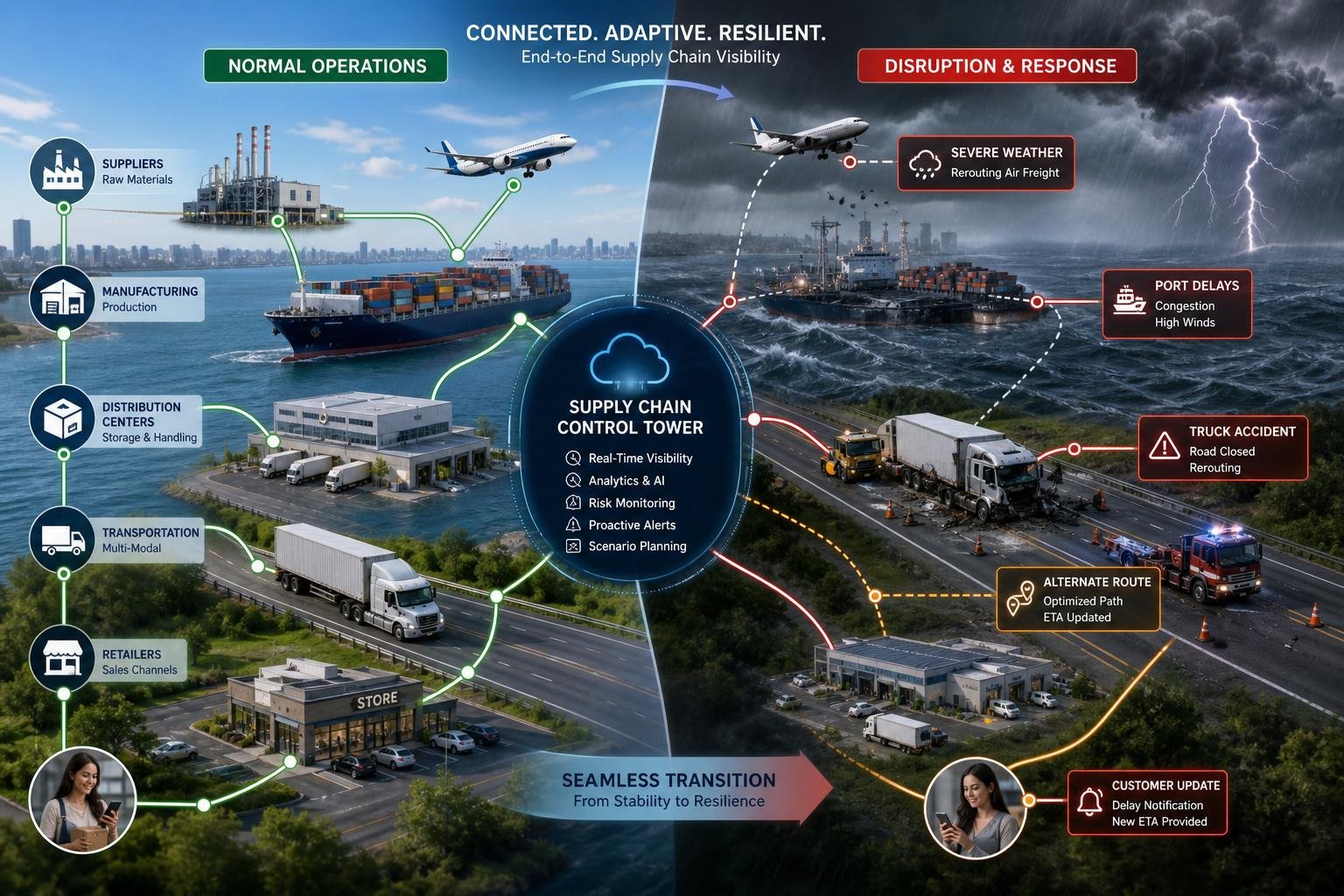
An emerging Microsoft-backed ontology is aiming to give consumer packaged goods logistics a more machine-readable backbone, modelling how products move from the factory gate to the retail shelf and, crucially, what happens when the process goes wrong.
Built around the everyday objects of supply chain operations, the framework covers orders, shipments, loads, vehicles, drivers, carriers, distribution centres and delivery commitments. Its emphasis, however, is on disruption as mu...
Continue Reading This Article
Enjoy this article as well as all of our content, including reports, news, tips and more.
By registering or signing into your SRM Today account, you agree to SRM Today's Terms of Use and consent to the processing of your personal information as described in our Privacy Policy.
ch as routine flow. Delays, equipment failures, temperature excursions and customs holds are treated as core parts of the model rather than unusual outliers, reflecting the reality that exceptions are often what keep logistics teams occupied.
The scenario it captures is familiar to any CPG operator. A retailer places an order, a manufacturer fulfils it, freight is moved to a distribution centre, goods are received and consolidated, and outbound loads are dispatched for final delivery under a promised time window. In practice, that sequence is frequently interrupted by problems such as refrigerated trailers breaking down overnight, warehouse space filling faster than outbound freight can clear, or drivers running up against hours-of-service limits before reaching their destination.
What distinguishes the ontology is the way it links those entities to operational decisions. By connecting transport events to shipments, it can help an AI agent flag deliveries at risk before a dispatcher spots the issue. By tying distribution centres to both inbound and outbound freight, it gives a system enough context to identify congestion and alert carriers before delays cascade. Delivery windows are linked to retailers alongside penalty terms, allowing the model to reflect commercial consequences, not just timetable data. Temperature ranges for vehicles are also matched with product storage requirements, strengthening cold-chain monitoring.
The design sits within a wider movement in industrial data modelling towards reference ontologies that can improve consistency and interoperability. The Industrial Ontology Foundry’s supply chain reference model, for example, provides generic concepts such as supplier, supply chain system and supply chain agent as a shared foundation for logistics semantics. NIST has also published work on a supply chain reference ontology built on a top-level framework, arguing that such approaches can improve logical consistency and completeness in domain models.
That broader push matters because CPG supply chains are becoming more data-intensive and more automated. Industry commentary increasingly points to vision AI, digital twins and agentic AI as tools for reducing latency and increasing throughput without adding headcount. In that context, a well-structured ontology can do more than organise information: it can give AI systems the relationships they need to reason about live operations, spot bottlenecks and respond to disruptions with less human prompting.
The ontology is presented through an interactive playground, allowing users to explore the relationships between the entities and exceptions that define CPG transport. Its central idea is simple but important: in logistics, a useful model is not one that only describes how goods should move, but one that also understands how and why they fail to.
Source: Noah Wire Services