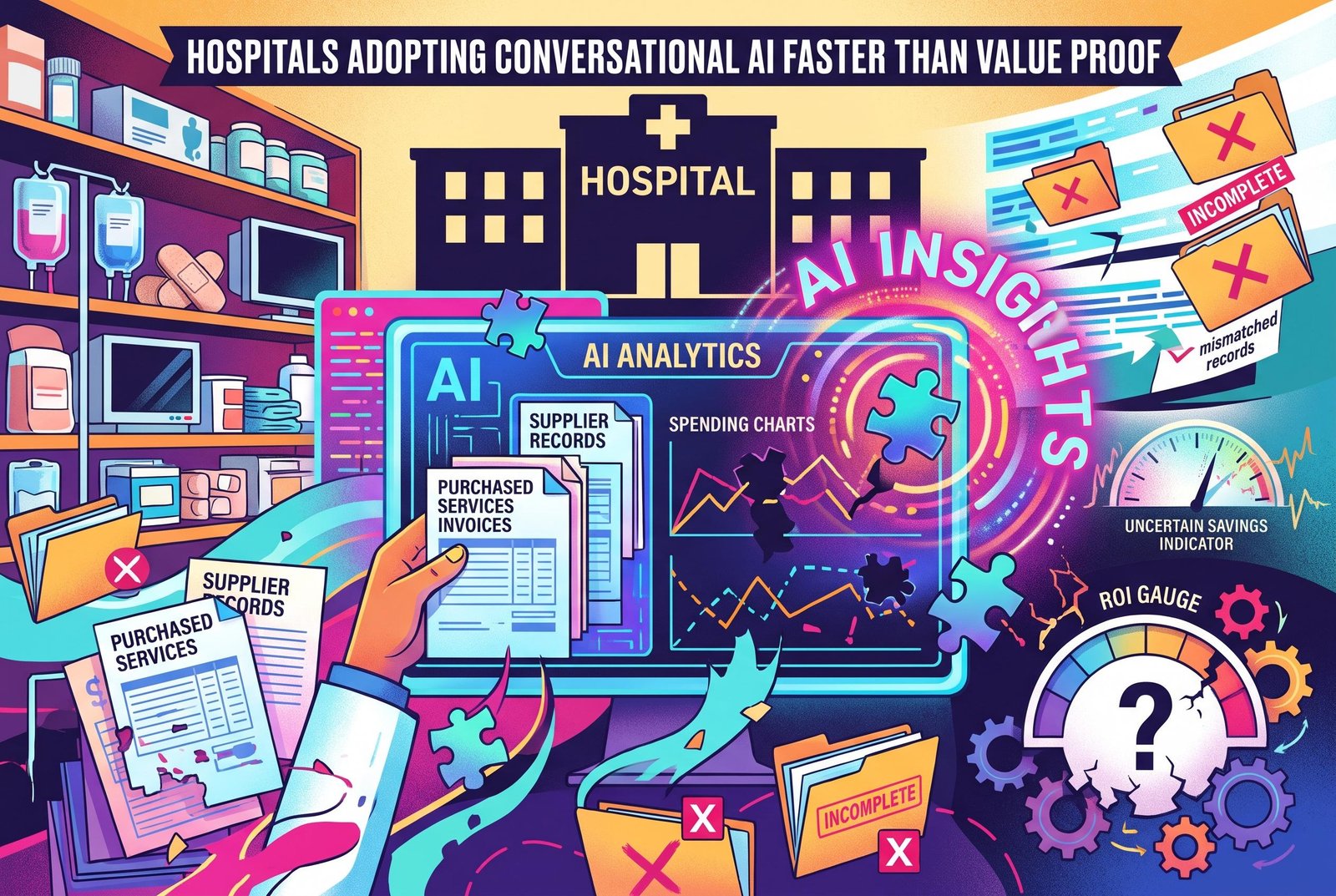
Hospitals’ investment in artificial intelligence is outpacing their ability to show what it delivers. The challenge is no longer simply finding data: it is helping people reach reliable answers quickly, then connecting those answers to decisions and measurable results.
That tension is especially visible in purchased services and indirect spending, where information can be dispersed across departments, suppliers and reporting systems. Conversational AI offers one way to make e...
Continue Reading This Article
Enjoy this article as well as all of our content, including reports, news, tips and more.
By registering or signing into your SRM Today account, you agree to SRM Today's Terms of Use and consent to the processing of your personal information as described in our Privacy Policy.
xisting data easier to explore. Instead of locating a specific dashboard or knowing which report to request, a user can begin with a business question and follow up as new details emerge.
The promise is practical rather than automatic. Faster access to information may help teams examine spending patterns, compare suppliers or investigate potential savings. But an insight is not a saving, and a fluent answer is only useful if the underlying information is dependable and the organisation can act on it.
A report from UPMC’s Center for Connected Medicine and KLAS Research found that more than 90 per cent of surveyed health systems had deployed third-party AI solutions. Yet only 44 per cent had a dedicated environment for testing them, while 63 per cent described their AI strategy as developing or ad hoc. Although 92 per cent said they evaluate external tools before deployment, the approaches varied, from formal testing to limited pilots and informal assessments.
Those figures point to a gap between adoption and readiness. In a separate survey of 50 healthcare decision-makers, conducted in summer 2025, Guidehouse and HIMSS found that 78 per cent of organisations were involved in AI projects, but only 52 per cent of respondents considered their organisation operationally prepared to deploy AI solutions. Respondents also cited data quality, standardisation, availability and governance as obstacles.
For spend analysis, the first answer is rarely sufficient. A team looking into an increase in a category may next need to know which suppliers account for it, whether the pattern is confined to certain facilities, or how contract terms affect the picture. A headline figure can suggest an opportunity, but operational circumstances may explain why spending differs or determine whether a change is feasible.
A conversational interface can preserve the thread of an enquiry, allowing users to narrow their investigation without rebuilding an analysis at each step. That may make initial exploration accessible to people who understand the operational problem but are not specialists in reporting systems. It does not remove the need for experienced procurement, finance and operational staff to validate findings and judge what action is appropriate.
The approach is already being marketed for healthcare purchasing. HealthTrust’s announcement of Valify AI Chat describes a tool that lets users ask questions about purchased-services expenditure in ordinary language and continue with context-aware follow-ups. The company says the product can examine spending across more than 1,400 categories, review contract coverage and surface possible savings opportunities. These are vendor claims, not independent evidence that the system has delivered savings. They nevertheless illustrate how suppliers are applying conversational AI to a field where information can be spread across many vendors and departments.
Access is only part of the problem. If records are incomplete, inconsistent or governed poorly, making them easier to query can make it easier to reach misleading conclusions. The Guidehouse-HIMSS findings underline that AI readiness involves more than purchasing technology: organisations also need aligned teams, appropriate processes and attention to compliance and security.
The wider hospital landscape likewise makes clear why oversight matters. The US Office of the National Coordinator for Health Information Technology found that 71 per cent of hospitals used predictive AI integrated with electronic health records in 2024, compared with 66 per cent in 2023. Its research concerns predictive systems rather than conversational spend tools, so it does not establish the benefits of procurement analytics. It does, however, show the expanding role of AI in hospitals and the importance of evaluating and monitoring systems after implementation. In 2024, 74 per cent of hospitals said responsibility for evaluating predictive AI was shared among multiple groups, including committees, department leaders and senior executives.
Health systems also have little agreement on what constitutes a successful AI investment. Qventus’s 2026 research found that four out of five surveyed technology leaders struggled to determine or measure return on investment. Revenue generation was cited as a success measure by 62 per cent of respondents, while 59 per cent prioritised hard-dollar savings; patient outcomes and staff productivity were each named by 49 per cent.
The same research highlights a mismatch in expectations. While 38 per cent of respondents did not expect returns within 13 months, 74 per cent said they needed to see a return within a year to justify an investment. Nearly two in five said they lacked a clear process for benchmarking AI performance or returns.
For purchased services, measurement should follow the work beyond initial use of a tool. Organisations can establish a baseline for the time required to investigate an opportunity, track how many opportunities proceed to review or negotiation, and assess which ultimately produce realised savings. The interval between identifying a possibility and seeing a financial result may be substantial, but recording each stage can help distinguish useful decision support from activity that produces no organisational change.
That makes the outcome more meaningful than adoption figures alone. The central question is not whether employees have tried a conversational tool, but whether it helps them investigate issues more effectively, make better-grounded decisions and carry viable opportunities through to implementation.
AI cannot make those decisions on behalf of a health system. Its contribution depends on trusted data, clear accountability and people who can interpret findings in context. When those foundations are in place, conversational access may help organisations put existing information to work, and assess its value by what changes as a result.
Source: Noah Wire Services