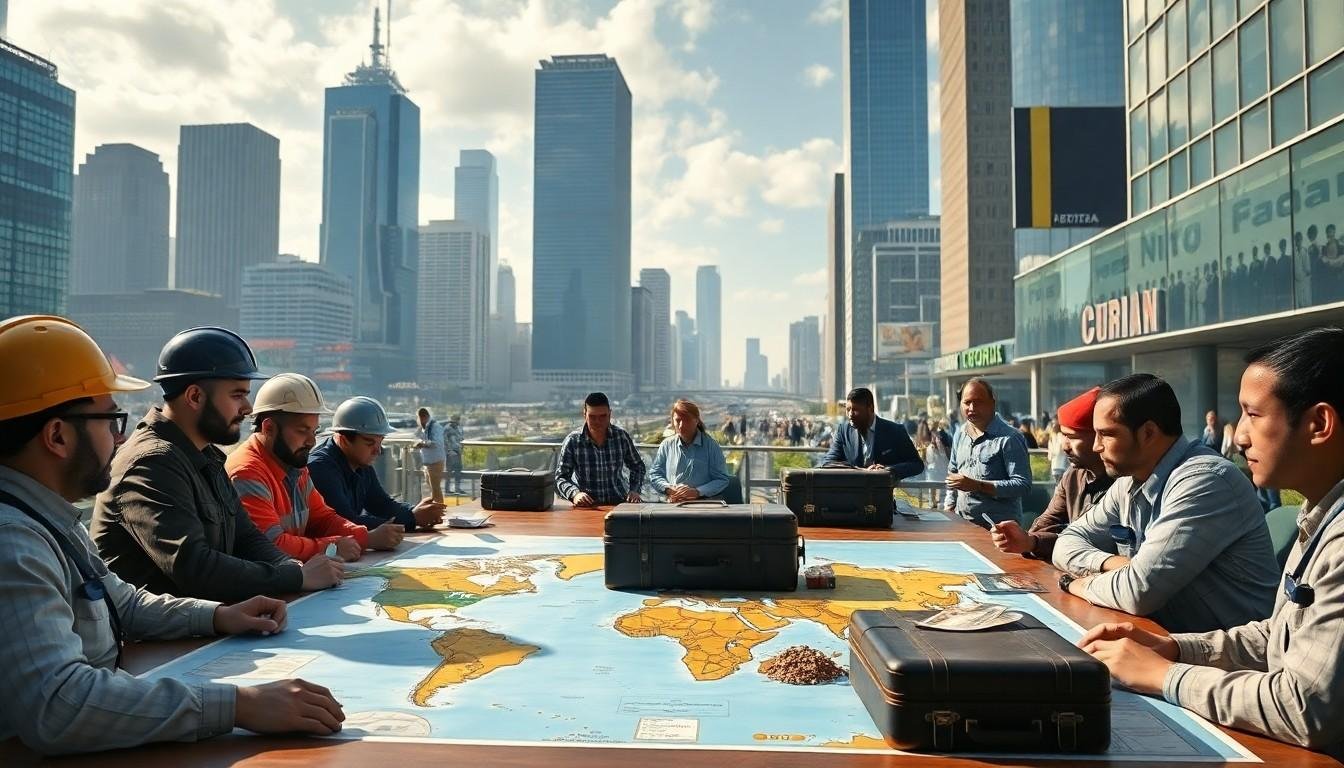
For much of its modern history, Australia treated geology as a proxy for power. Vast ore bodies underpinned export income, budget receipts and a sense of strategic security. Yet the emergence of China Mineral Resources Group has exposed a more uncomfortable reality: in tightly contested markets, influence may rest less with those who own the rocks than with those who organise the buying.
That shift has become especially visible in iron ore. According to industry reporting, BHP ...
Continue Reading This Article
Enjoy this article as well as all of our content, including reports, news, tips and more.
By registering or signing into your SRM Today account, you agree to SRM Today's Terms of Use and consent to the processing of your personal information as described in our Privacy Policy.
conceded in January 2026 that pricing pressure was building on its Western Australian operations as negotiations with CMRG continued. The miner said it remained able to maintain record output in the first half of the financial year, but the commercial signal was clear enough: China’s centralised buying strategy is no longer a theoretical experiment, but a force shaping the market.
CMRG was created to consolidate Chinese purchasing power and improve Beijing’s leverage over imported iron ore. Since at least March 2023, market observers have noted that the agency’s efforts have been aimed at strengthening China’s position as the world’s largest buyer, even if the underlying balance of supply and demand still matters most to prices. In other words, CMRG has not abolished market fundamentals; it has sought to bend them in China’s favour.
That distinction matters because it goes to the heart of how economic power now works. Australia has spent years trying to harden supply chains, commissioning reviews, drafting strategies and committing public money to secure access to fuel, semiconductors, critical minerals and other essentials. But China has been pursuing a parallel logic: if supply-chain security is about controlling access to inputs, demand-chain power is about controlling the terms on which those inputs are sold.
Iron ore has long illustrated the advantages of Australia’s resource endowment. China’s steel sector needed high-grade Australian ore, and miners benefited from exceptional margins while governments collected substantial royalties and tax revenue. The assumption was that scarce resources created bargaining power. CMRG has challenged that assumption by showing that a large, coordinated buyer can also shape outcomes, not merely respond to them.
The implications reach well beyond one commodity. China’s influence in critical minerals is growing too. A recent S&P Global report said Chinese firms are expanding their presence across the global critical-minerals sector, backed by state support and tighter control over value chains. That matters because minerals such as lithium, cobalt and rare earths sit at the centre of electric vehicles, batteries and renewable-energy systems. Control of extraction is only part of the story; refining, processing, financing, standards and end-user demand often determine where value is captured.
That is precisely where Australia’s policy debate still tends to be too narrow. Securing supply and increasing production are necessary, but they are not sufficient if others dominate the downstream stages that turn raw material into industrial advantage. If Australia remains primarily an exporter of unprocessed inputs while rivals command the machinery of processing and market access, the same structural vulnerabilities now emerging in iron ore could repeat themselves in critical minerals.
There is also a competitiveness question. Capital is mobile and increasingly unforgiving. It compares labour costs, energy prices, regulation, taxation and productivity across jurisdictions. Attractive geology can help, but it cannot indefinitely compensate for an economy that becomes less appealing for investment. Resource wealth creates opportunities; competitiveness turns them into durable power.
Diversification is part of the answer, though not through any simplistic effort to replace China. China will remain Australia’s dominant trading partner for the foreseeable future. The more realistic objective is to reduce concentration risk by deepening commercial links with India, Japan, South Korea, south-east Asia and Europe. That does not eliminate dependence, but it broadens Australia’s options and reduces the leverage any single market can exert.
Recent reporting on global mining deals suggests the wider contest is intensifying. A CSIS analysis published this month said Chinese firms completed ten mining transactions worth more than US$100 million in 2024, the busiest year for overseas Chinese mining investment in more than a decade. Taken together with CMRG’s role in iron ore, the pattern is consistent: Beijing is not only buying resources, but trying to shape the conditions under which strategic minerals are financed, traded and used.
For Australia, the lesson is straightforward but sobering. Economic security is not only about what is dug out of the ground. It is about who controls the institutions, networks and decisions that determine how resources move through the world economy. Those who organise demand increasingly shape where value ends up, and who captures it.
Source: Noah Wire Services