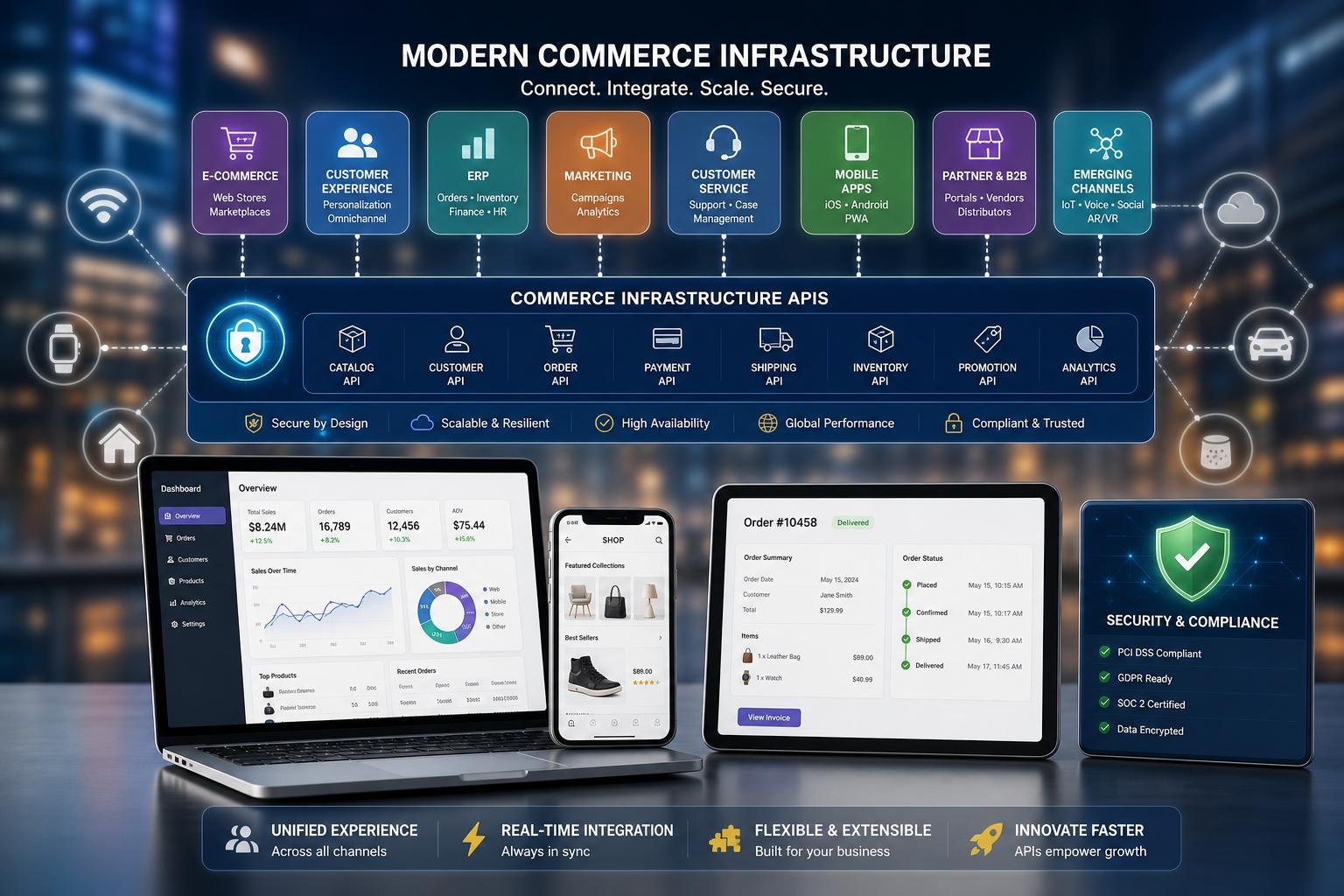
APIs have moved from being invisible plumbing to becoming one of the most exposed and business-critical layers in modern commerce. Imperva says APIs now account for 71% of web traffic, while Akamai reported 311 billion web application and API attacks in 2024, up 33% year on year. IBM’s 2025 breach report put the global average cost of a breach at $4.4 million. For merchants building beyond a scrappy stack, integration choices are therefore no longer just technical; they are decision...
Continue Reading This Article
Enjoy this article as well as all of our content, including reports, news, tips and more.
By registering or signing into your SRM Today account, you agree to SRM Today's Terms of Use and consent to the processing of your personal information as described in our Privacy Policy.
s about resilience, security and day-to-day operations.
That is the central argument behind a strong API integration strategy. Rather than stitching systems together ad hoc, mature teams define how integrations are designed, secured, tested and operated over time. The difference matters because point-to-point links may work early on, but without shared rules on ownership, data contracts, monitoring and release discipline, they become brittle as the stack grows.
In practical terms, an integration strategy should answer basic questions that large commerce businesses inevitably face: which system owns inventory, orders, pricing and customer data; when a workflow should be event-driven rather than synchronous; how credentials are managed and rotated; and what counts as a healthy integration. In enterprise Shopify environments, this is less about enabling connections than about creating operational control.
The payoff is tangible. Orders can flow from Shopify into ERP and warehouse systems without manual handling. Inventory mismatches become exceptions rather than recurring tickets. Finance teams can close books without endless spreadsheet reconciliation. New software can be added without redesigning the entire architecture. Security reviews are also easier when there are no undocumented connections or unmanaged tokens lurking in the background.
A production-ready strategy typically includes five elements. First is architecture: deciding whether a flow should use point-to-point links, middleware, an iPaaS platform, an API gateway, or an event-driven model. Second is data standards: defining canonical objects such as order, customer and inventory, along with versioning rules and required fields. Third is security: setting scopes, token hygiene, rate limits, audit logging and alerting. Fourth is governance: establishing who approves changes and how breaking updates are handled. Fifth is observability: putting in place service-level objectives, alerts, incident response and postmortems.
Most larger Shopify deployments end up hybrid. High-change flows such as orders and inventory usually work best with webhooks, queues and retries. Flows that touch several systems often need middleware or tightly governed iPaaS tooling. Read-heavy, user-facing operations can use synchronous APIs, provided rate limits are watched carefully. Lower-priority or long-tail integrations can sit comfortably in an iPaaS layer if the data model remains consistent.
Two common patterns illustrate the approach. In one, a new order in Shopify triggers a webhook, which writes the event to a queue before ERP, WMS and marketing systems each consume it independently. That buffer keeps the operation stable if one downstream system slows down. In another, inventory changes are owned by ERP or WMS, which then updates Shopify, marketplaces and retail POS after standardising SKUs, locations and pack sizes. That keeps sellable stock aligned across channels and reduces overselling.
The strategy becomes real only when it is executed methodically. Teams should begin by mapping their systems and identifying which ones own orders, inventory, customer data and fulfilment. From there, they should rank the most important flows by business impact and complexity, rather than trying to fix everything at once. Stability is more important than coverage in the first version.
Next comes the architecture decision for each flow. Frequent changes usually merit event-driven integration. Flows involving more than three systems often need middleware or stronger governance. Lower-value connections may be fine in iPaaS. After that, teams need a canonical exchange model, with clear mappings between Shopify, ERP and other systems. The point is to stop data from drifting over time.
Testing and rollout should be treated as operational work, not an afterthought. That means staging with realistic volumes, validating schemas and transformations, checking awkward cases such as returns and split shipments, proving idempotency, and using retries, dead-letter queues and canary launches before full release. A rollback plan should exist before anything goes live.
Once live, the strategy needs active management. Useful measures include order sync success rate, inventory accuracy, webhook latency, mean time to recover and the effect on finance close duration. If manual reconciliation falls and reliability improves, the architecture is doing its job.
Shopify changes the implementation details, not the underlying principles. The Admin API is generally used for operational reads and writes, webhooks for change detection, and the Storefront API for headless experiences. Real-time inventory synchronisation normally needs webhooks, queues and retries. B2B pricing often depends on a pricing engine or ERP with explicit contracts. Multi-location inventory works best when one source of truth feeds all channels.
The commercial case is strong. Some brands have used integration discipline to unlock growth, stability and customer experience gains. Everlast linked Microsoft Dynamics 365 with Shopify to synchronise orders and inventory in real time, reporting a 23% rise in web sales and a 152% higher conversion rate. Who Gives A Crap combined Shopify Plus, NetSuite ERP and Shopify Flow to support international expansion and B2B growth. Death Wish Coffee relied on consolidated ERP and inventory visibility during a surge in demand after a Super Bowl feature, while Kotn simplified its storefront architecture with Shopify’s Storefront API to improve resilience at peak traffic. Good American aligned online and in-store operations through Shopify POS and NetSuite integration, helping to reduce return friction and strengthen customer satisfaction.
The broader lesson is straightforward. When integrations are treated as infrastructure, they stop being a source of hidden risk and start becoming a platform for scale. That means documenting ownership, standardising patterns, defining contracts and monitoring reliability with the same seriousness applied to revenue or fulfilment. In mature commerce organisations, APIs are no longer a side concern. They sit at the centre of how the business runs.
Source: Noah Wire Services