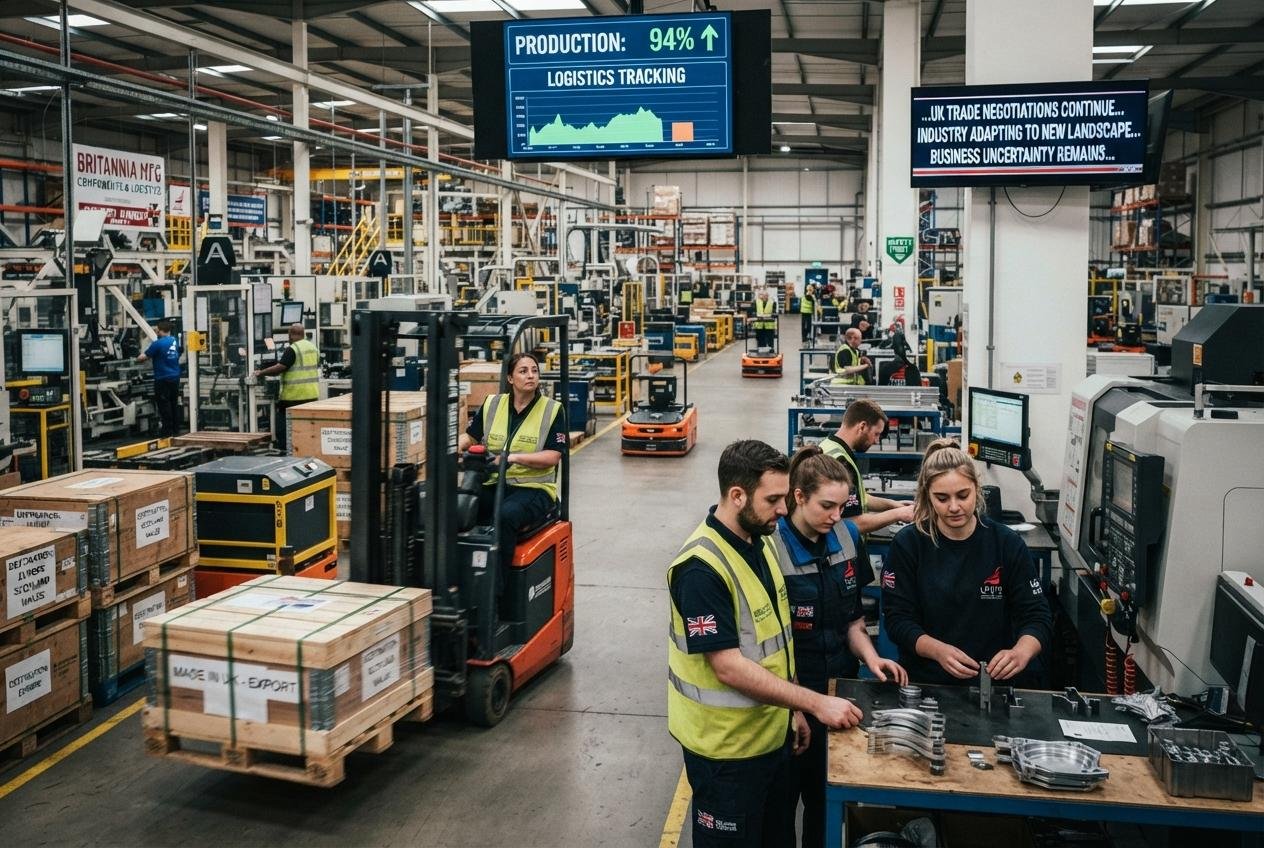
A new prime minister inevitably brings a reset in priorities, but business leaders in manufacturing, logistics and distribution will be watching closely to see whether the UK’s commitment to digital transformation survives the change of administration.
That matters because the debate is no longer about whether technologies such as enterprise resource planning, artificial intelligence and automation have a place in traditional industries. Their impact is already being felt acr...
Continue Reading This Article
Enjoy this article as well as all of our content, including reports, news, tips and more.
By registering or signing into your SRM Today account, you agree to SRM Today's Terms of Use and consent to the processing of your personal information as described in our Privacy Policy.
oss supply chains, where they are helping firms improve productivity, respond more quickly to demand and build greater resilience into operations.
The case for staying the course has been reinforced by the government’s own industrial policy. Its Modern Industrial Strategy places robotics, automation and AI at the centre of a 10-year plan running to 2035, with an ambition to scale up intelligent automation across advanced manufacturing, digital sectors, and professional and business services. The strategy also points to a broader aim of nearly doubling annual private investment in strategic subsectors, signalling that ministers see digital capability as an economic lever rather than a niche technology agenda.
In manufacturing, that direction is echoed by the Advanced Manufacturing Plan, which seeks to make Britain a more attractive place to start and grow industrial businesses. It emphasises support for innovation, research and development, stronger international co-operation on supply chain resilience, and measures designed to cut costs and remove barriers to investment.
The same logic is extending into logistics, where the government has committed £600 million to accelerate development of logistics and industrial sites. According to the plan outlined this year, a Strategic Sites Accelerator will be used to unlock land for logistics and advanced manufacturing by tackling planning, infrastructure and grid connection constraints. A national Supply Chain Centre is also due to coordinate investment across freight corridors, intermodal infrastructure and warehousing clusters, backed by an observatory to monitor vulnerabilities.
Private sector investment is moving in the same direction. Leonardo’s Future Factory programme is designed to digitalise core business processes, integrating enterprise systems into a single data environment to support faster delivery of equipment for the UK Armed Forces and allies. DHL Supply Chain has separately announced a £550 million expansion for its UK and Ireland operations, alongside further automation roll-outs to meet demand in e-commerce and healthcare logistics.
The government’s Digital and Technologies Sector Plan: Year One Update, published on 10 June 2026, suggests the strategy is being backed with substantial public funding, including nearly £4 billion for frontier technologies through UK Research and Innovation through to 2029/30. It also highlights a major skills drive in AI, with an ambition to reach 10 million workers.
Taken together, the policy direction and corporate spending point to the same conclusion: digital transformation is now central to the competitiveness of the UK economy. For ministers, the challenge will be to ensure that a change at the top does not weaken the momentum already building across the country’s most important industries.
Source: Noah Wire Services