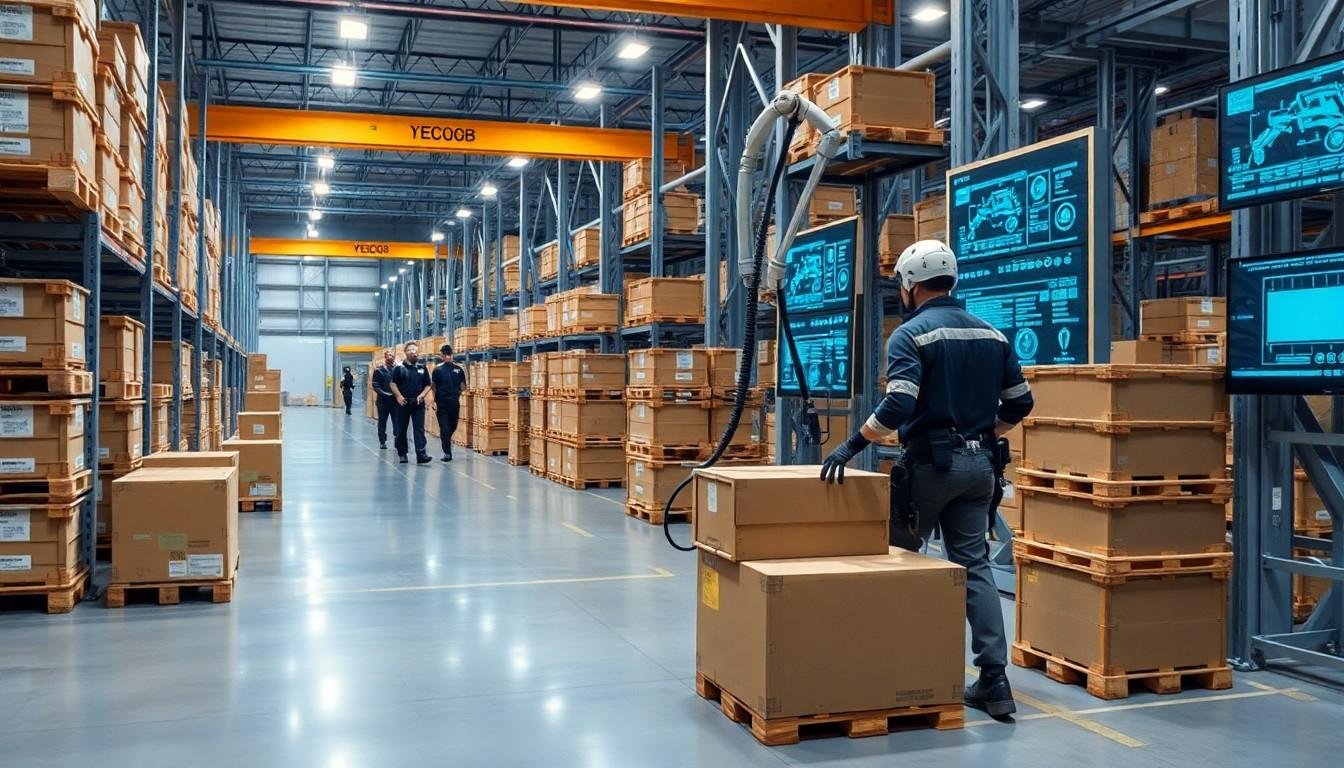
As the UK defence sector recalibrates around sovereign capability, the pressure on logistics is becoming harder to ignore. Procurement priorities are shifting, production cycles are getting more complex and, according to the Ministry of Defence, the supply chain is now expected to do far more than move parts from one place to another: it must help bring innovation into service, strengthen resilience and support a more competitive industrial base.
That wider policy direction is ...
Continue Reading This Article
Enjoy this article as well as all of our content, including reports, news, tips and more.
By registering or signing into your SRM Today account, you agree to SRM Today's Terms of Use and consent to the processing of your personal information as described in our Privacy Policy.
already being reflected in the market. The MoD has backed innovation through mechanisms including the Defence Innovation Fund, the Defence and Security Accelerator, and wider partnerships designed to connect industry, academia and investors. At the same time, defence contractors and logistics firms are moving to offer more integrated support, with alliances and partnerships emerging around digital systems, procurement and end-to-end supply chain control.
At DPRTE 2026, the discussion centred on a simple but demanding proposition: defence manufacturing only works at pace if materials arrive in the right sequence, at the right time and in the right place. The focus is no longer on holding ever-larger stocks, but on precision, visibility and the ability to respond quickly when demand shifts.
That means logistics is increasingly being treated as part of manufacturing rather than as a separate afterthought. Inbound flow has become a critical control point, with visibility needed from supplier to production line if schedules are to be maintained and costly disruption avoided. Breaking down the traditional divide between procurement, logistics and manufacturing is now seen as essential to better planning and lower risk.
Oliver George-Taylor, head of logistics UK at BAE Systems, underlined that point by saying: “We look to industry to demonstrate best practice in planning and inventory management. We need to know what’s arriving and when, so our staff are there to receive the goods and manage quarantine. This reduces costs further up the supply chain.”
The message from the sector is that visibility matters as much as capacity. Better tracking across the supply chain can reduce the need for excess stock, improve delivery accuracy and limit the kind of reactive buying that can expose programmes to disruption. As defence production becomes more demanding, suppliers and prime contractors are also being pushed to think differently about warehousing and distribution, especially where sites lack space and bulk purchasing forces inventory offsite.
That is why adaptive infrastructure is becoming a strategic issue in its own right. Logistics networks need to be able to scale quickly, while still maintaining control over stock and movement. Industry observers say there is much the defence sector can learn from automotive and fast-moving consumer goods, where precision flow, disciplined inventory and tightly managed sequencing are already well established.
Technology is central to that shift. Digital tools and artificial intelligence are being used more widely to improve procurement, tracking and control, with the aim of giving decision-makers a clearer view across the entire chain. Alan Lewis, category manager for supply chain services at Thales, said: “At Thales we have hundreds of different projects, each with very niche requirements. The transport control tower matched that need for multiple niche logistics operations with the efficiency of working with one supplier.”
His remarks reflect a broader trend towards centralised coordination, fewer administrative layers and more flexible operating models. The goal is not simply to cut costs, but to build a logistics system that can scale without necessarily increasing headcount.
That thinking is also visible in the growing number of sector partnerships. Unipart and KBR have formed a defence collaboration focused on integrated supply chain solutions, combining logistics and digital expertise with systems engineering and programme support. Separately, Amentum, GXO Logistics, Accenture and A.P. Moller – Maersk have launched the Torus Defence Supply Chain alliance, aimed at providing more resilient and integrated support for the UK defence sector.
For GXO, which was previously Wincanton, the message is that defence logistics has become a strategic enabler rather than a back-office function. The company says its combined experience across aerospace and defence, together with technology-led logistics capability, is intended to support operational readiness across the full spectrum of defence activity.
In an environment shaped by geopolitical uncertainty, longer production horizons and renewed emphasis on domestic capacity, the role of logistics is expanding fast. The sector’s next test will be whether it can turn that ambition into a genuinely integrated supply chain that is agile enough for today’s threats and robust enough for tomorrow’s demand.
Source: Noah Wire Services