Tradeshift has added a series of AI upgrades to its document-processing stack, sharpening controls for invoice extraction while also giving finance teams a clearer record of how each decision was made.
According to the company’s release announcement, the latest update to AI Document Intelligence is built around two priorities that have become increasingly important in enterprise automation: customisation and traceability. The new configuration tools allow Tradeshift’s profe...
Continue Reading This Article
Enjoy this article as well as all of our content, including reports, news, tips and more.
By registering or signing into your SRM Today account, you agree to SRM Today's Terms of Use and consent to the processing of your personal information as described in our Privacy Policy.
ssional services teams to adapt extraction rules for individual customers and, where needed, for specific supplier connections, without code changes or deployment work. That means exceptions can be isolated rather than pushed across an entire buyer base, reducing the risk of one supplier’s terminology or layout disrupting the wider workflow.
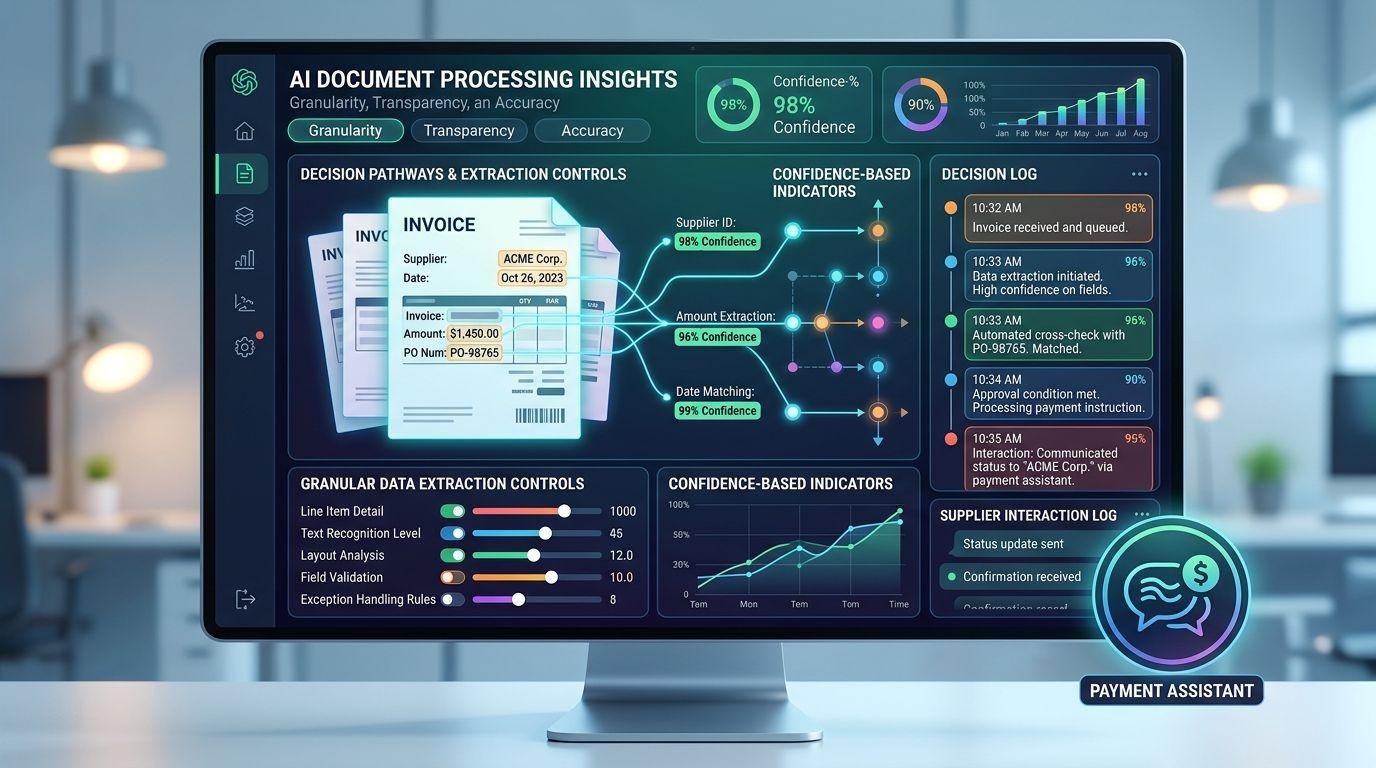
Tradeshift says the buyer-level controls can add or remove extracted fields and override rules across all invoices for a customer, whilst connection-level settings apply only to one supplier relationship. In practical terms, a field labelled “Ship Date” by one supplier can be mapped locally without affecting any other data stream. That kind of granular control mirrors a wider shift in document-intelligence software, where vendors are increasingly marketing systems not just on accuracy, but on the ability to govern exceptions cleanly and transparently. Related platforms such as Meibel, DocuHelix and Veridex also stress scored extraction, traceability and decision logs as core selling points.
Alongside those configuration options, Tradeshift has introduced a Business Audit Trail that records both extraction activity and changes to system settings. The company says each attempt is logged as started, successful or failed, with the model used and confidence score attached. Configuration updates are also tracked with before-and-after values, the identity of the person making the change and the time it was recorded. For organisations operating in regulated or high-volume environments, that level of logging is designed to answer a simple question: not only what changed, but who changed it and why.
The release also includes Invoice PO Reference Auto-Enrichment, a feature intended to remove a common bottleneck in clearance-based invoicing flows. Tradeshift says the system now fills in the purchase order number and line reference as soon as the PO becomes available, eliminating a manual “view PO” step that could hold invoices in limbo, particularly in countries such as Poland and France where buyers may need to push PO data through before processing can continue.
A fourth addition, launched in September 2026, is Confidence-Threshold Auto-Dispatch. This lets customers set a minimum confidence level for AI-extracted fields: invoices that meet the threshold can be sent onwards automatically, while those that fall short are flagged for review with a warning banner and a colour change in the interface. Tradeshift says the automation rate is monitored live, allowing teams to measure how much of their workload is genuinely straight-through and how much still needs human intervention.
The company is pitching the package as part of a broader push towards what it calls procure-to-pay financial intelligence. That wider stack includes Agentic Analytics, which is designed to answer natural-language questions over large datasets; compliance tooling for clearance, Peppol and other mandates; and an open agentic platform exposed through APIs and MCP tools. Tradeshift says the architecture is intended to support secure access, permissions inherited from the user, and an immutable audit trail, all within a single AWS perimeter.
The other major addition in the release is AskAda for Sellers, a supplier-facing assistant that lets vendors ask questions such as “Where is my payment?” directly inside the platform. Tradeshift says the tool can return real-time information on invoices, payments and purchase orders in plain language and in the supplier’s own language, reducing the need for support tickets and back-and-forth queries. In effect, the company is extending the same automation logic to the seller side of the network, where delays often arise not from missing data, but from difficulty finding the right answer quickly.
Taken together, the updates point to a broader trend in enterprise document intelligence: buyers are no longer satisfied with systems that merely extract data. They want tools that can explain themselves, isolate exceptions, and preserve a complete record of how each outcome was reached. Tradeshift’s autumn release is clearly aimed at that market, positioning AI not as a black box, but as a governed layer of finance operations.
Source: Noah Wire Services