
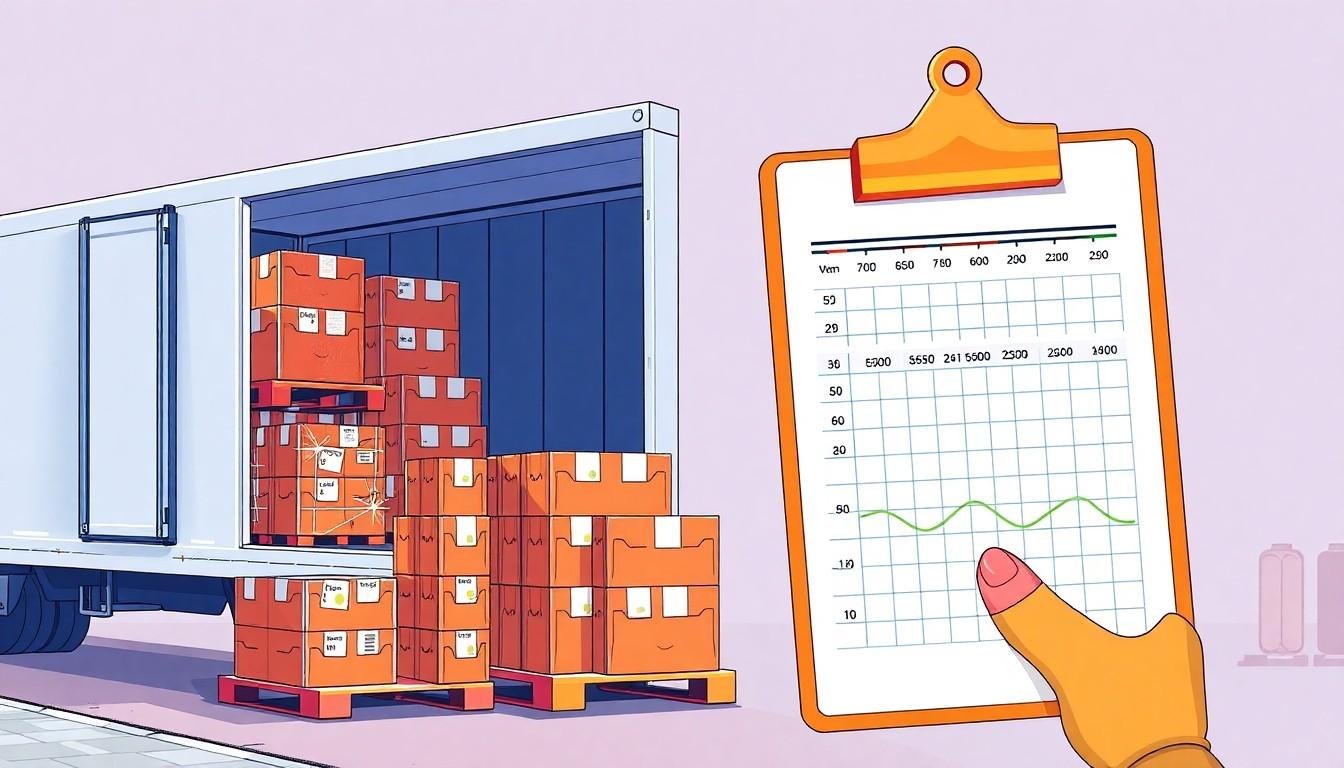
Food loss remains substantial before products reach shops, with fresh produce especially vulnerable. The Food and Agriculture Organization of the United Nations estimates that 13.3 per cent of food was lost between harvest and retail in 2023. Fruit and vegetables recorded the highest commodity-group rate, at 25.4 per cent, up from 23.2 per cent in 2015. The FAO links their greater losses in part to perishability and handling demands, but its figures do not establish how much was cause...
Continue Reading This Article
Enjoy this article as well as all of our content, including reports, news, tips and more.

By registering or signing into your SRM Today account, you agree to SRM Today's Terms of Use and consent to the processing of your personal information as described in our Privacy Policy.
For retailers, restaurants and distributors relying on imported seafood, meat and produce, long journeys and multiple transfers create opportunities for quality to deteriorate. A shipment may spend weeks in transit, encounter changing climates or be held up at a port. A rejected load also means lost freight and handling costs, as well as the expense of replacing inventory.
The challenge is not simply whether refrigeration is operating when a delivery arrives. A receiving-point measurement cannot show whether cargo experienced an earlier temperature spike, how long it lasted or whether conditions varied within the load. A refrigeration unit might be switched off during a journey and restarted before arrival, leaving the final reading unable to reveal what happened in between.
Delays after a vessel reaches port merit particular scrutiny. Clearance, terminal storage and transfer to a domestic carrier can extend dwell time, while staging at a cross-dock adds another exposure point. Each hand-off needs clear responsibility, suitable temperature control and a plan for responding when schedules change. Frozen products, including seafood, vegetables and pasta held at -18°C, have little tolerance for warming; partial thawing may damage quality without leaving an obvious sign at delivery.
A combination of monitoring methods can make these gaps easier to detect. Pallet-level trackers can record temperature over time and, where communications allow, add location data and alerts. They may help teams spot prolonged delays and intervene before a load is broken up. But once cases are separated or sent through different distribution routes, a single pallet record cannot describe the subsequent handling of every box.
Research published in the journal Food Engineering Reviews points to that distinction. In studies involving raw-pork sausage, fish and mixed products, researchers observed temperature interruptions during unloading and differences between individual boxes. Their survey of German food businesses also found that monitoring often relied on static checks, visual inspection or date labels, while time-temperature indicators were not widely used and temperature information was seldom shared effectively between supply-chain partners. The authors’ trials suggest that indicators placed on packaging can help reveal weak points, though their results relate to the products and settings studied rather than every supply chain.
Time-temperature indicators, or TTIs, can stay with individual cases after a pallet is split. An irreversible colour change, interpreted against product-specific limits, can offer receiving staff a quick indication of whether goods should be accepted, rejected or held for further review. The result should be recorded against the lot and shipment history. Indicator choice, placement and exposure thresholds need to match the product; a tool suitable for one cargo may not provide reliable evidence for another.
A separate study of six strawberry shipments across the continental United States illustrates why a single measurement may miss variation within a load. Researchers placed multiple loggers at different heights and positions across three pallets in each shipment, collecting readings from 54 points. The resulting dataset captures how temperatures can differ across locations and journeys. It supports the case for monitoring throughout transit, but does not demonstrate that a particular tracking system or predictive model will prevent spoilage.
Connectivity is another limitation. Steel containers may weaken GPS or cellular signals, while device placement and cargo configuration can also affect performance. Monitoring systems should therefore retain timestamped readings locally during outages and transmit them when a connection returns. Staff need to know whether a displayed reading is current or delayed, and missing data should be treated as a gap rather than silently filled in.
Artificial intelligence can help identify patterns in temperature records, lane histories, dwell times and ambient conditions, but only if its predictions are grounded in trustworthy measurements. A model might flag a load approaching its temperature limit while a port delay exceeds the route’s usual pattern, prompting a check of refrigeration or a move to suitable storage. Predictions should then be compared with subsequent sensor readings to test whether the warning was reliable.
Research on machine-learning methods for predicting pallet temperatures found that models trained on experimental measurements performed 20 to 40 per cent better in the study than those based on synthetic data. The authors caution against treating that result as universal: it relates to a particular modelling task and dataset. The broader lesson is that abundant simulated data cannot automatically substitute for representative observations from real shipments.
Reliable analysis also depends on calibrated sensors, consistent lot identifiers, timestamps and clearly defined product limits. Estimates generated by a model should remain distinguishable from direct measurements. And an alert matters only if it reaches someone authorised to act: operators need an accountable owner, an escalation route and the ability to arrange corrective measures, including outside normal working hours.
Traceability records can strengthen that response by linking products and hand-offs through the supply chain. The US Food and Drug Administration’s Food Traceability Final Rule applies additional record-keeping requirements to businesses handling specified foods, using Critical Tracking Events and Key Data Elements to help supply-chain partners share information and identify potentially contaminated products. The FDA says the original compliance date was 20 January 2026, but subsequent legislation directed the agency not to enforce the rule before 20 July 2028. Temperature monitoring is not itself a requirement of the rule; pairing condition evidence with traceability records is a complementary way to document how goods were handled.
Cold-chain performance also has an environmental dimension. A review of research on food cold-chain logistics describes the need to protect quality and safety while accounting for refrigeration’s energy use and greenhouse-gas emissions. Monitoring is therefore part of a wider management challenge, not a substitute for efficient refrigeration or careful operational planning.
Investment should be assessed against measurable results: fewer temperature excursions, quicker responses, reduced spoilage and more consistent acceptance decisions. Starting with a route that has repeated delays or high losses can give operators a baseline against which to judge whether better visibility and intervention are protecting product value. Records of conditions at each transfer can also help clarify responsibility when a dispute arises.
The strongest approach combines shipment-level visibility with evidence that remains attached to individual cases, reliable records and teams prepared to act. No tracker, indicator or algorithm can eliminate every risk, but used together they can give food businesses a clearer account of what happened to a load, and a better chance to respond before its value is lost.
Source: Noah Wire Services
Subscribe to Industry Updates
Get the latest news and updates directly to your inbox.