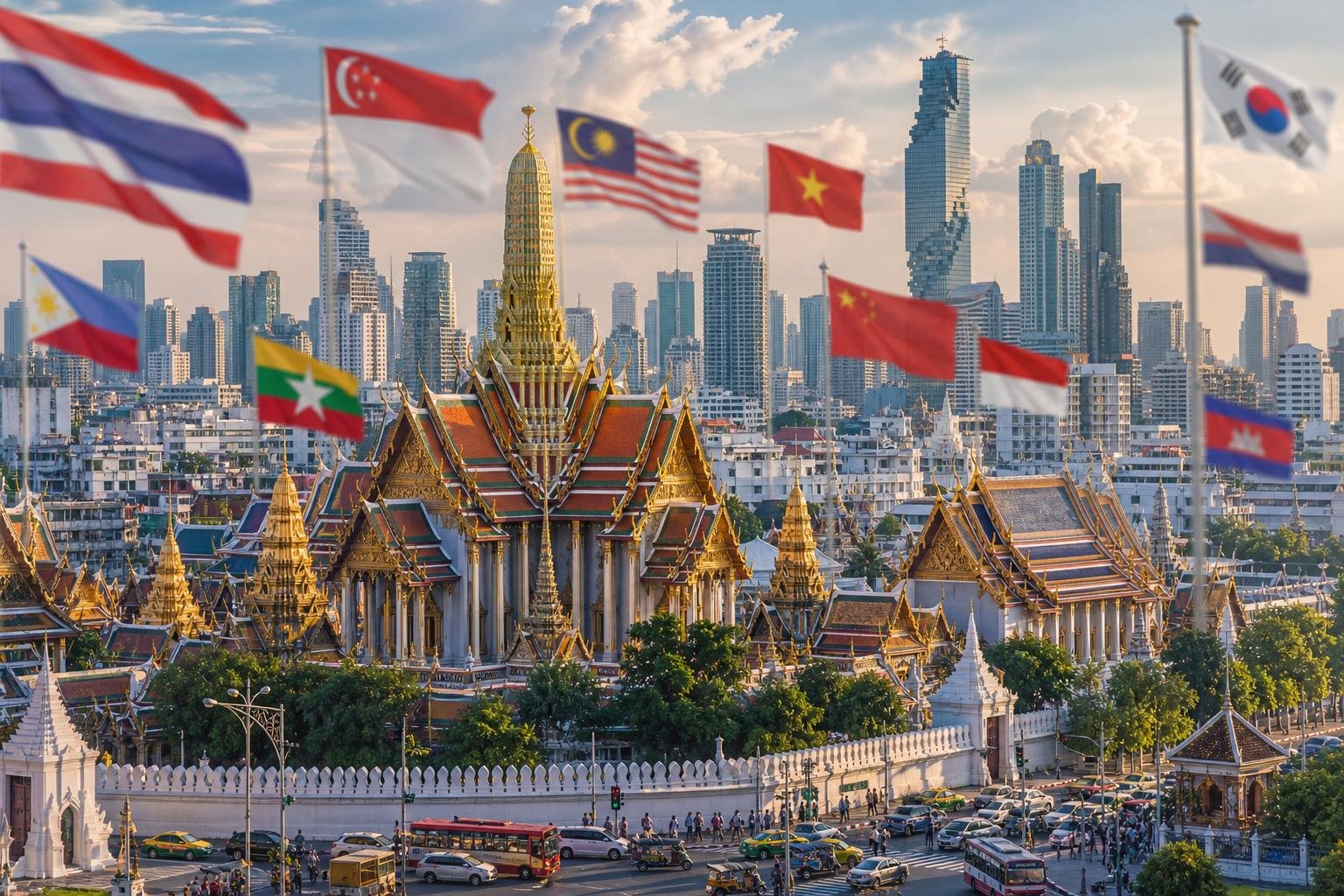
Thailand’s effort to keep China, the United States and ASEAN all in play is less a sign of hesitation than a calculated way of working. In public, officials in Bangkok stress balance, regional cooperation and multilateralism. In practice, the country is trying to preserve room for manoeuvre in an era when great-power rivalry is tightening around trade, investment and supply chains.
That balancing act is visible in nearly every major policy discussion now under way. Thailand r...
Continue Reading This Article
Enjoy this article as well as all of our content, including reports, news, tips and more.
By registering or signing into your SRM Today account, you agree to SRM Today's Terms of Use and consent to the processing of your personal information as described in our Privacy Policy.
emains deeply tied to China as an economic partner, retains its long-standing security relationship with Washington, and continues to present itself as a core supporter of ASEAN-led diplomacy. Rather than choosing one camp, Bangkok is trying to extract advantage from all three.
The strain in that model is becoming harder to ignore. In a 2024 ISEAS-Yusof Ishak Institute survey, 90.6% of Thai respondents said they were concerned about China’s growing economic influence, the highest level in South-East Asia. That anxiety sits uneasily alongside the government’s continued welcome for Chinese capital, technology and infrastructure cooperation. The contradiction is not accidental. It reflects a country that depends on Chinese trade and investment while remaining wary of overdependence on any single power.
The proposed Southern Economic Corridor land bridge captures that tension neatly. The project would link ports on the Gulf of Thailand and the Andaman Sea through a 90-kilometre rail and road corridor across the south of the country, offering an alternative to the Strait of Malacca. Supporters argue that it could shorten shipping routes and turn Thailand into a more important logistics hub. Critics, however, have questioned whether the numbers add up.
According to reporting by The Nation, some analysts believe the port-and-overland transfer system could add more than $250 per container compared with a route through Malacca, while the transfer itself could take about 54 hours, longer than the 48 hours needed to pass through the strait. Separate reporting has highlighted concerns over the project’s THB1 trillion price tag, the lack of certainty over future demand, environmental risks, and competition from Singapore and Malaysia, both of which are also expanding port capacity.
Academic work on the land bridge has raised further doubts. A study on the project’s southern logistics model pointed to domestic political instability, long payback periods, ecological disruption and security risks in the region, including separatism and terrorism. The same study noted that the initiative is unfolding amid sharper strategic competition between China and the United States, which complicates attempts to present the project as a purely commercial undertaking.
That is precisely why the land bridge is so politically sensitive. For Beijing, it offers the possibility of a major logistics foothold in mainland South-East Asia without direct control of a maritime chokepoint. For Thailand, it promises infrastructure and regional prominence. Yet it also risks deepening the very dependence Bangkok says it wants to avoid. The government has continued to promote the project, but the pace of development suggests caution rather than certainty.
Pressure from Washington is adding another layer of difficulty. US trade policy has become more aggressive towards supply chains linked to China, and Thailand is feeling the effects. Firms that rely on Chinese inputs, Chinese ownership or thin value addition in Thailand face growing scrutiny over rules of origin and market access. That makes it harder for Thailand to serve as a simple rerouting point for Chinese exports into the American market.
For businesses, the message is clear: a Thai registration alone is no longer enough. Companies hoping to use Thailand as a manufacturing or export base need genuine local value creation, whether through labour, sourcing, design or research. The days of easy tariff arbitrage are fading.
Bangkok’s answer has been to broaden its options. Thailand has applied to join BRICS, a move that has drawn concern from economists who warn it could complicate trade and diplomatic relations. On January 1, Thailand became an official BRICS partner, placing it closer to a bloc that includes China, Russia, India and several other large emerging economies. At the same time, the country continues to pursue free-trade talks with the European Union and maintain commercial ties with South Korea, Canada and other partners.
This widening of options is consistent with Thailand’s long-standing approach to foreign policy. The country has generally preferred not to bind itself too tightly to any one bloc. Instead, it seeks leverage through overlap: security with one partner, trade with another, and regional legitimacy through ASEAN. That posture may look vague from the outside, but it is highly deliberate.
Public opinion, however, is pushing in the opposite direction. Concerns about Chinese labour practices, land ownership, low-cost imports and the crowding out of Thai firms have all sharpened domestic scrutiny of Chinese-backed projects. That has already led to calls for tighter oversight of foreign ownership rules, VAT enforcement on cheap imports and closer review of large infrastructure proposals.
For investors and executives, Thailand’s message is therefore more complicated than it may first appear. The country remains open, connected and strategically important, but it is also more politically sensitive and more commercially demanding than before. Its multi-alignment strategy creates opportunity, yet it also means businesses must navigate shifting expectations from Bangkok, Beijing and Washington at the same time.
The land bridge, if it ever moves beyond feasibility debates and political argument, will be the clearest test of that strategy. It would reshape not only Thailand’s logistics map but also its place in regional power politics. Until then, it remains a symbol of the country’s wider dilemma: trying to be useful to everyone without becoming beholden to anyone.
Source: Noah Wire Services