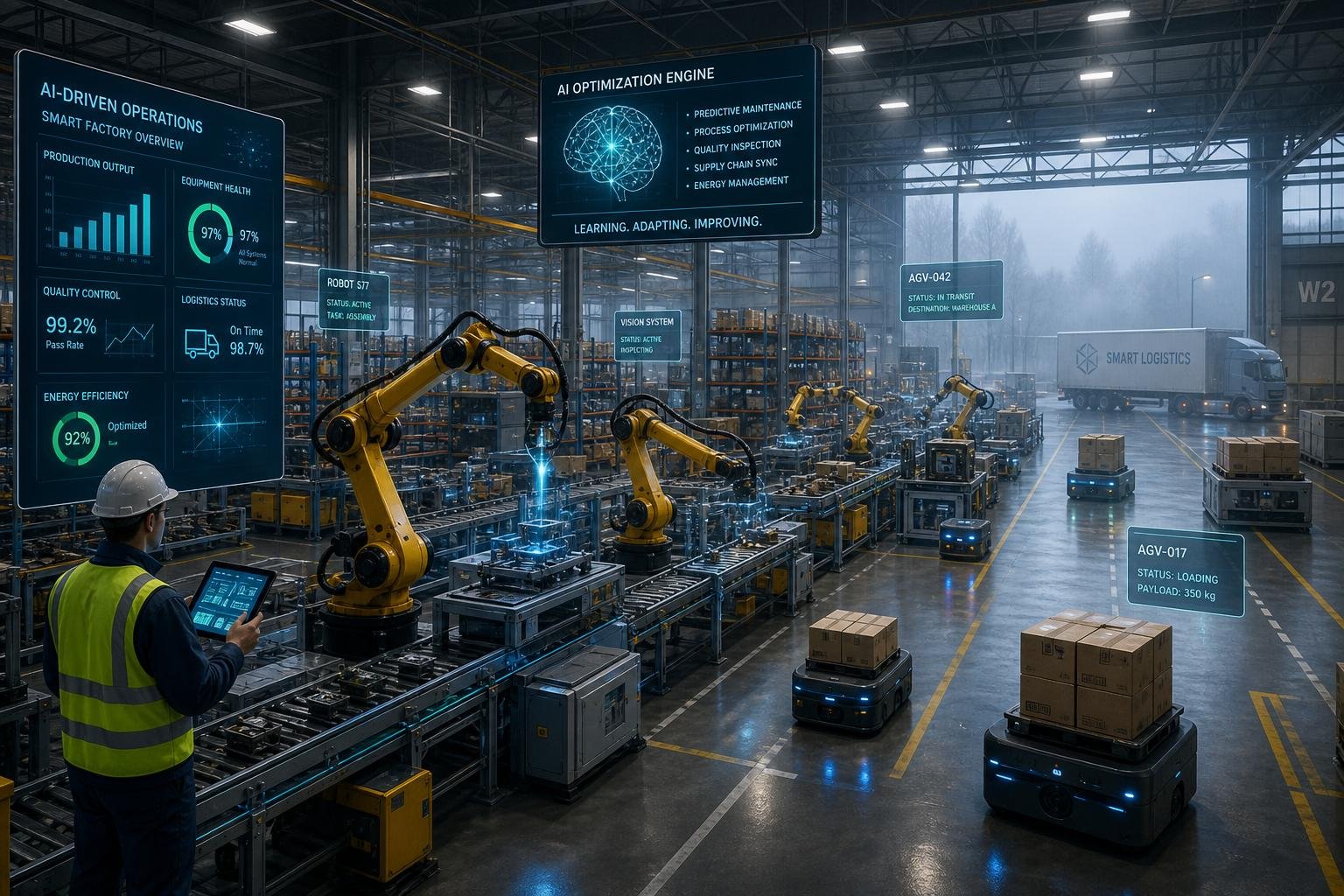
Manufacturers are moving quickly to hard-wire artificial intelligence into their operations, while also redrawing supply chains around resilience rather than lowest cost, according to a new Industry Today report on the state of manufacturing and supply chains in 2026.
The survey of 321 leaders across engineering, supply chain, manufacturing, research and development, and digital innovation in climate tech, electric vehicles, robotics and medical technology found that AI has mov...
Continue Reading This Article
Enjoy this article as well as all of our content, including reports, news, tips and more.
By registering or signing into your SRM Today account, you agree to SRM Today's Terms of Use and consent to the processing of your personal information as described in our Privacy Policy.
ed from pilot projects to core infrastructure. Almost all respondents said it is now embedded in major manufacturing and supply chain workflows, with adoption rising most sharply in supply chain execution, quality management and production planning.
That shift echoes wider industry findings. Gartner said in 2024 that the strongest supply chain organisations were using AI and machine learning to optimise processes at more than twice the rate of weaker peers, while a separate Gartner survey found that half of supply chain leaders planned to deploy generative AI within 12 months. Microsoft has also argued that generative AI can shorten development cycles, improve maintenance and security, and support lower-carbon operations across the manufacturing value chain.
The new report suggests the pressure to modernise is being intensified by a more volatile operating environment. Nearly all the executives surveyed said they were taking active steps to counter tariff exposure, including changing suppliers, redesigning components and reshaping sourcing strategies. The message is that businesses are no longer waiting for conditions to stabilise; they are making structural changes to protect margins and continuity.
That is consistent with broader supply chain trends. Gartner reported last year that 73% of companies had added or removed production locations over the previous two years, as leaders prioritised resilience, agility and flexibility over pure cost minimisation. Deloitte has similarly noted that manufacturers are increasingly expanding in the US or closer to end markets, while strengthening ties with trade partners to balance performance and cost.
The Industry Today survey also points to a growing strain on engineering teams. More than four-fifths of engineers are now spending over four hours a week on procurement-related tasks, a burden that appears to be rising as product complexity increases. For manufacturers, that is more than an administrative nuisance: it is becoming a drain on technical capacity at a time when speed of development matters.
The report argues that digital manufacturing platforms are becoming indispensable as companies look to reduce fragmentation and improve visibility across supplier networks. Respondents overwhelmingly said such systems are now essential, reinforcing the shift towards integrated, AI-enabled tools that can support real-time coordination and decision-making.
Academic research supports the direction of travel. A systematic review published in ScienceDirect found that AI adoption in supply chain management is being driven by a combination of operational, organisational and environmental factors, while barriers include complexity, data issues and implementation challenges. Taken together, the evidence suggests the industry is not simply experimenting with new tools, but re-engineering how manufacturing networks are planned, run and defended against disruption.
Source: Noah Wire Services