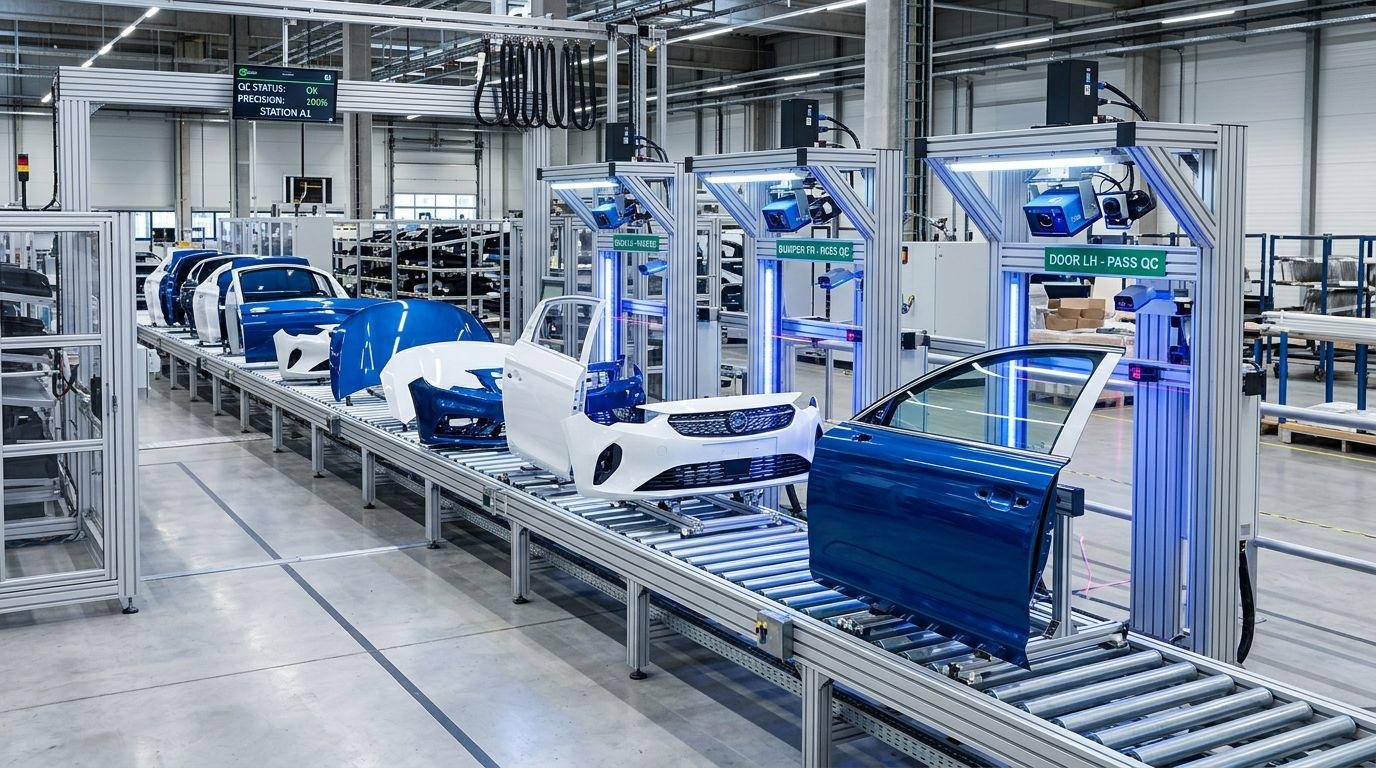
Toyota, Honda, Mazda, Suzuki and Mitsubishi usually meet on the same battlegrounds as rivals, competing for buyers, market share and technical bragging rights. Yet in late July, more than 100 representatives from the five manufacturers and their suppliers gathered at Toyota’s Tahara plant for a rather different purpose: to ask whether every tiny flaw in a component really deserves to trigger rejection, rework or scrap.
The discussion centred on Toyota’s Smart Standard Activ...
Continue Reading This Article
Enjoy this article as well as all of our content, including reports, news, tips and more.
By registering or signing into your SRM Today account, you agree to SRM Today's Terms of Use and consent to the processing of your personal information as described in our Privacy Policy.
ity, or SSA, a programme the company began in 2017 to challenge what it sees as excessive quality demands in parts production. The idea is straightforward but potentially far-reaching. If a mark, blemish or slight imperfection is invisible to the customer and has no bearing on how a part functions, should it automatically be treated as a defect?
Toyota has pointed to examples such as an air vent for rear passengers in which faint traces on the underside of the blades were judged irrelevant because they could not be seen from a normal seated position and did not affect performance. In such cases, the company argues, insisting on correction wastes time, materials and labour for no real gain.
That logic becomes more compelling when multiplied across an industrial system as large as Japan’s car sector. One supplier may produce similar parts for several marques, yet face different acceptance criteria depending on whether the component is destined for Toyota, Honda or Mazda. The result can be duplicated inspections, more documentation and unnecessary variation on the same production line. Toyota’s efforts, therefore, are not aimed at setting one uniform quality code for all Japanese carmakers, but at identifying areas where each company has arrived at a different answer to the same problem.
The scope of the co-operation remains carefully circumscribed. According to the companies involved, the talks do not touch pricing, volumes, contract terms or proprietary technology. Instead, they focus on part appearance, inspection methods and manufacturing processes , areas where standardisation can ease life for suppliers without giving any brand an advantage in vehicle design.
The push has also gained institutional backing. The Japan Automobile Manufacturers Association, working with the Japan Auto Parts Industries Association, launched a Smart Standard Activity group in 2025, broadening what began as a Toyota initiative into a more formal industry exercise. The trade bodies say the goal is to improve supply-chain competitiveness by trimming waste and reducing unnecessary variability, while keeping vehicle safety and performance untouched.
Toyota says it has already examined about 7,500 cases under SSA and has implemented 67 per cent of the proposed changes. The company wants the approach to spread further, arguing that even modest improvements can deliver sizeable savings when applied across a sector that supports about 5.5 million jobs in Japan.
There is also a strategic dimension. Japanese carmakers face growing pressure from Chinese rivals, whose scale and cost discipline have sharpened competition across the market. In that environment, the industry is looking for efficiencies wherever it can find them. Toyota and its peers are not abandoning rivalry; rather, they are trying to reserve it for the areas that matter most to customers, such as technology, price and product appeal.
The programme is no longer confined to Japan either. Toyota has been extending similar efforts in North America, with related projects under way in Europe and Asia. It is also not the first time the company has taken a collaborative approach to engineering challenges. Toyota already works with Mazda and Subaru on the next generation of combustion engines, even as each brand continues to pursue its own strengths.
For now, SSA seems to embody a practical compromise: fierce competition on the showroom floor, but a shared refusal to waste resources on defects that do not really exist in the customer’s eyes. In a country long associated with exacting manufacturing standards, that may be the most notable shift of all.
Source: Noah Wire Services