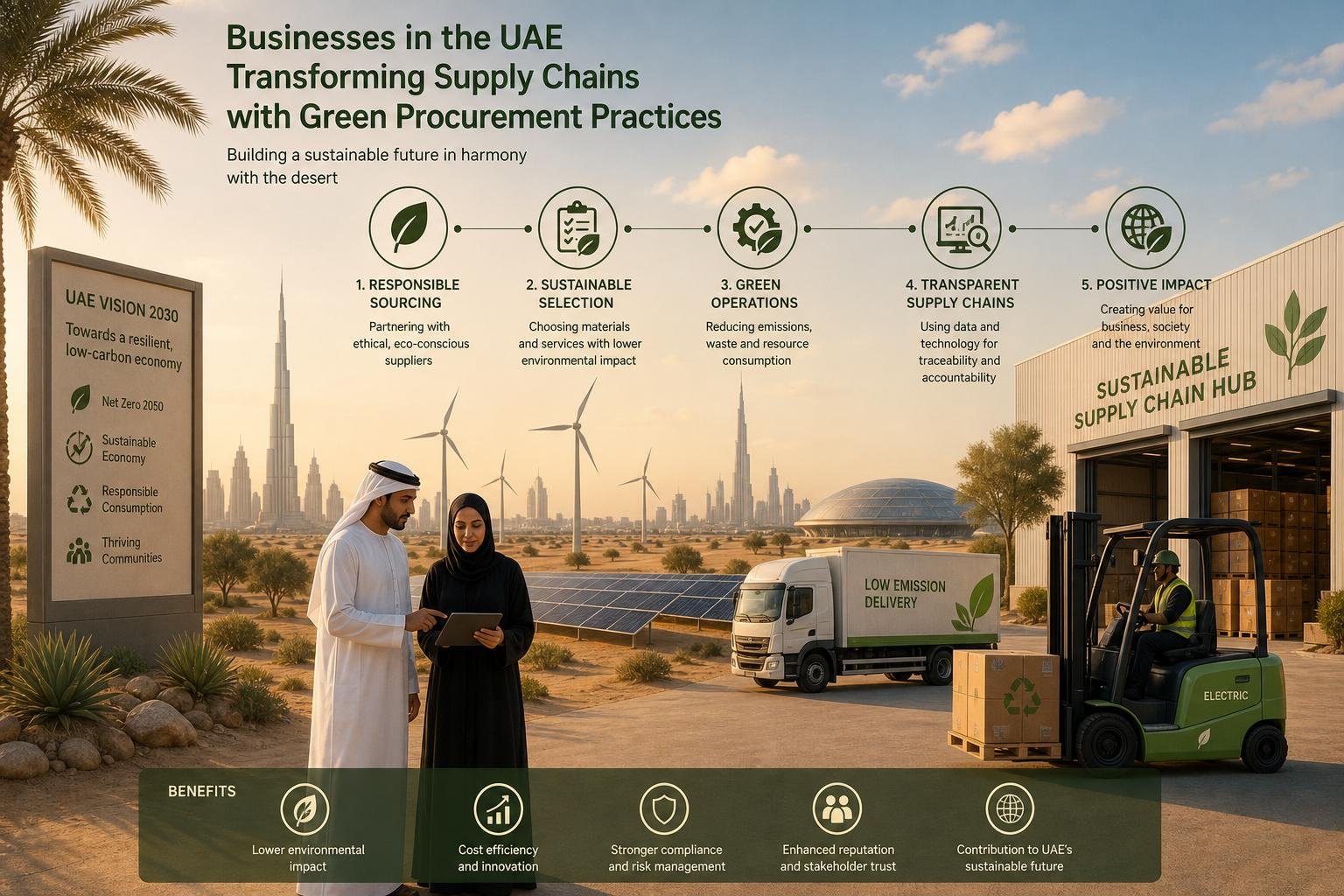
Procurement has long been judged on price, quality and delivery, but that calculus is widening. In the UAE and across the wider region, buying teams are increasingly expected to help cut supply-chain emissions as well as protect margins, turning purchasing into a lever for both sustainability and commercial efficiency.
The logic is straightforward: greener procurement is not simply an environmental add-on. It is a way of choosing goods and services that use fewer resources, cre...
Continue Reading This Article
Enjoy this article as well as all of our content, including reports, news, tips and more.
By registering or signing into your SRM Today account, you agree to SRM Today's Terms of Use and consent to the processing of your personal information as described in our Privacy Policy.
ate less waste and, in many cases, cost less over their full life cycle. The US Environmental Protection Agency says some greener products and services are already cheaper than conventional alternatives, while energy- and water-efficient purchases can deliver savings over time. Even where upfront costs are higher, the agency says falling demand and wider adoption should help bring prices down.
That broader trend is reflected in how institutions are already buying. Lehman College says its green procurement approach includes paperless purchasing, recycled-content paper, duplex printing, green cleaning products and Energy Star appliances, all designed to reduce environmental harm and energy use. Rowan University describes a similar strategy, focusing on environmentally preferable products that limit impacts on human health and the environment.
The argument for green procurement is also becoming more persuasive at a policy level. The World Economic Forum has said public procurement plays an outsized role in global emissions because governments spend trillions of dollars a year, making buying decisions that influence entire supply chains. Its view is that greener purchasing frameworks can help accelerate the net-zero transition while also supporting the market for cleaner products and services.
For private-sector procurement teams, the practical lesson is that sustainability works best when it is embedded into supplier selection, contract design and performance monitoring rather than treated as a separate initiative. That can mean prioritising low-carbon transport, reducing packaging, choosing recycled or reusable materials and pressing suppliers to improve energy efficiency and reporting.
The EPA has also highlighted a health dividend: greener procurement can reduce emissions of hazardous air pollutants and volatile organic compounds, improving indoor air quality as well as environmental performance. In other words, the benefits do not stop at the balance sheet or the carbon ledger.
As companies in the region rethink supply chains under tighter cost and climate pressure, green procurement is emerging as a rare business discipline that can deliver both. Done properly, it is less about compromise than about redesigning purchasing so that lower emissions and lower costs move in the same direction.
Source: Noah Wire Services