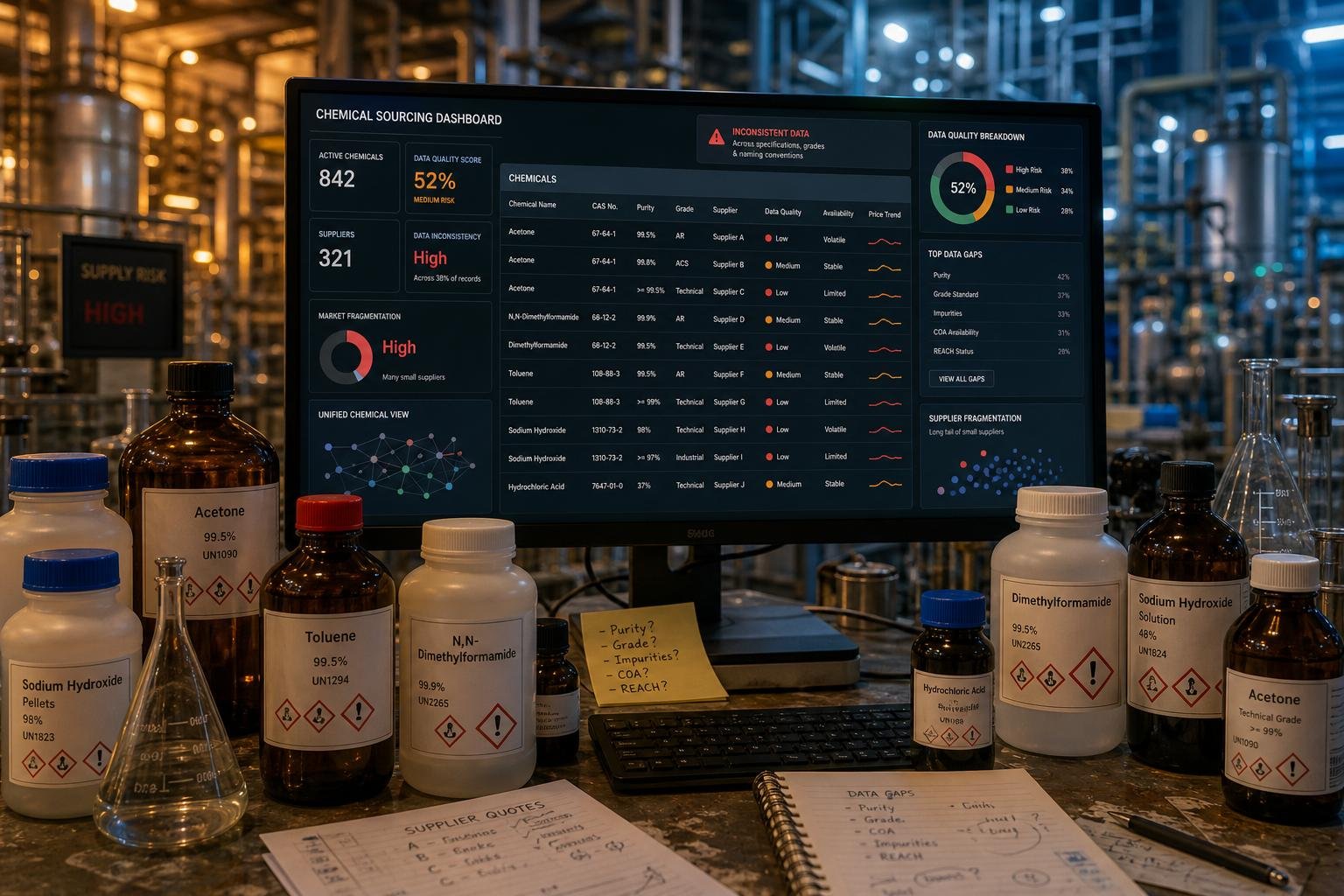
Procurement software vendors have rushed to brand their platforms as “AI-powered”, but in chemical sourcing the gap between marketing and practical value remains wide. In the bulk chemicals segment, the hardest problems are not a shortage of algorithms but messy product naming, opaque pricing and fragmented supply networks that make data-driven procurement far more difficult than in categories such as office supplies or software.
That matters because chemical spend ...
Continue Reading This Article
Enjoy this article as well as all of our content, including reports, news, tips and more.
By registering or signing into your SRM Today account, you agree to SRM Today's Terms of Use and consent to the processing of your personal information as described in our Privacy Policy.
data is often riddled with inconsistent descriptions. The same material may appear under chemical names, trade names, abbreviations or concentration variants, and until those records are cleaned and standardised, even sophisticated analytics struggle to produce reliable output. Industry practitioners commonly say the groundwork can take months, not days. The result is that many AI demonstrations look impressive in theory but collapse once they meet the reality of enterprise chemical data.
Where AI is proving genuinely useful is in spend classification. Procurement teams can use natural language processing to normalise purchase descriptions, reconcile duplicate categories and reveal hidden consolidation opportunities across business units. In practice, that can expose buying that was previously scattered across different supplier names and price points. Contract review is another area where the technology is already delivering value. KPMG’s Contract IQ, for example, is marketed as a way to continuously compare transactions with contractual commitments so that teams can spot leakage, performance risks and billing mismatches. Covasant makes a similar case for invoice validation, arguing that AI can check every line against agreed terms before payment is released.
Supplier and risk monitoring tools also have a role, especially for larger chemical producers with footprints that generate plenty of public data. Platforms such as Proconomy’s NOVA and other AI risk systems promise continuous supplier health scoring, commodity exposure tracking and contract intelligence, while more specialised monitoring services say they can flag signs of financial distress, geopolitical exposure or operational disruption in near real time. But their usefulness tends to fall where the supplier base is private, niche or lightly documented. In those cases, the signals are often too thin to be genuinely predictive.
Forecasting is more mixed. McKinsey’s Spendscape Input Cost & Resilience offering is built around the idea that spend data should be paired with market indicators to improve negotiation timing and assess price fairness. That logic is sound in principle, but chemical markets are regularly jolted by events that historical data cannot foresee: plant outages, environmental interventions, tariffs, port disruption and geopolitical shocks. AI tools can highlight trends and anomalies, yet claims that they can reliably forecast chemical prices several months ahead remain much harder to defend, particularly in volatile categories.
Specialty supplier discovery is another area where expectations often outstrip reality. AI-powered search tools may surface familiar distributors and large manufacturers, but for narrower chemical categories the real supply chain can be hidden behind traders, intermediaries and regional producers that are poorly represented in commercial databases. That is why many procurement teams still find human market intelligence more effective than algorithmic discovery when sourcing niche intermediates, silicones or pharmaceutical precursors.
The clearest message for buyers is that AI should be treated as infrastructure, not magic. It works best where the data is already strong, the category is well defined and the use case is narrow. It is far less convincing when vendors promise plug-and-play price prediction or instant visibility into fragmented specialty markets. In chemical procurement, the most valuable systems are still the ones that improve classification, support contract compliance and sharpen risk awareness, while leaving market judgement to experienced sourcing teams.
Source: Noah Wire Services