

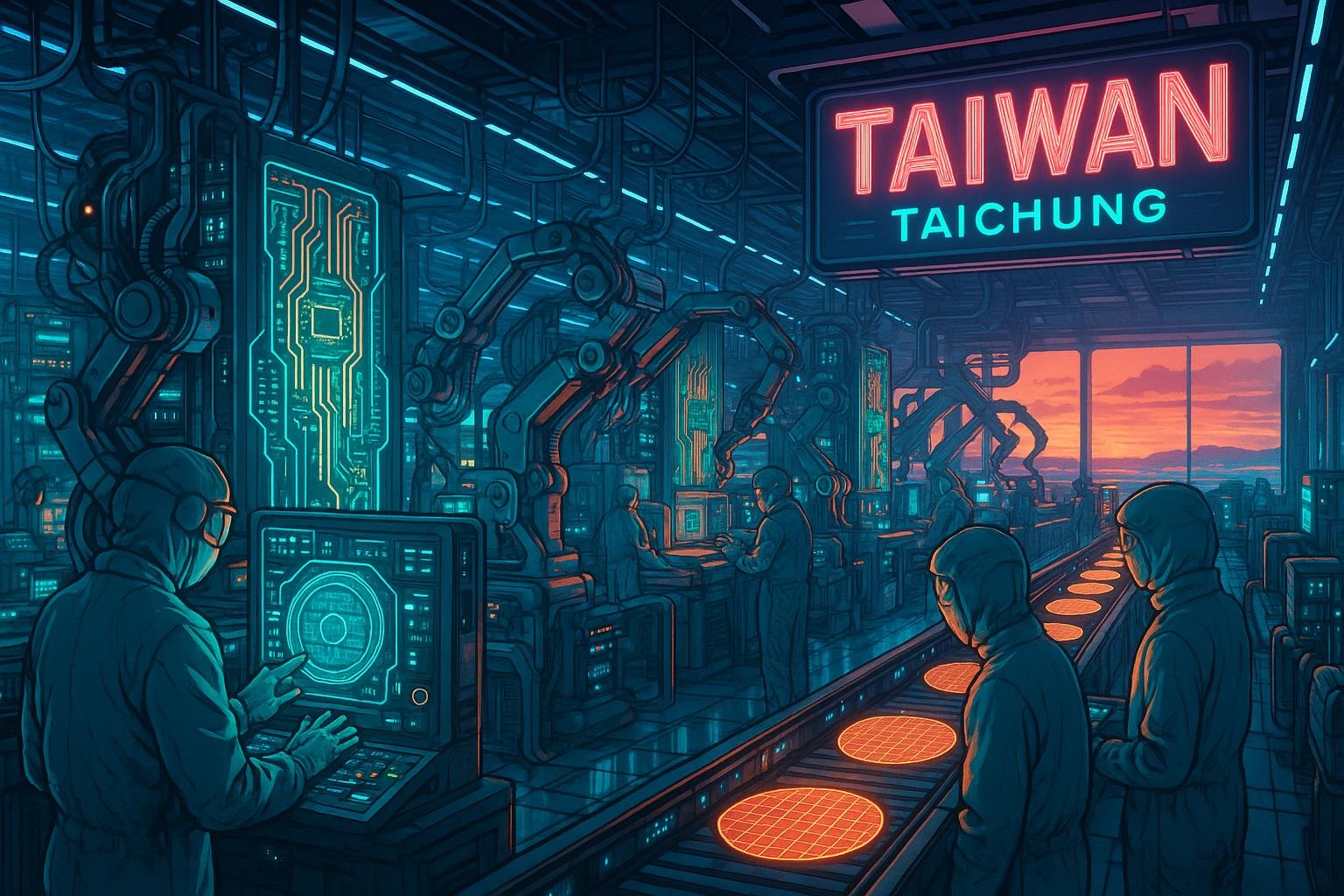
The landmark agreement between the United States and Taiwan commits over $500 billion in investment to boost American semiconductor manufacturing, amid surging AI-driven demand and ongoing geopolitical realignment in the industry.

The United States and Taiwan have sealed a sweeping commercial compact intended to accelerate the relocation of advanced chipmaking to American soil at a moment when artificial intelligence is driving unprecedented demand for semiconductors.
Continue Reading This Article
Enjoy this article as well as all of our content, including reports, news, tips and more.
By registering or signing into your SRM Today account, you agree to SRM Today's Terms of Use and consent to the processing of your personal information as described in our Privacy Policy.
Signed on 15 January 2026, the agreement binds Taiwanese technology and semiconductor firms to at least $250 billion of direct investment in the U.S., backed by a further $250 billion in credit guarantees to spur additional projects, the U.S. Department of Commerce said. The package is designed to foster onshore capacity by creating industrial parks and other infrastructure to support logic, memory and AI-related production, and it formally recognises prior commitments such as TSMC’s roughly $100 billion Arizona investment announced in 2025, according to the Commerce Department fact sheet.
As part of the deal, the United States trimmed tariffs on a broad set of Taiwanese exports to 15%, down from earlier proposed levels, a concession the Associated Press described as one of the most favourable tariff arrangements granted by Washington to a country with a trade surplus. The accord also includes targeted duty relief for firms that relocate or expand manufacturing inside the United States, and specific tariff exemptions for sectors including pharmaceuticals and aerospace, the Commerce Department noted.
Policy makers and industry participants portray the arrangement as a strategic pivot from punitive trade measures toward an incentives-first approach that pairs capital inflows with predictable trade terms. Reuters characterised the move as a geopolitical manoeuvre that underscores semiconductors’ centrality to U.S.-Taiwan relations. For supporters of reshoring, the combination of investment pledges and tariff clarity reduces political and commercial uncertainty that has long complicated long-term capacity decisions.
The timing of the agreement dovetails with a sharp upswing in chip demand driven by AI. Market researcher Omdia forecasts global semiconductor revenues will top $1 trillion in 2026 for the first time, driven by surging sales of DRAM, NAND and advanced logic ICs. Omdia’s analysis projects industry revenue growth of about 30.7% year-on-year in 2026, following a revised 20.3% increase in 2025, and identifies computing and data storage as the fastest-growing segment, expected to expand more than 40% and surpass $500 billion as hyperscalers scale capacity.
Those revenue dynamics are concentrating production priorities at fabs worldwide. With memory and logic commanding most of the market’s growth, foundries and memory manufacturers are increasingly allocating wafer starts to AI-focused products, a shift that is squeezing availability for other semiconductor categories. Industry commentary warns that allocation pressure is likely to intensify, keeping prices elevated and elevating volatility in spot markets for memory components tailored to training and inference workloads.
The commercial and industrial consequences are immediate. OEMs and electronics manufacturers face greater risk of component shortages and surging bill-of-materials costs as capacity shifts toward high-margin AI parts. Hyperscale capital expenditure, estimated at roughly $500 billion from the largest cloud providers this year alone, is shaping production roadmaps and procurement cycles, amplifying the influence of a few large buyers on global capacity planning.
In response, supply-chain strategists are urging firms to adopt multi-tiered sourcing plans, longer-term lifecycle management and design diversification to reduce exposure. Sourceability, the publication of the lead article, recommends using authorised supplier networks and cross-generation part substitutions to protect continuity and margins. The firm’s commentary stresses that without deliberate sourcing changes, many customers will face allocation-driven delays and higher costs.
The U.S.-Taiwan deal may ease some competitive pressures by shifting incremental capacity to North America over time, but its impact will not be instantaneous. Building advanced fabs and packaging lines takes years, and reports indicate that TSMC’s Arizona project may be preparing to move beyond 3nm-class production toward even more advanced nodes and packaging capabilities. Industry analysts caution that even with large-scale investment, the pace at which new capacity comes online will determine whether supply keeps up with AI-fuelled demand.
For corporate procurement teams, the near-term reality is unchanged: tighter supply and elevated pricing for memory and logic are likely to persist through 2026 as fabs prioritise AI workloads. At the same time, the new bilateral framework offers a clearer policy backdrop for long-horizon capital commitments, potentially reducing geopolitical risk for firms willing to invest in U.S.-based production.
Taken together, the trade accord and the AI-driven market surge mark a pivotal moment for semiconductor industrial policy and commercial strategy. The agreement injects substantial capital and policy support into U.S. manufacturing ambitions, while Omdia’s revenue forecast and industry commentary illustrate how quickly demand can reconfigure supply priorities. For buyers and suppliers across the electronics value chain, the combined imperative is to secure flexibility, shore up multi-source access and plan for a period of elevated allocation and price risk as the industry adjusts to both new capital flows and an accelerating AI agenda.
Source: Noah Wire Services
Subscribe to Industry Updates


