


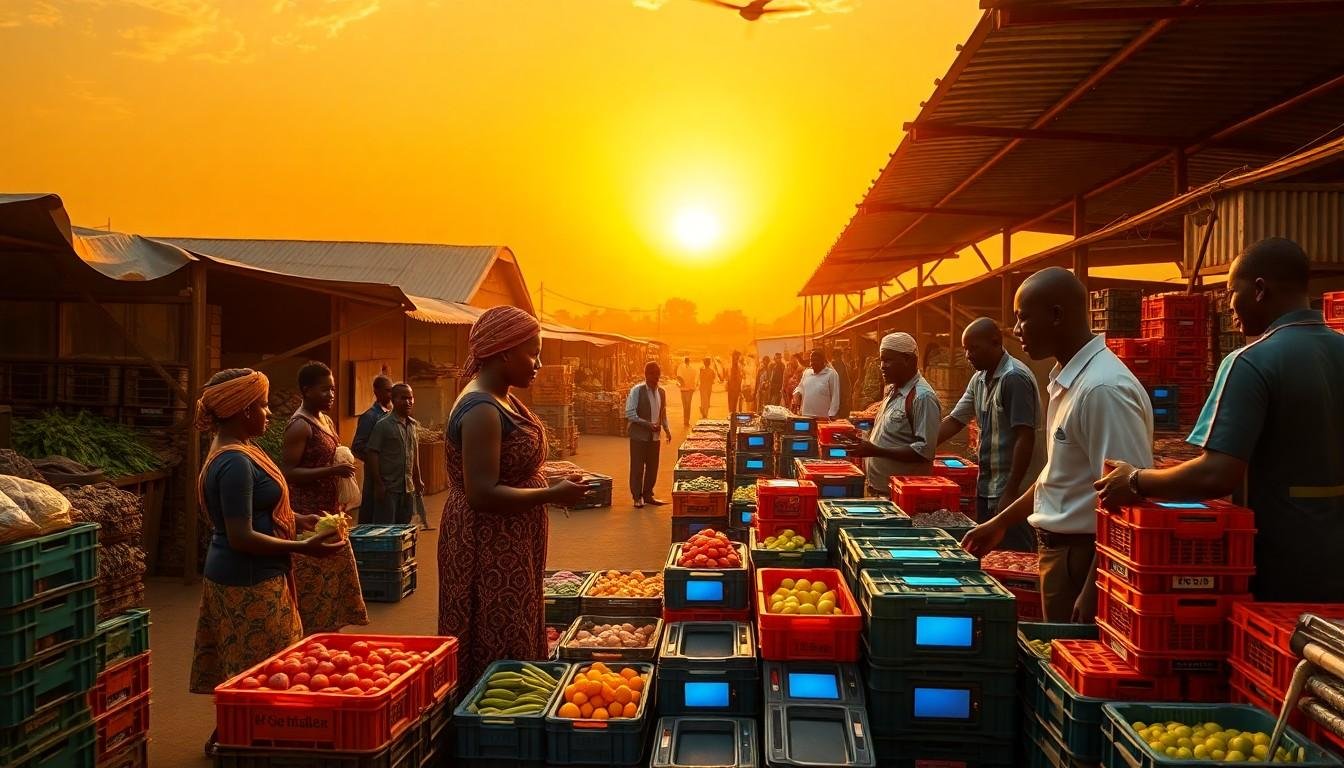
Recent events in West Africa have shown that the weakest point in a farm-to-factory chain is often not production, but trust. In The Gambia, groundnut growers in Jokadou entered the 2026/2027 rainy season still waiting for money from sales made before the previous trade season closed on 31 March 2026. In Côte d’Ivoire, exporters and buyers have warned that a new card-based traceability and payment system for cocoa could slow purchases and shipments just as tougher EU anti-defor...
Continue Reading This Article
Enjoy this article as well as all of our content, including reports, news, tips and more.

By registering or signing into your SRM Today account, you agree to SRM Today's Terms of Use and consent to the processing of your personal information as described in our Privacy Policy.
That is the gap in the advice published by Business Elites Africa on 2 September 2026. Its warning about over-reliance on the nearest or cheapest producer is sound, as is its suggestion that founders should check actual production capacity, diversify sourcing across regions and identify cases where a single supplier accounts for more than 30 per cent of inputs. But the wider reporting shows that resilience depends just as much on how the relationship is structured after that first selection. The FAO has long argued that pricing and payment terms are among the hardest parts of any farming contract, and that clear formulas and practical payment arrangements are what create goodwill on both sides. (businesselitesafrica.com)
Evidence from Malawi suggests that a tougher contract is not always the answer. Writing for IIED, Thierry Berger described an “incentive-based” approach under the Malawi Oilseed Sector Transformation programme that tried to reduce side-selling and loan default by rewarding farmers for staying in the system rather than relying chiefly on penalties. Participating soybean farmers repaid loans in specified grain volumes and were offered larger input packages in later seasons if they performed well; average loan repayment reached 96 per cent. In cotton, repayment rates were reported at more than 90 per cent in a sector where they were usually below 30 per cent. The programme, which ended in November 2018, also exceeded its gender target, with women making up 52 per cent of beneficiaries against a 50 per cent goal. IIED said the timing of payment, usually at harvest, was critical because farmers needing cash for food were more likely to sell outside the contract. (iied.org)
The FAO’s contract-farming handbook helps explain why some arrangements hold and others unravel. It distinguishes between basic market-specification contracts, where only quality standards are set, and more intensive management-and-income models that include input advances, technical support and tighter control over production. On pricing, it sets out fixed, flexible, spot-market, consignment and split-price models, warning that payments linked to market swings need independent arbitration if both sides are to trust the outcome. It also says consignment pricing is rarely seen in well-structured schemes and is best avoided, while split pricing, where a base amount is paid first and a final amount later, can work when the resale price is uncertain. For farmers, the most convenient option is normally immediate cash after delivery, though the FAO notes that many schemes end up paying two to four times during a season with advances deducted at the end. (fao.org)
Kenya’s potato sector offers a more optimistic example, but also a warning. VOA reported that a consortium set up in 2016 by the National Potato Council, the Alliance for a Green Revolution in Africa and Grow Africa linked farmers to processors and offered a guaranteed price for good-quality potatoes delivered on time. Wachira Kaguongo of the National Potato Council said 5,000 farmers had signed up, with 23,000 expected by 2020. One farmer, Macharia, said his price had risen to 22 Kenyan shillings a kilo and added: “I am paid in cash at my farm.” Kenya’s then agriculture minister, Willy Bett, defended council scrutiny of contracts, saying: “Businessmen will always want to get farmers to sign something that may not be favorable to them.” Yet the same report carried objections from researcher Felix Matheri, who said low harvests could leave families selling all their potatoes to meet contract obligations, and from roadside trader Louise Wangari, who feared processors would drain supply from smaller local buyers. (voanews.com)
Research in Ethiopia by the IFC suggests that liquidity can matter as much as headline price. Its study of malt barley, chicken feed and vegetable chains found that barley and chicken feed worked more like sellers’ markets, where side-selling is a bigger risk because buyers compete for limited supply, while vegetables behaved more like a buyers’ market. In the vegetable sample, awareness of supply-chain finance tools was extremely high: 98 per cent had heard of inputs on credit, 91 per cent of pre-paid inputs, 89 per cent of buyer advances before harvest and 100 per cent of payment only after delivery. Use was lower, but many respondents still found the tools useful for easing cash flow, including 94 per cent for post-delivery payment and 79 per cent for buyer loans before harvest. The IFC also said most financial service providers already had digital payment channels and recommended a more data-driven approach, with information segmented by farming zone and value chain. (ifc.org)
The Gambian case shows what happens when payment design fails completely. According to Foroyaa, quoted by allAfrica on 17 July 2026, officials were verifying each claim by checking the Purchase Receipt, payment receipts and the kilos supplied before compensating farmers directly rather than routing money through the Seccos again. NFSC deputy managing director Lamin Sanyang said: “You cannot pay like that. You have to authenticate, you have to confirm, and then confirm the PR — the Purchase Receipt Order — and the receipt.” By 28 July, Foroyaa reported that the government had begun paying D1.6m to Jokadou farmers, even though Sanyang insisted the state had already transferred funds to the Secco and was effectively covering a loss. He said investigators had found suspicious transfers by some Secco presidents and warned farmers to be more careful about which cooperative they dealt with. The practical consequence was severe: some growers said they had delayed planting or resorted to borrowed inputs because the previous crop had not been paid for. (allafrica.com)
Côte d’Ivoire points to a different tension: digitisation can strengthen traceability while also creating a new bottleneck. Reuters reported in July 2025 that about 900,000 of the country’s 1 million cocoa farmers had received digital ID cards that would double as bank cards and support mobile-money payments. A year later, on 20 August 2026, Reuters said the Coffee and Cocoa Council regarded the country as ready for the EU regime, with producer cards in operation from the start of the 2026/27 season on 1 September and more than one million small producers expected to gain banking access. But exporters said farmers without cards, or buyers without enough terminals, could jam up purchases, and there was still disagreement over how much cocoa from protected areas enters the national crop: the regulator put it at 15 per cent, while exporters and European environmental groups put it closer to 30 per cent. The regulatory timetable has shifted as well. Where the earlier Reuters report referred to a December 2025 EU start date, the European Commission now says the deforestation rules apply from 30 December 2026 for large and medium-sized operators and from 30 June 2027 for many other micro and small operators. (tradingview.com)
Taken together, the reporting suggests that SMEs should think less about “finding suppliers” and more about engineering a system that farmers can afford to stay in. That means contracts short enough to understand, price formulas that move with the market, payment speeds that match household cash needs, input support tied to performance, and records good enough to withstand both an audit and a dispute. It also means stress-testing the chain for concentration risk, whether that is one dominant grower, one district, one cooperative or one payment intermediary. Business Elites Africa was right that founders should start by mapping those exposure points. The rest of the evidence shows that once they are found, they need to be redesigned before the next harvest, not after the next failure. (businesselitesafrica.com)
Source: Noah Wire Services
Subscribe to Industry Updates
Get the latest news and updates directly to your inbox.

