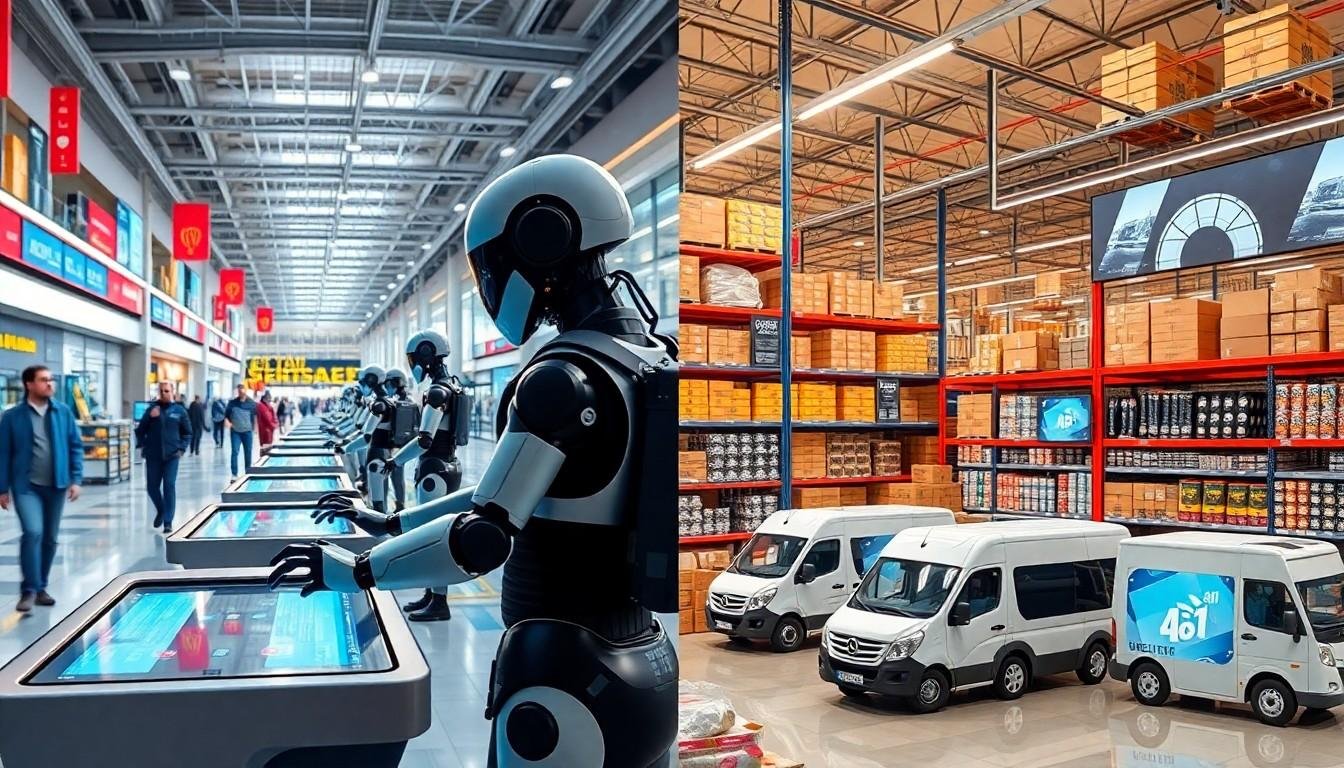
Retail is entering a phase in which speed matters as much as scale. The familiar priorities of standardisation and cost efficiency are still relevant, but they are no longer sufficient on their own in a sector where shoppers expect fluid journeys between online browsing, collection in store and rapid home delivery. Buy online, pick up in store, curbside collection and same-day fulfilment have all made convenience more demanding to deliver, while higher costs, geopolitical volatility a...
Continue Reading This Article
Enjoy this article as well as all of our content, including reports, news, tips and more.
By registering or signing into your SRM Today account, you agree to SRM Today's Terms of Use and consent to the processing of your personal information as described in our Privacy Policy.
nd fragile supply chains have left operators with less room for error.
That is why artificial intelligence is moving from a peripheral technology to a core operating capability. In the most advanced retail environments, AI is no longer being used simply to personalise offers or automate a chatbot. It is being woven into the daily running of stores, helping businesses respond in real time to changes in demand, inventory, staffing and systems performance.
The pressure on retail operations is building from several directions at once. Labour and input costs remain elevated, sourcing remains uncertain and omnichannel expectations continue to rise. According to recent reporting in SCMR, the most effective retail AI deployments are increasingly those embedded directly into order management, inventory and fulfilment workflows rather than isolated pilot projects. That shift reflects a broader recognition that retail value now depends less on standalone tools than on integrated systems that can observe, decide and act across multiple functions at once.
This is also changing what retailers need from their infrastructure. Point-of-sale systems, video management platforms and other store technologies still have to work reliably, but they now sit alongside AI-driven workloads that require resilient, highly available environments. For enterprise teams, the challenge is no longer just keeping stores running. It is maintaining a connected architecture that can support both traditional IT and intelligent automation without losing visibility into what is happening at the edge.
The move from reactive support to predictive operations is one of the clearest signs of that transition. AI-driven operations models, often referred to as AIOps, are helping retailers spot early signals of trouble before they become visible to customers. Those warnings might include system slowdowns, unusual transaction behaviour or bottlenecks in fulfilment. Instead of burying support teams in alerts, intelligent systems can surface the most commercially important issues first, allowing technicians and managers to focus on problems that affect revenue and service.
Much of the value appears behind the scenes. Inventory replenishment, once heavily manual and often delayed, can be adjusted in real time so that stock is where it is most needed. That matters in stores that double as fulfilment points, particularly when retailers are trying to support BOPIS and same-day delivery without adding operational strain. Physical locations are increasingly being treated not just as places to sell, but as nodes in a wider logistics network.
The store floor is changing too. AI is helping retailers improve queue management, provide real-time stock visibility and support customer-facing digital assistants that can reduce friction during busy periods. For employees, the technology can provide guided, step-by-step help when problems arise, whether that means dealing with a payment issue, troubleshooting a device or locating inventory. Lenovo, which says it is supporting more than 10,000 retail stores worldwide, has also pointed to operational gains from its own AI systems, including a supply chain intelligence programme that it says has cut logistics costs by about 20 per cent.
Other companies are pursuing similar ambitions in different ways. Swyft, for example, promotes AI-powered retail systems designed to integrate with existing operations, including secure robotic cabinets for satellite retail sites. The company says its platforms have eliminated retail shrinkage in some deployments, illustrating how automation is being sold not only as a service enhancer but also as a tool for loss prevention and cost control.
The broader commercial logic is straightforward. In a network of stores that are expected to act simultaneously as shopping destinations, fulfilment hubs and service points, delays and inefficiencies compound quickly. The more retailers rely on fragmented systems, the harder it becomes to maintain a consistent customer experience. By contrast, embedded AI agents and unified operating environments, as described by SCMR and others, can act across systems in a more coordinated way, resolving issues before they are visible to shoppers or staff.
That perspective is influencing how companies think about store strategy and even real estate. Industry commentary from CRE Daily and Cushman & Wakefield suggests that AI is changing the economics of physical retail, pushing stores towards a more flexible role in fulfilment, customer acquisition and reverse logistics. As retailers make greater use of data, automation and computer vision, landlords and developers are being asked to consider power, connectivity, back-of-house space and other infrastructure needs that were once secondary concerns.
The implications for store performance are especially clear at peak trading periods, when small failures can quickly become expensive. AI can help retailers shift staffing, support customers and keep fulfilment moving when demand spikes. The aim is not to replace human judgement, but to give operators better tools to anticipate pressure and respond before service levels slip.
What is notable about the current phase of adoption is its practicality. The focus is less on futuristic novelty than on everyday execution: reducing friction, improving resilience and making store operations easier to manage at scale. That is also where the strongest returns are likely to come from. As Progressive Grocer has noted in its coverage of workforce and store technology, retailers are increasingly looking for connected platforms that bring forecasting, scheduling, inventory and execution together in one system.
The result is a new operating model for retail, one in which success depends on being able to respond immediately across channels and locations. AI is becoming the tool that makes that possible.
Source: Noah Wire Services