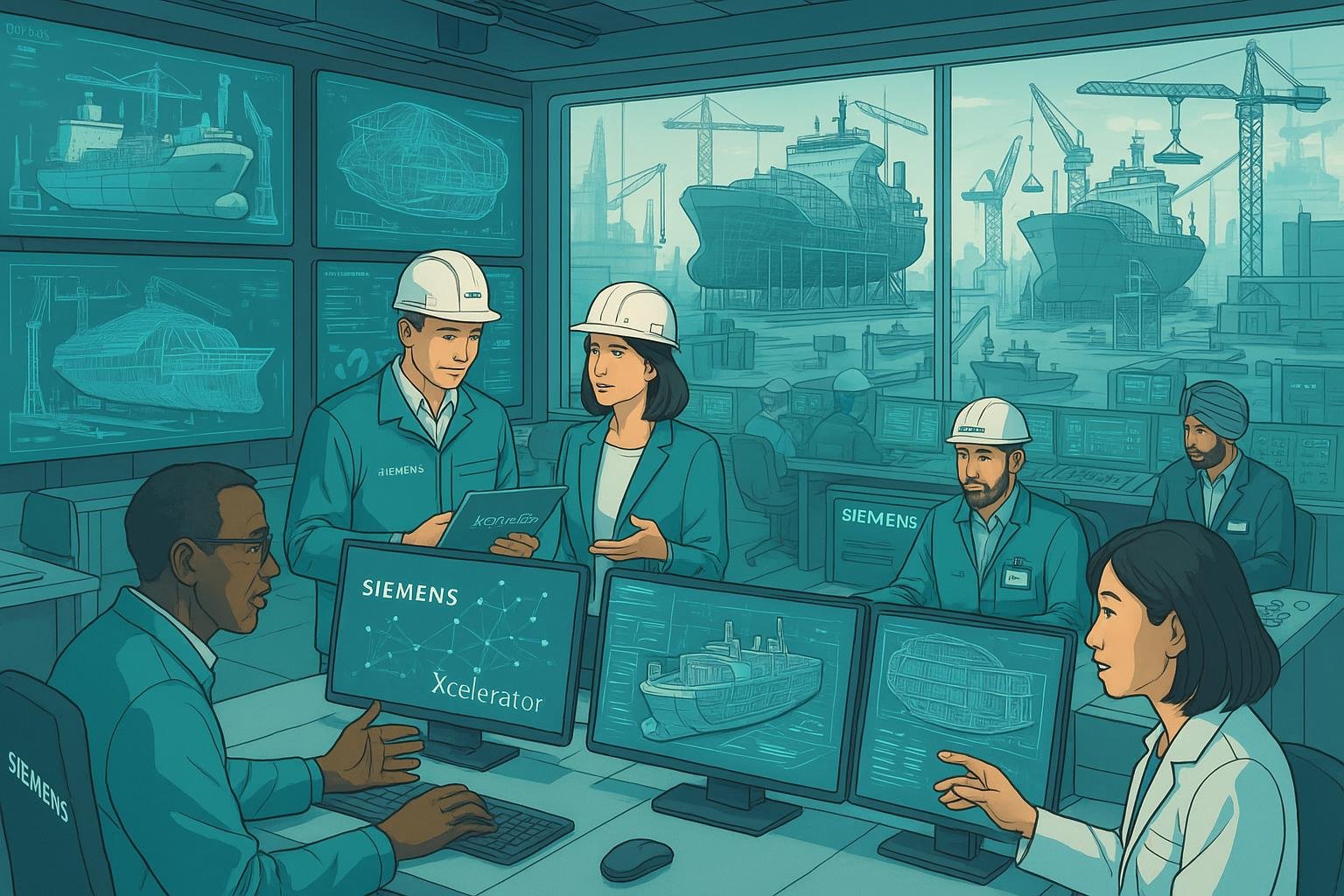
Hd Hyundai has selected Siemens’ Xcelerator platform to create a unified digital system across its global shipyards, aiming to modernise processes, reduce errors, and achieve a pioneering integrated digital shipyard by 2030.

HD Hyundai has chosen Siemens’ Xcelerator platform as the backbone of a unified digital system intended to knit together ship design and production across its global yards, the companies said, aiming to tackle long-standing gaps in data flow and...
Continue Reading This Article
Enjoy this article as well as all of our content, including reports, news, tips and more.
By registering or signing into your SRM Today account, you agree to SRM Today's Terms of Use and consent to the processing of your personal information as described in our Privacy Policy.
According to the report by Develop3D, the initiative, branded within HD Hyundai’s Future of Shipyard programme, seeks to replace fragmented information exchanges with a single, continuous data stream stretching from initial design through to manufacture and lifecycle support. The alliance plans a staged rollout that includes applying the platform to an operational vessel by 2028 and delivering the broader shipyard transformation by 2030.
Industry statements outline several technical priorities. A unified data backbone will link computer-aided design, product lifecycle management, digital manufacturing, automation and simulation, enabling planners and engineers to validate planning, construction, refit and expansion work in virtual models before committing changes on the slipway. According to ARC Advisory Group and engineering trade outlets, the approach intends to reduce rework and errors that arise when engineering and production work from different, inconsistent data sets.
HD Hyundai said the platform will cover a broad range of vessel types, from conventional commercial ships to specialised platforms, and will incorporate model-based engineering practices to bring block assembly, welding instructions, piping and electrical information into integrated 3D models. The company claims this will sharpen design accuracy, streamline production sequencing and standardise shop-floor procedures across its facilities.
“The selection of Siemens Xcelerator represents an important milestone in advancing HD KSOE’s digital shipbuilding strategy,” said Taejin Lee, exec VP and head of digital innovation office at HD Hyundai. “By establishing an integrated digital platform that ensures consistency from design through production, we aim to address long-standing data discontinuity challenges and create a more structured and collaborative shipbuilding environment. This initiative will strengthen our ability to execute increasingly complex projects while enhancing efficiency, quality and competitiveness across our global shipyard operations.”
Siemens characterised the collaboration as the next step in a relationship that has been developing since 2022. “Since 2022, Siemens’ collaboration with HD Hyundai has been focused on the future of shipbuilding and the development of next-generation digital design and production platforms,” said Tony Hemmelgarn, president and CEO, Siemens Digital Industries Software. “Siemens Xcelerator and our comprehensive digital twin technologies are well-positioned to support a unified digital thread across design, engineering and production. We look forward to helping HD Hyundai establish a scalable, open and future-ready manufacturing innovation platform that supports sustainable growth and operational excellence.”
Beyond creating a continuous engineering record, the partners have said they will build photorealistic, metaverse-style representations of ships and yard environments. According to Siemens’ announcement, those digital twins will be used with AI models trained on synthetic and industrial datasets to enable interactive visualisation and physics-based simulation of complex production activities.
The collaboration also extends into a wider strategic dimension. A recently signed memorandum of understanding between Siemens and HD Hyundai envisages work to modernise the U.S. shipbuilding sector, coupling technology deployment with workforce development, automation pilots and measures aimed at boosting industrial resilience and cybersecurity, according to a Siemens news release and a joint press statement. The partners have described pilot programmes and training collaborations with universities and other institutions as part of efforts to improve skills and preparedness in yards adapting to higher levels of digital automation.
Analysts say the plan reflects a broader industry shift toward integrated digital threads and model-based systems engineering in large-scale manufacturing. Engineering and trade coverage notes that success will depend not only on software and digital twins but also on the ability to harmonise legacy systems, standardise data schemas across suppliers and train shop-floor staff to operate within a model-driven workflow.
HD Hyundai and Siemens presented the project as scalable and open, signalling potential future commercialisation of technologies and processes developed during the programme. Company materials describe the initiative as an attempt to accelerate quality, reduce production risk and cut costs through greater use of automation and data-driven decision-making.
If realised, the integrated platform would represent a major advance in applying digital engineering practices to an industry long challenged by bespoke designs, complex supply chains and geographically distributed construction. The programme’s stated milestones, application on an operational vessel by 2028 and completion of the Future of Shipyard project by 2030, set a clear timetable against which progress will be judged.
Source: Noah Wire Services
Subscribe to Industry Updates