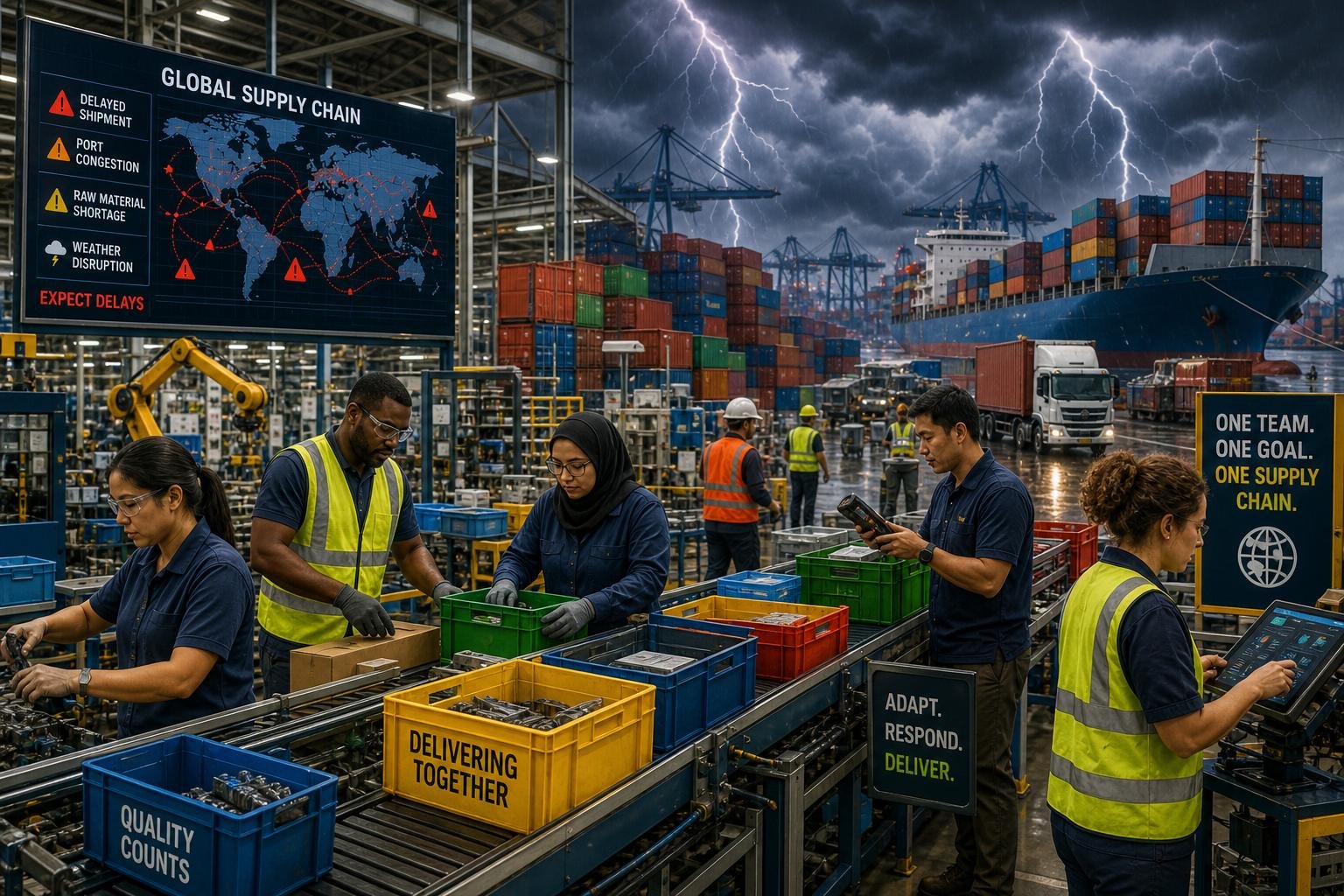
Toyota’s evolving approach to supply chain resilience shows how manufacturers are trying to protect the gains of lean production without leaving themselves exposed to a more turbulent world.
For decades, Toyota has been the reference point for just-in-time inventory control, disciplined operations and continuous improvement. According to recent coverage in Logistics Viewpoints, that reputation has not changed. What has changed is the environment in which those principles now ...
Continue Reading This Article
Enjoy this article as well as all of our content, including reports, news, tips and more.
By registering or signing into your SRM Today account, you agree to SRM Today's Terms of Use and consent to the processing of your personal information as described in our Privacy Policy.
operate: geopolitical tension, supplier concentration, transport disruption, semiconductor shortages, natural disasters and labour instability have all highlighted the limits of highly optimised supply chains.
The key point, as the Logistics Viewpoints analysis argues, is that Toyota has not responded by abandoning lean thinking. Instead, it has adjusted it. That distinction matters because the lesson for industry is not that efficiency is obsolete, but that efficiency now has to be designed alongside resilience.
Lean systems work best when conditions are predictable. Stable supplier relationships, dependable logistics and tightly managed inventory flows allow waste to be reduced and production to move in step with demand. But when volatility rises, systems with very little slack can fail quickly. A delay in one tier of the supply base, or a shortage of a critical component, can ripple through the entire network.
Toyota’s response, according to the broader reporting, has been to build resilience into the operating model rather than simply pile up inventory. That means greater supplier diversification, better visibility into dependencies, more careful risk analysis and contingency planning that can be activated when conditions change. Harvard Business Review has also highlighted Toyota’s supplier relationships as a major source of strength, noting that the company’s resilience has been reinforced by long-term partnerships rather than transactional procurement alone.
The semiconductor crisis offered a particularly stark example of why this matters. Automotive manufacturers across the sector were caught out not just by limited supply, but by poor visibility into lower-tier dependencies and long lead-time components. The result was production stoppages, delivery delays and financial pressure. The lesson, as Toyota and its peers have learned, is not merely to hold more stock, but to understand where fragility sits in the network and how quickly it can spread.
Toyota’s experience after the 2011 earthquake and tsunami in Japan also shaped this thinking. Reporting by Planet Lean described how the company’s recovery exposed weaknesses in its disaster preparation, even as its values and routines helped guide the response. That episode appears to have reinforced a broader lesson: resilience is not just about tools or systems, but about how an organisation behaves under stress.
The post-pandemic period has pushed the same argument further. Supply Chain Dive reported that Toyota has been reassessing parts of its inventory strategy after global disruption exposed the vulnerability of purely lean supply chains. The company’s challenge, as described in that coverage, has been to retain the discipline of lean manufacturing while adapting to a world in which shocks are more frequent and less localised.
The direction of travel is clear. Manufacturers are increasingly trying to combine lean operations with strategic flexibility, stronger orchestration and faster coordination across procurement, production and logistics. Toyota’s example suggests that resilience does not have to mean bloat. It can mean smarter buffers, better intelligence and more disciplined responses when disruption arrives.
In that sense, Toyota remains a benchmark not because it has stood still, but because it has shown how a lean system can evolve without losing its core logic.
Source: Noah Wire Services