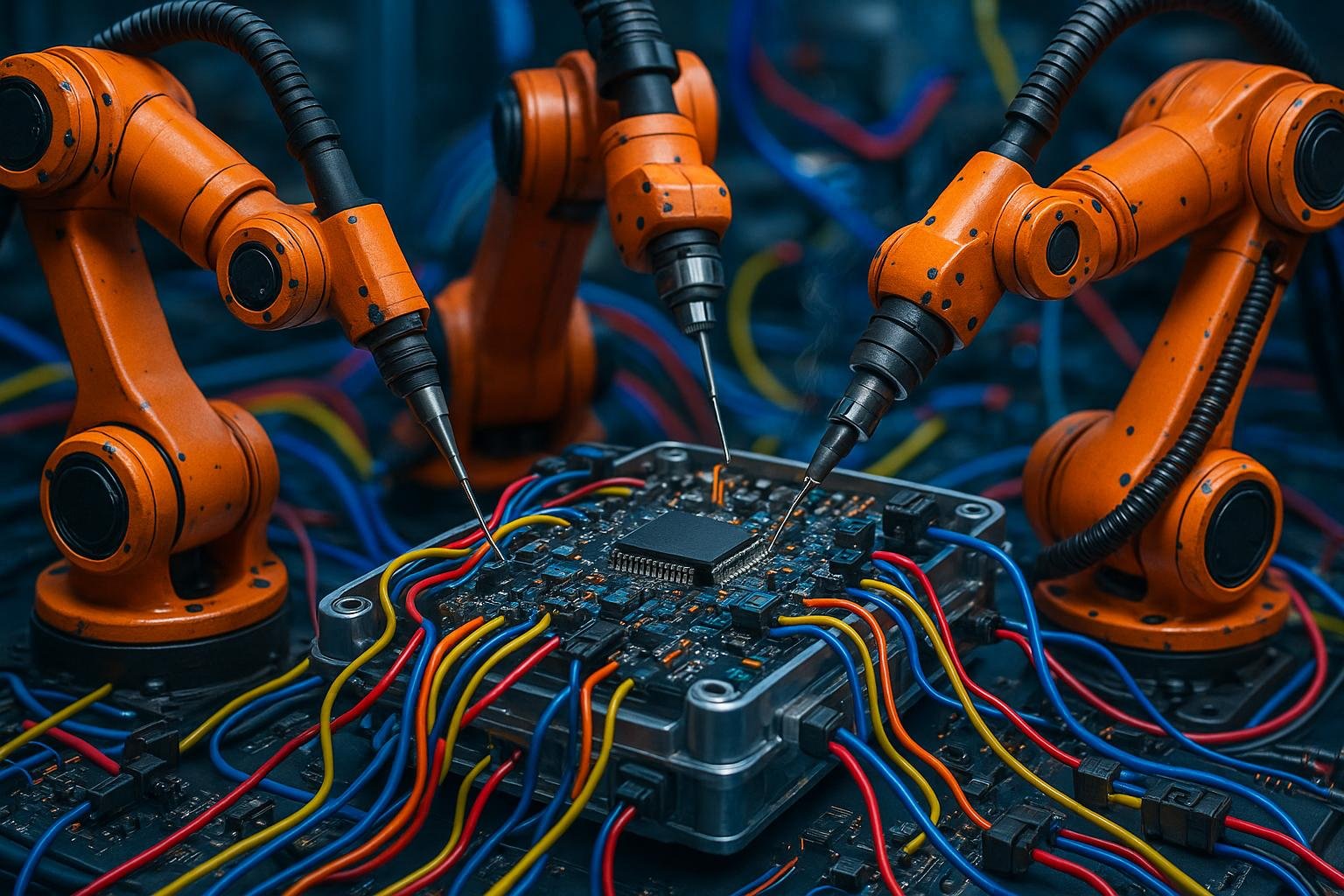
Toyota Systems and Fujitsu have achieved a world-first in applying quantum-inspired optimisation and AI to automate connector pin placement in ECU design, accelerating processes over 20 times faster and paving the way for smarter, more sustainable vehicle manufacturing.

Nagoya, Tokyo and Kawasaki, Japan , Toyota Systems Corporation and Fujitsu Limited, in collaboration with Toyota Motor Corporation, have applied quantum‑inspired optimisation and artificial intelligenc...
Continue Reading This Article
Enjoy this article as well as all of our content, including reports, news, tips and more.
By registering or signing into your SRM Today account, you agree to SRM Today's Terms of Use and consent to the processing of your personal information as described in our Privacy Policy.
According to a JCN Newswire release carried by GuruFocus, the project targeted connector pin placement , the arrangement of metal pins in a 100‑pin terminal array that transmit electrical signals between circuits. Toyota Systems and Fujitsu said the combination of an AI model trained on engineers’ placement patterns and scores, together with Fujitsu’s Digital Annealer to rapidly solve the resulting mathematical optimisation problem, produced design outcomes more than 20 times faster than conventional methods. The partners reported that the mechanism entered parallel use alongside existing processes for Toyota’s mass‑produced ECUs in May 2025.
Toyota Systems characterised the effort as a response to rising design complexity and a shortage of skilled personnel in the mobility industry, and said it encoded Toyota’s design standards and specialist know‑how into the automated workflow. Fujitsu framed its role as supplying Digital Annealer computing and AI to accelerate combinatorial optimisation and support the Toyota Group’s sustainability and digitalisation objectives. The Fujitsu announcement on its global site reiterated plans to broaden the system’s use across Toyota Group manufacturing and among supplier companies.
Industry coverage by The Quantum Insider and IntelligentCIO echoed those claims, describing the work as a world first in applying quantum‑inspired optimisation to connector pin placement and noting the potential to replace protracted, expertise‑driven review cycles. ElectronicsMedia likewise reported the performance uplift and the partners’ intention to expand deployment.
The initiative builds on an existing relationship between Fujitsu and Toyota Systems. Fujitsu’s Digital Annealer has been trialled in automotive contexts before: Fujitsu and Toyota Systems announced a Digital Annealer‑based production instruction system at Toyota’s Tsutsumi plant in 2022, and in 2020 they demonstrated supply‑chain and logistics optimisation using the same quantum‑inspired approach, the companies’ earlier press releases show. Fujitsu has promoted the Digital Annealer as a tool for large combinatorial problems that are challenging for conventional hardware.
The companies emphasised practical benefits beyond speed. Toyota Systems said the automation could shorten development cycles, reduce reliance on individual experts and contribute to cost and quality improvements across ECU development. Fujitsu noted the contribution to “realising a safe, secure and comfortable mobility society” by supporting more sustainable product development through digital transformation, according to its statement.
Both firms signalled an immediate focus on expanding the mechanism’s scope: Toyota Systems plans to roll the capability out to suppliers and integrate it further within group engineering workflows, while Fujitsu intends to continue supporting those deployments with its Computing as a Service offerings and AI tools. The announcements stop short of publishing technical benchmarks beyond the reported 20x acceleration or of disclosing specific production volumes affected, and both companies framed the results as company claims rather than independent verification.
As automotive ECUs grow more complex and vehicle electrification deepens, manufacturers face rising combinatorial design challenges across hardware and software. The Toyota–Fujitsu work demonstrates an applied route for quantum‑inspired optimisation to relieve those bottlenecks, while highlighting the continuing industry trend of pairing domain expertise with specialised optimisation hardware and AI to scale engineering capacity.
Source: Noah Wire Services
Subscribe to Industry Updates