


Emerging digital tools and logistics models are revolutionising sustainability efforts by enhancing transparency, reducing waste, and cutting emissions across source to consumer supply chains, despite ongoing systemic challenges.

Sustainability conversations have moved upstream. Rather than beginning at consumption or household recycling, attention is increasingly on the chain of processes that creates and moves goods, mining and farming, manufacturing, transport, stora...
Continue Reading This Article
Enjoy this article as well as all of our content, including reports, news, tips and more.
By registering or signing into your SRM Today account, you agree to SRM Today's Terms of Use and consent to the processing of your personal information as described in our Privacy Policy.
Improved visibility at the origin of products has become a priority. Blockchain-based ledgers are being adopted to create immutable records of each hand-off from raw material to finished item, helping firms and customers verify claims about responsible forestry, ethically sourced minerals or fair labour practices. According to the World Economic Forum, a large majority of industry leaders view blockchain as a source of competitive advantage for reporting and monitoring environmental, social and governance standards. Industry case studies cited by the Blockchain Council and council-run guides point to pilots and deployments that track battery supply chains, verify ethically sourced commodities and reduce fraud by providing a single, shared source of truth for authorised participants. Those accounts also warn of hurdles such as the need for reliable digital tagging, integration across fragmented chains and the risk of exposing commercially sensitive data.
Reducing production-side waste is another critical front. Machine learning and predictive analytics are increasingly used to align output with demand, lowering the incidence of surplus stock that later becomes markdowns or landfill. Academic research published in Sustainability finds that AI-driven forecasting improves responsiveness in e-commerce and can cut the twin problems of overproduction and stockouts. Industry analysts report that advanced forecasting can reduce forecast errors substantially, translating into lower inventory carrying costs and lower material and energy use across operations.
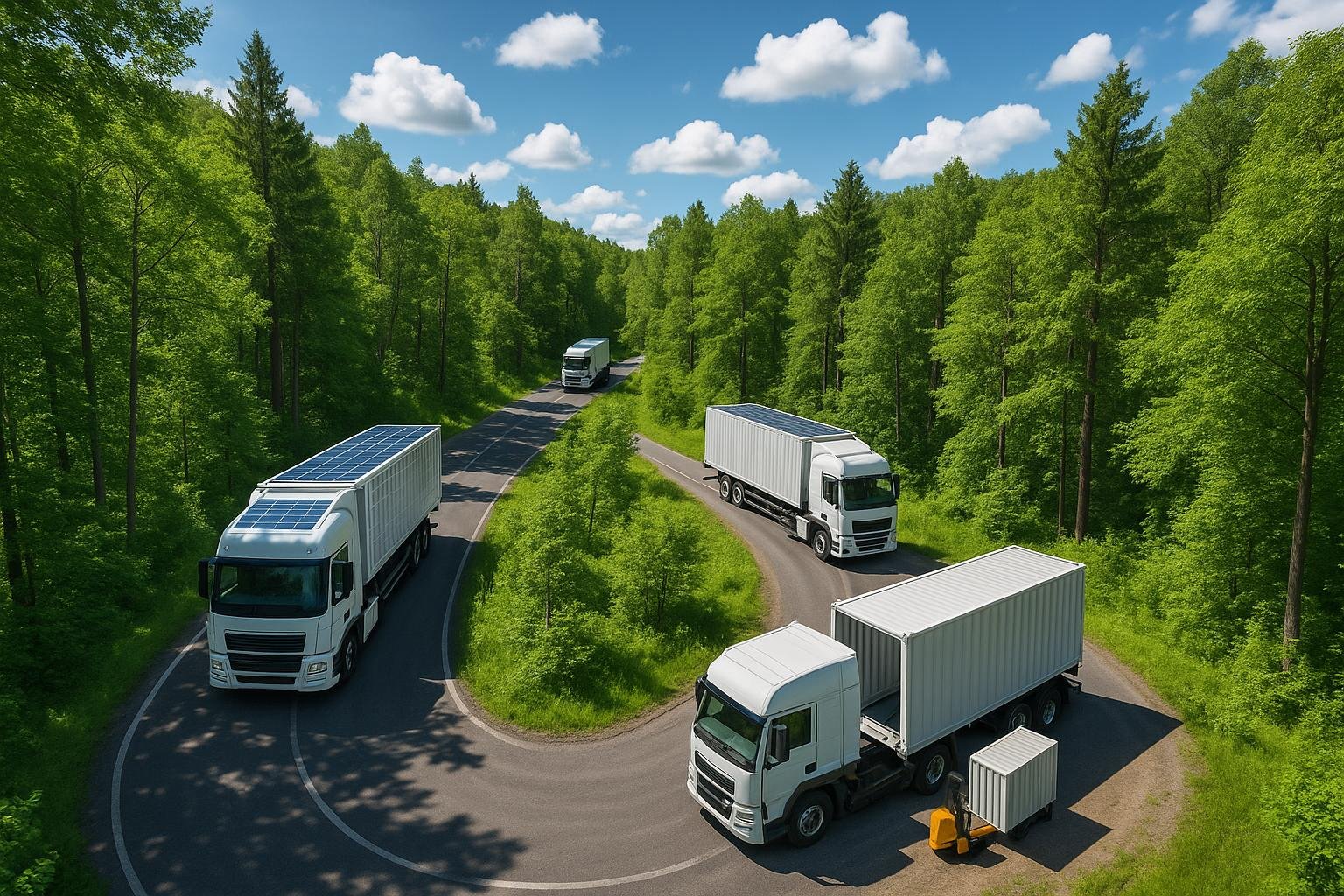
Transport remains a major emissions source, yet software and vehicle technology are changing that calculus. Route‑planning systems powered by artificial intelligence now ingest traffic, weather and delivery constraints to shave idle time and unnecessary mileage, reducing fuel consumption and delivery windows simultaneously. At the fleet level, electrification and alternative fuels are being explored beyond last‑mile vans; hydrogen fuel cells and sustainable biofuels are under trial for longer hauls while expanding charging infrastructure makes urban electrification more practicable. The public‑health benefits in cities, fewer nitrogen oxides and particulates, are as salient as the climate gains.
Sensors and connectivity are tightening control over fragile supply chains. Internet of Things devices in refrigerated containers monitor temperature, humidity and location in real time, triggering alerts and interventions that can prevent spoilage and waste for food and pharmaceuticals. That preventive capability preserves the embedded water, land and energy investments in perishable goods while strengthening safety and reliability for users.
Warehouses, often overlooked in sustainability debates, are also evolving. Buildings now incorporate rooftop solar, efficient lighting, better insulation and rainwater capture, while operators pursue strategies to consume more on-site green power, for instance timing electric forklift charging to periods of peak solar output. Internal automation, robots, smarter shelving and order consolidation, reduces unnecessary movement and the need to heat or light underused space, although firms must manage workforce impacts carefully as technology displaces routine tasks.
Closer-to-consumer distribution models are reshaping the last mile. Micro‑fulfilment centres located within urban footprints allow fulfilment by electric vans or cargo e-bikes, cutting emissions, congestion and noise. Transport modelling suggests that replacing van trips with cargo e-bikes can reduce substantial tonnes of CO2 per vehicle annually when scaled across dense city networks. Those gains matter most where heavy truck traffic has concentrated health and environmental harms.
Finally, circular economy strategies address what happens after sale. Robust reverse logistics, trade‑in programmes, returns networks and takeback schemes, keeps materials in use via repair, refurbishment and recycling, reducing virgin extraction and opening new revenue opportunities. Firms redesigning products for disassembly and investing in collection infrastructure are turning end‑of‑life goods into feedstock for fresh production rather than waste.
Despite the momentum, systemic obstacles remain. Digital tools demand interoperable standards, secure data governance and verification frameworks. New materials must be assessed across full life cycles to avoid unintended consequences. And the transition to low‑carbon transport requires parallel grid decarbonisation and investment in charging or hydrogen infrastructure. Nevertheless, a combination of traceability technologies, predictive analytics, cleaner logistics and circular business models is beginning to align economic and environmental objectives. As companies and regulators push for greater accountability, supply chains are becoming a deliberate arena for innovation rather than an invisible backdrop to consumption.
Source: Noah Wire Services
Subscribe to Industry Updates

