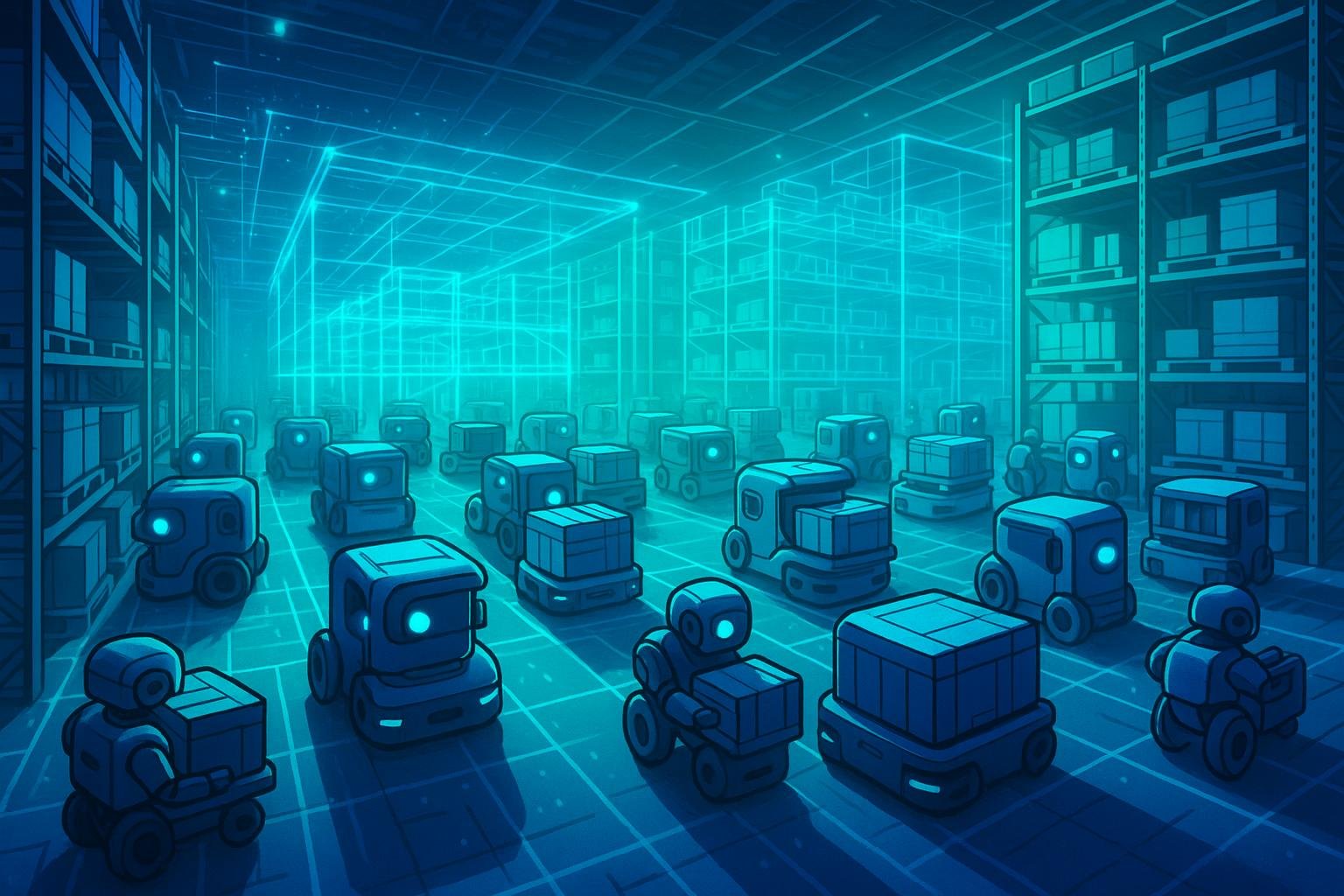
Otto Group’s new network-wide programme uses NVIDIA’s Omniverse and Isaac Sim to create a digital twin of its warehouses, enabling virtual testing and orchestration of robot fleets at scale, setting a potential blueprint for future logistics transformation.

The Otto Group has launched a network-wide programme to coordinate fleets of warehouse robots using a simulated “Robotic Coordination Layer” built on NVIDIA’s Omniverse libraries and Isaac Sim, with the...
Continue Reading This Article
Enjoy this article as well as all of our content, including reports, news, tips and more.
By registering or signing into your SRM Today account, you agree to SRM Today's Terms of Use and consent to the processing of your personal information as described in our Privacy Policy.
The layer creates physics‑based digital twins of distribution and fulfilment centres so robots can be trained, tested and virtually orchestrated before being deployed in live operations. The system, developed initially by IT services specialist Reply and to be governed by Otto Group One.O, links real robot fleets to an exact virtual representation of the warehouse and integrates with fleet management tools and the Warehouse Management System to visualise and manage robot traffic in real time. According to the Otto Group announcement, Loehne will serve as the blueprint for subsequent roll-outs.
“More than three years ago we embarked on a journey to deploy AI and robotics in the field of logistics. Our experiences to date have shown the huge potential for improving efficiency and service,” says Kay Schiebur, Member of the Executive Board, Services, Otto Group, in the company statement. “With NVIDIA and Reply, we are now ready to take intelligent automation to the next level. This partnership will provide the fundamental structure – a truly innovative way for our robots to communicate – allowing us to quickly scale up robotic solutions in our complex operations, strengthening our leadership in responsible business, especially here in Europe. We are always striving to improve our performance and ensure our future viability.”
NVIDIA framed the effort as an application of “physical AI” to transform warehouses from static facilities into dynamic, responsive systems. “Physical AI is redefining what’s possible in supply chain, transforming warehouses from static facilities into dynamic, responsive systems that can adapt in real-time,” Azita Martin, Vice President and General Manager Retail & Consumer Products and Goods at NVIDIA, said on the company blog. “Leveraging NVIDIA RTX Pro 6000 and NVIDIA Omniverse on GCP, together with Isaac Sim, Otto Group is training a fleet of robots using physics-based simulation, creating a scalable blueprint for the future of logistics, where fleets of robots and intelligent systems collaborate seamlessly to boost efficiency and drive agility.”
Reply emphasised the role of reality capture and post‑processing in building the digital twin, noting use of sensor data and imagery collected by a Boston Dynamics Spot robot. “Creating a digital twin is more than just mapping a space – it’s about enabling intelligent orchestration at scale,” said Kai Uwe Ernst, Executive Partner at Reply, in the company release. He described the stack as enabling virtual reconfiguration for process optimisation, and dynamic simulations to size robot and personnel requirements for peak periods.
The initiative sits alongside Otto Group’s other recent robotics partnerships and pilots. The company announced a strategic deal with AI robotics firm Covariant to deploy more than a hundred AI‑powered robots to automate manual fulfilment tasks, and has already integrated Boston Dynamics’ Stretch unloading robot at its Haldensleben centre in what Otto Group described as the European premiere for that system. Those moves underline a broader shift toward mixed fleets of specialised and generalist robots in fulfilment operations.
Industry reporting and the vendors involved frame the Otto project as notable for its emphasis on interoperability and governance: the coordination layer is intended to allow disparate robotic platforms to share tasking, navigation and safety information through a centralised virtual representation. Eurotransport and other logistics outlets note this addresses a common barrier to scaling robotics in complex, heterogeneous warehouse environments.
Technically, the stack will be offered as a ready‑to‑run solution on cloud marketplaces, running on Google Cloud infrastructure with NVIDIA RTX Pro GPUs to enable large‑scale simulation and model training. NVIDIA’s prior factory and logistics engagements, including with automotive manufacturers, suggest the company sees supply chain simulation and a unified robotics software architecture as a growing market.
Otto Group positions the project as both an efficiency and resilience play: it aims to improve peak management, shorten deployment times for new robot fleets, reduce disruption through virtual testing and give operators a simpler overview of all robotic activity. The company has stated the initial development involves a double‑digit million euro investment and that One.O will assume governance for the coordination layer as it is scaled.
As companies attempt to combine multiple suppliers and robot types, the Otto initiative will be watched as an early European example of a centrally governed, simulation‑first approach to warehouse automation. The technical proof points will include how quickly new robot fleets can be integrated, how effectively the digital twin mirrors live operations, and whether simulated optimisations translate into sustained labour and throughput gains in the field.
Source: Noah Wire Services
Subscribe to Industry Updates