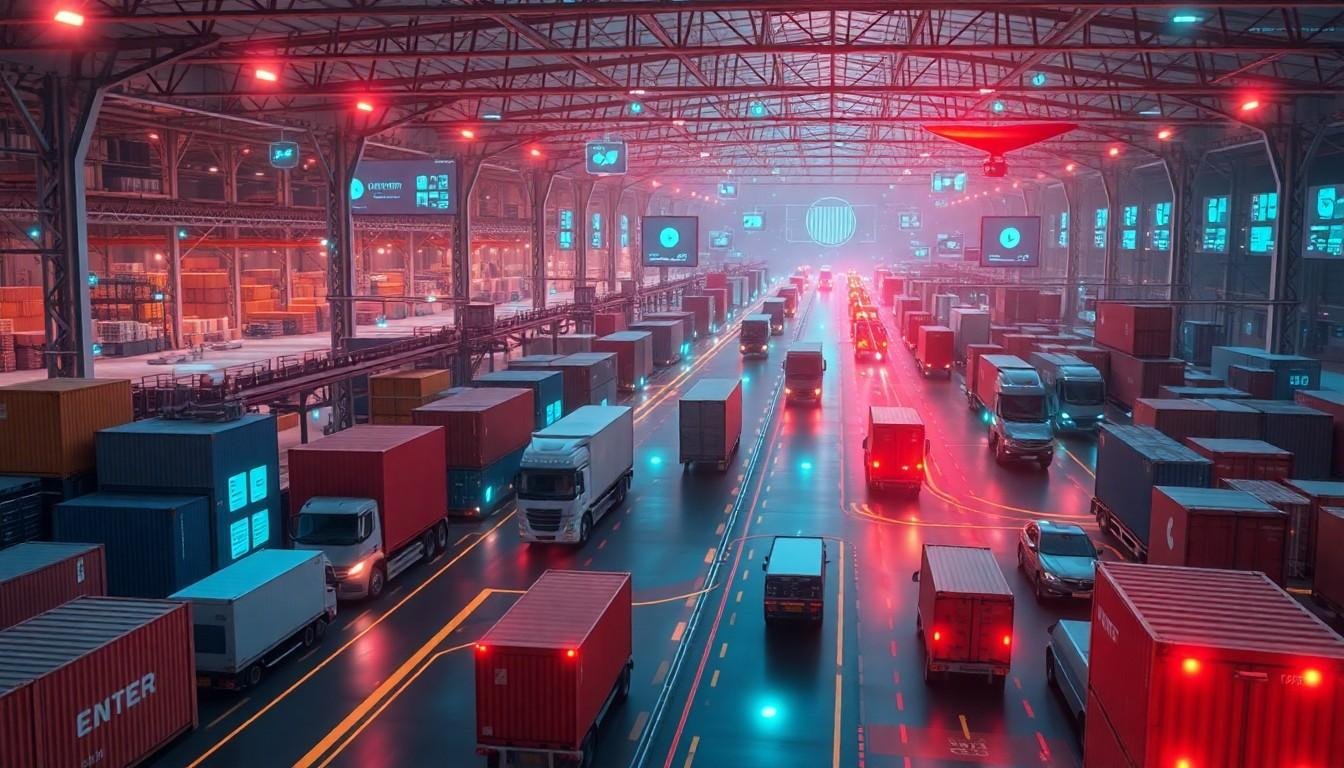
Multi-agent AI is beginning to move from pilot projects into the operational core of supply chains, as companies look beyond dashboards and human approval loops towards systems that can act on their own within defined limits.
The shift matters because conventional planning tools can identify risk and recommend responses, but they still depend on planners to validate each move. Multi-agent setups go a step further: different software agents can watch live signals from transport,...
Continue Reading This Article
Enjoy this article as well as all of our content, including reports, news, tips and more.
By registering or signing into your SRM Today account, you agree to SRM Today's Terms of Use and consent to the processing of your personal information as described in our Privacy Policy.
warehousing and production systems, then carry out actions such as rerouting freight, adjusting stock positions or reallocating dock space inside enterprise platforms.
Lenovo says it has already put that model to work across its global iChain network, which spans 180 markets, more than 30 factories and 100 logistics centres. The company says its Order Fulfilment Agent and Risk Management Agent are linked directly to transaction systems, with fulfilment decisions running three times faster, disruption response four times faster, risk assessment reaching 85 per cent accuracy and delivery accuracy improving by 30 per cent.
Other industrial users are reporting similar gains. Simor Consulting documented a mid-sized automotive parts maker that introduced five specialist agents across 15 countries and 200 suppliers during an 18-month production run. According to that account, on-time delivery rose from 82 per cent to 94 per cent, while the disruption-detection agent spotted threats 48 hours before manual monitoring teams. The same study also found that the communication agent worked well with established suppliers but struggled with unfamiliar vendors until it had learned their response patterns.
The interest is not confined to internal operations. Fujitsu and Rohto Pharmaceutical have tested inter-enterprise logistics routing in a virtual setting, with reported transport cost reductions of as much as 30 per cent. The companies plan to extend that work into a live physical supply chain between January 2026 and March 2027, suggesting that bounded autonomy is starting to move from simulation into real-world execution.
Gartner has also signalled where the market may be heading. In May 2025, the research firm predicted that by 2030, half of cross-functional supply chain management solutions will include intelligent agents capable of autonomously executing decisions across the ecosystem. In May 2026, it said autonomous supply chains will depend on three building blocks: operations, intelligence and workforce, with companies needing to move beyond efficiency-only automation.
The cautious pace is deliberate. As the AI News report notes, direct system writes can magnify mistakes if they are not constrained by strict financial and operational guardrails. In practice, that means routing changes should stay within set cost ceilings, inventory adjustments beyond agreed thresholds should trigger manual sign-off, and supplier-facing agents should remain in draft mode until they prove reliable.
That caution is echoed by industry vendors. NVIDIA’s Multi-Agent Intelligent Warehouse framework is pitched as a way to optimise warehouse operations through real-time monitoring and natural-language interaction, but it still frames the technology as an aid to coordination rather than a licence for unrestricted automation. Databricks, meanwhile, is promoting a unified agentic architecture built on the lakehouse, while Deloitte says agentic AI is best understood as a way to sense conditions, reason across data sources and act in real time without leaving governance behind.
For now, the most advanced deployments still appear to be bounded, selective and heavily supervised. But the direction of travel is clear: supply chains are moving from systems that recommend to systems that increasingly execute.
Source: Noah Wire Services