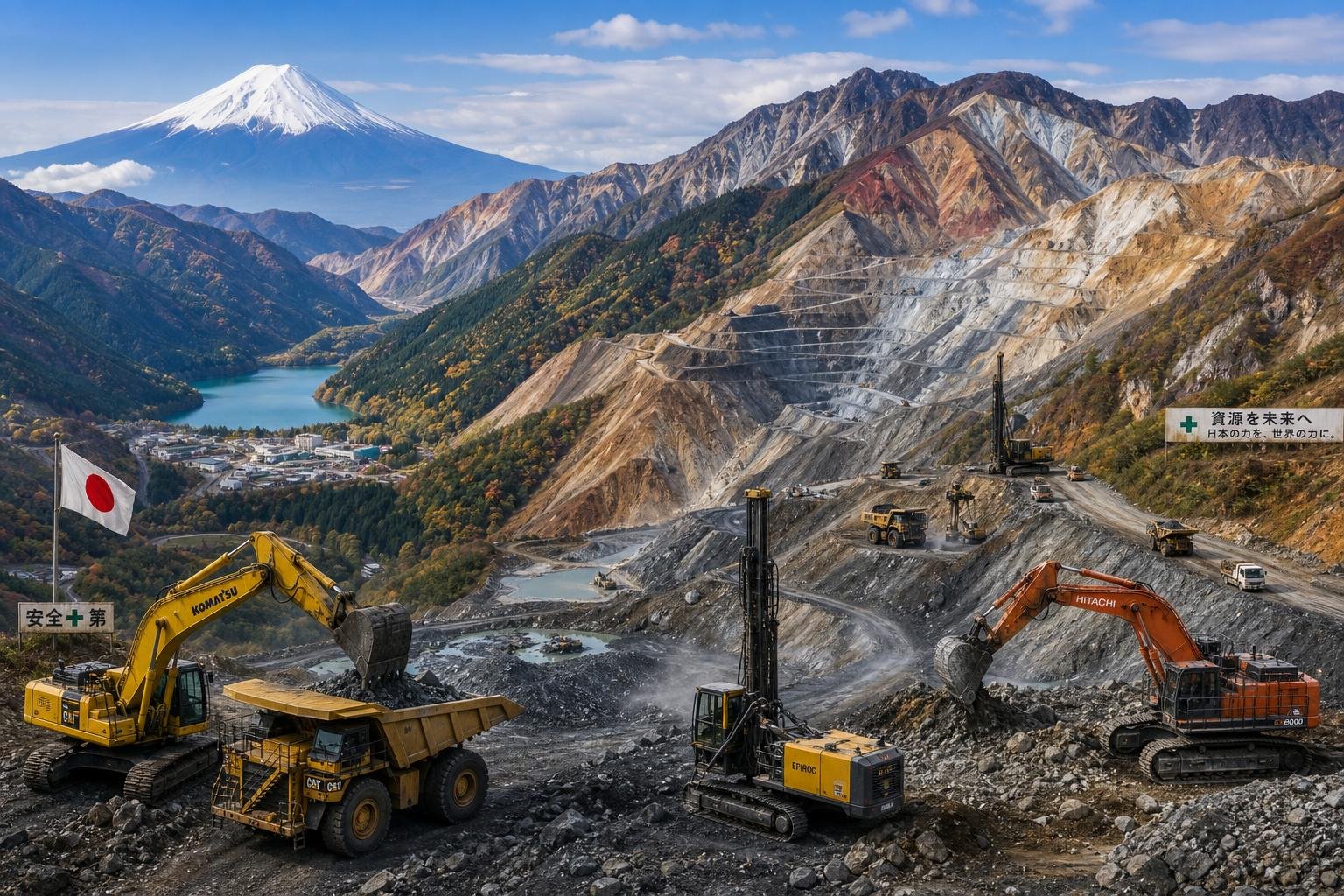
China’s latest tightening of rare earth exports has reopened an old Japanese anxiety: how much reliance on a single supplier is tolerable when the material in question underpins defence systems, electric vehicles, electronics and semiconductors?
For Japan, the answer has become more urgent since Beijing broadened controls in 2025, first in April and again in October, targeting a wider range of medium and heavy rare earths and, in some cases, extending restrictions to foreign-...
Continue Reading This Article
Enjoy this article as well as all of our content, including reports, news, tips and more.
By registering or signing into your SRM Today account, you agree to SRM Today's Terms of Use and consent to the processing of your personal information as described in our Privacy Policy.
made products containing Chinese-origin material or technology. The measures have hit supplies of dysprosium, terbium, yttrium oxide and gallium, among other inputs, and have reinforced China’s dominant position in the processing and magnet supply chain.
The timing has not helped. The latest disruption comes as Tokyo and Beijing remain at odds over Taiwan, reviving memories of the 2010 shock that followed a collision near the Senkaku Islands and exposed how quickly trade could be turned into leverage.
Yet Japan is not in the same position it was 15 years ago. Yasuyuki Todo, a professor at Waseda University and program director at the Research Institute of Economy, Trade and Industry, told Japan Forward that diversification has progressed, but unevenly. Using UN Comtrade data, he found that China’s share of Japan’s imported parts has fallen since around 2011, though it still sits above 25%. By contrast, the United States has cut China’s share of its own parts imports to below 10%.
Some sectors remain especially exposed. China still supplies nearly half of Japan’s auto parts imports, while its share in electrical and electronic products has been broadly stable. In rare earths, the picture looks better at first glance: China’s share, Todo said, has dropped from roughly 80% or 90% to around 40%, with Vietnam gaining ground. But he cautioned that such figures can be misleading, because dependence in specific materials can remain much higher.
That matters because China’s controls now reach deep into the industrial chain. The Japan Times reported in October that Beijing’s export rules were widened to cover materials critical to defence and semiconductor users. A separate legal analysis by Jones Day said the October measures also asserted extraterritorial reach over some foreign-made goods containing Chinese rare earth content, with further application to internationally produced items from December 2025. The European Union has also been affected, with an EU policy briefing saying the restrictions exposed vulnerabilities in digital, green and defence supply chains.
Todo argued that Japan has handled rare earths “reasonably well” so far, with companies broadening procurement and developing magnets and motors that use less of the most sensitive materials. But he said that does not amount to security. If Beijing were to impose tougher export limits, Japan would still face serious disruption.
The deeper warning is that supply-chain shocks are no longer exceptional. Todo said companies once treated security-related disruptions as outliers. That view, he suggested, is no longer credible. Energy shortages, pandemic-era shortages of masks and medical supplies, and wider tensions over oil and naphtha have all shown that vulnerability can appear in many forms, not just in headline sectors such as rare earths and chips.
He rejects full decoupling from China as unrealistic, given the economic cost. The better approach, he said, is de-risking: lowering dangerous concentrations of dependence without pretending trade can be severed cleanly. Reshoring can help in some areas, but overdoing it would damage efficiency. Friendshoring has limits too, he noted, because even the United States cannot be assumed to be a permanent refuge from political risk.
That leaves Japan with a more complicated diplomatic task. Todo said the country must strengthen ties with resource-rich nations in the Global South through trade, investment and development assistance, while also deepening cooperation with partners such as the Quad, South Korea, the OECD and Mercosur. Japan is preparing trade talks with Mercosur partly to diversify supplies of oil and critical minerals and reduce exposure to China in rare earths.
For government, he said, the main role is to supply information rather than micromanage corporate decisions. Smaller firms in particular often lack the expertise to judge foreign political risk, regulatory conditions or supplier reliability. Public agencies should gather that intelligence and pass it on. Companies, in turn, need to use it to build resilient procurement strategies rather than simply retreating behind national borders.
Todo’s target is blunt: China’s share of Japan’s imported parts should fall from about 25% to around 15%, while its share of rare earth imports should be cut to roughly 10% to 20%. That will not be achieved through stockpiles alone. It will require a broader redesign of supply chains, and a political recognition that a materials problem is also a strategy problem.
Source: Noah Wire Services