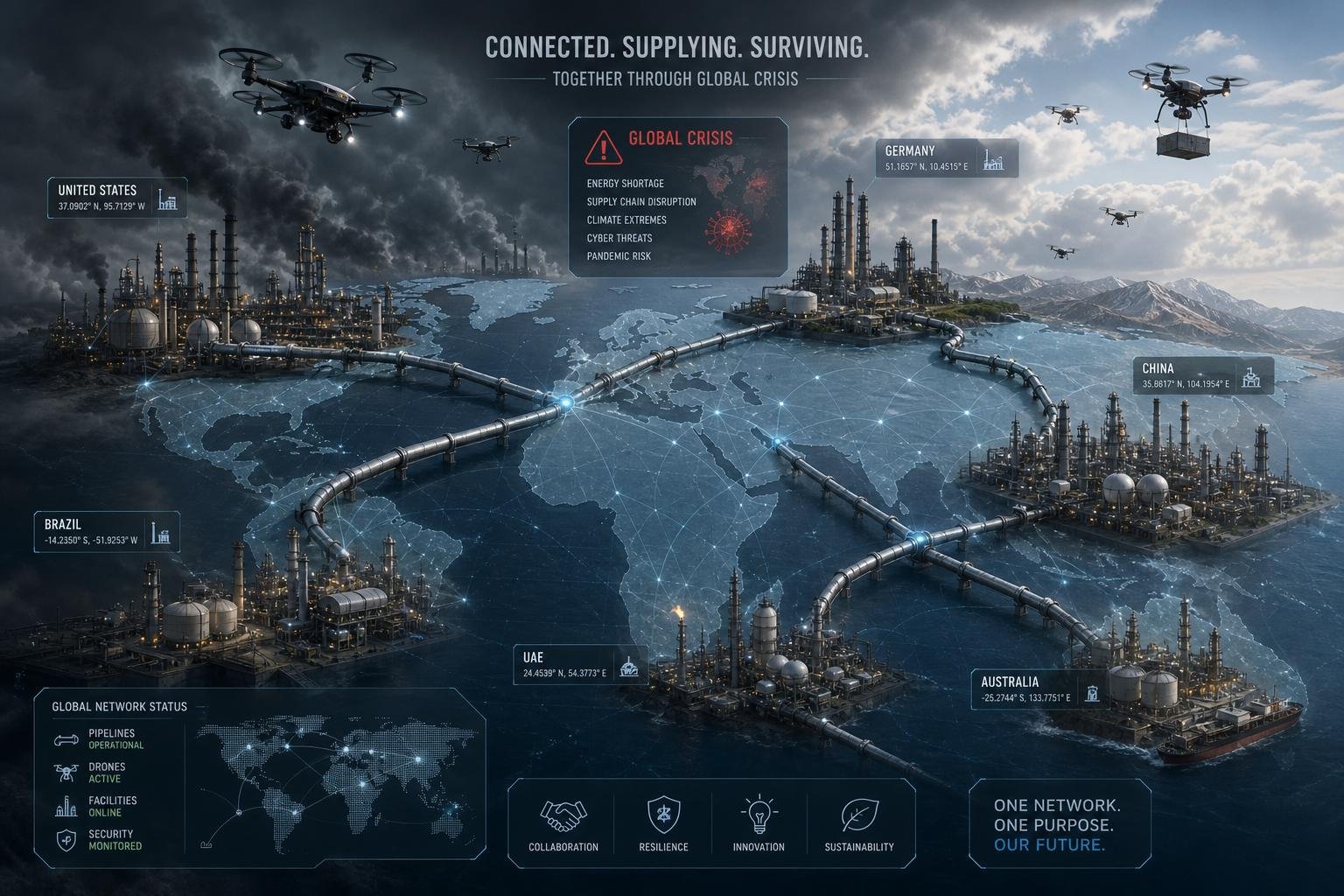
Industrial companies are no longer dealing with disruption as a temporary setback. They are having to operate through a more permanent condition in which inflation, geopolitical tension, energy instability and rapid technological change are all colliding at once.
That was the central message emerging from RS Connect, where Brian Andrew, managing director of RS South Africa, argued that internal efficiency alone is no longer enough to protect performance. The next phase of indus...
Continue Reading This Article
Enjoy this article as well as all of our content, including reports, news, tips and more.
By registering or signing into your SRM Today account, you agree to SRM Today's Terms of Use and consent to the processing of your personal information as described in our Privacy Policy.
trial competitiveness, he suggested, will depend increasingly on external relationships, shared capability and the ability to coordinate across wider value chains.
The case for that view is strengthened by the 2026 RS and CIPS Indirect Procurement Report, which shows how widespread the pressure has become. Sixty-eight per cent of organisations cite inflation and rising costs as their most immediate concern, while half point to supply chain risk and 47 per cent highlight geopolitical uncertainty as medium-term threats. The significance of those figures lies not just in their size, but in how they overlap: cost volatility is now being intensified by structural changes in trade, sourcing and industrial systems.
At RS Connect, global strategist Dr Abdullah Verachia drew a distinction between cyclical shocks and deeper structural change. Short-term pressures such as price movements and demand swings can still be managed through conventional tools such as pricing discipline and operational efficiency. But other forces, including geopolitical fragmentation, climate-related risk, supply chain realignment and digital acceleration, do not simply reverse. They accumulate, and in doing so they reshape how industry works.
That broader reading is echoed in recent analysis from the World Economic Forum and FTI Consulting, both of which describe industrial strategy as being increasingly shaped by a mix of geopolitical, technological and energy-related shifts. In that environment, resilience is becoming less about insulating a business from change and more about building the capability to absorb, adapt and respond quickly.
Procurement is one area where that shift is especially visible. According to the RS and CIPS report, half of organisations are consolidating their supplier base, while 46 per cent are deepening strategic supplier relationships in the hope of improving resilience and efficiency. Procurement, once seen largely as a transactional function, is being recast as a driver of system-wide performance.
That evolution matters because industrial operations are now too interconnected for isolated decision-making to work well. In practice, procurement is becoming a coordination mechanism, one that provides visibility, trust and responsiveness across networks rather than simply negotiating lower costs on individual purchases. The Economist Impact has made a similar point in its global procurement research, describing the function as a source of strategic value rather than a savings exercise.
The same logic is clear in maintenance, repair and operations. The RS and CIPS data show that 66 per cent of organisations can place emergency MRO orders within a single working day, underlining how closely continuity now depends on speed and reliability. In environments where even a brief delay can trigger downtime, safety concerns or financial loss, MRO is no longer a back-office category. It is part of operational resilience.
Technology is another area where ambition is still running ahead of execution. Only around one in 10 organisations currently use artificial intelligence in procurement, according to the report, while 38 per cent do not know their internal cost to process a purchase order. That lack of visibility makes it hard to identify inefficiencies or build a credible case for transformation.
Several industry outlooks make the same point: digital tools are no longer optional, but they only create value when they are embedded in day-to-day workflows. Pilots and proofs of concept are not enough. The real test is whether technology improves procurement, operations and supplier collaboration at scale.
Sustainability is also being pulled into the same operational frame. The RS and CIPS research found that 59 per cent of organisations have introduced energy management initiatives, 60 per cent are using renewable energy sources and 74 per cent prioritise recycling. These measures are no longer being treated purely as environmental commitments. In many industrial settings, especially in Southern Africa, they are tied directly to energy security, continuity and cost control.
That convergence is changing the nature of leadership as well. As Dr Verachia noted, organisations now operate within ecosystems rather than fixed boundaries, meaning decisions in one area can quickly affect suppliers, partners and internal functions elsewhere. Leaders therefore need to interpret immediate disruption and long-term structural change at the same time, while coordinating across organisational lines rather than simply managing within them.
The practical conclusion is straightforward. Collaboration is moving from a useful capability to a form of infrastructure. In a system marked by persistent disruption, industrial performance will depend less on how effectively companies operate in isolation and more on how well they connect, coordinate and adapt with the rest of their ecosystem.
For industrial organisations looking ahead, that may be the defining shift of the next decade.
Source: Noah Wire Services