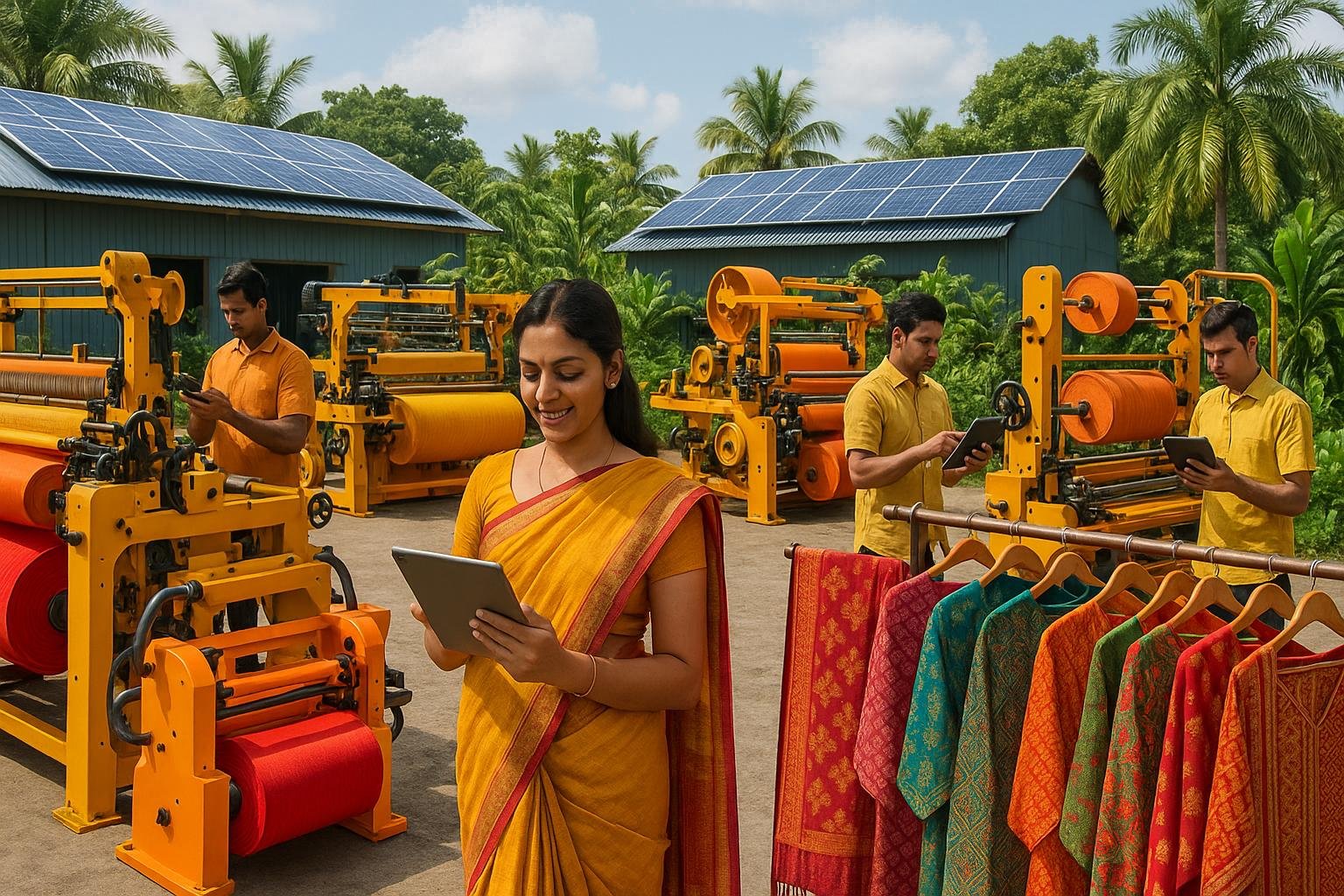
The Indian textile sector is shifting from traditional labour-driven methods to embracing automation, IoT, AI and sustainability initiatives, transforming its competitive landscape amid operational and technological upgrades.

The Indian textile sector is moving beyond its historic strengths in labour-driven scale and into a phase shaped by digital tools, cluster-level interventions and sustainability-linked practices. Once primarily competitive on cost, the industry is ...
Continue Reading This Article
Enjoy this article as well as all of our content, including reports, news, tips and more.
By registering or signing into your SRM Today account, you agree to SRM Today's Terms of Use and consent to the processing of your personal information as described in our Privacy Policy.
Automation and sensor-enabled equipment have begun to reshape tasks across spinning, weaving, processing and garmenting. Factories are adopting programmable controls, robotic material handling and precision cutting; where full mechanisation is impractical, targeted automation for repetitive or quality-critical operations is delivering clear gains in throughput and defect reduction. At the same time, the Internet of Things is providing live visibility of machine health, energy use and production rates, with spinning mills and dyeing units among the early adopters because small performance improvements here materially affect margins.
Artificial intelligence and advanced analytics are being applied across inspection, maintenance and planning. Computer-vision systems now shoulder much of the fabric-quality checking previously done by hand, while predictive-maintenance algorithms pre-empt breakdowns and AI-driven scheduling tools tighten line balance and order fulfilment. According to the India Brand Equity Foundation, the Tiruppur knitwear cluster reports roughly a 10% rise in production efficiency after integrating AI across its value chain, and Tiruppur’s knit exports exceeded Rs. 40,000 crore (US$4.61 billion) in fiscal 2024–25. These shifts reflect a movement from craft and experience-led operations toward decision-making guided by data.
Cloud-based manufacturing execution systems and ERP platforms are lowering entry barriers for smaller firms by removing the need for heavy up-front IT investment. Mobile dashboards and SaaS supply‑chain tools are helping micro, small and medium enterprises link design, procurement and logistics more tightly, and services such as Reverse Resource have emerged to help MSMEs digitise workflows while meeting sustainability requirements sought by global buyers.
Sustainability is now tightly coupled with digitisation. Digital monitoring of water, energy and chemical inputs, and the adoption of modern effluent treatment and process-control technologies, reduce environmental footprints while simplifying regulatory compliance. International programmes are reinforcing this focus: the UNEP-run InTex India initiative, funded by Denmark and working with the Ministry of Textiles, is supporting circularity and eco-innovation in brands and in two cluster geographies through to December 2027, aiming to accelerate life-cycle approaches across production hubs.
The cluster model itself is evolving into a platform for technology diffusion. Public–private programmes are combining digital training, e-commerce and design curricula to uplift traditional handloom communities. Projects such as the Pochampally Digital Cluster Programme, backed by Microsoft, and DigiKargha under the Digital Cluster Development Programme, target artisan empowerment via digital design tools, market access and entrepreneurship support. Tata Trusts’ Project ReWeave has introduced an e-commerce platform and digital learning for weaving clusters in Telangana, and Microsoft described its role in the partnership with Tata Trusts by saying, “As a part of our philanthropies’ programs in India, we are focused on reviving some of the forgotten and fading handloom forms in India’s textile heritage. Our partnership with Tata Trust will help reach down to the grass-root level of the weaver clusters and train them, hence building a digitally inclusive society. We aim to use our Project Sangam to empower the weavers across India so that they can adopt and deploy digital tools to improve their craft,” Anil Bhansali, CVP Cloud & Enterprise and Managing Director, Microsoft India, said. Tata Trusts added, “We are delighted to partner with Microsoft to digitally educate and further empower these weavers. Often, these communities are marginalized and do not receive much exposure to modern technical amenities or training to develop business skills. Through this initiative, we want to empower artisans and bring them up to par making them competitive in the industry,” R Pavithra Kumar, Chief Program Director, Tata Trusts, said.
Despite encouraging results, obstacles remain significant. High capital outlays for modern plant and sensors restrict uptake among smaller units; many factories operate mixed vintages of machinery that complicate systems integration. Skills gaps are widening as operators must now interpret machine data and maintain connected equipment, creating urgent demand for reskilling. Cybersecurity and data governance have also become priorities as production and commercial information flows across networks and cloud services.
Policy and finance responses will influence how quickly the sector modernises. Modular, pay-as-you-go solutions and targeted government programmes for infrastructure, cluster digitalisation and workforce training can ease the transition for MSMEs. Industry groups and buyers are increasingly conditioning business on traceability and environmental performance, making technology adoption not merely a productivity play but a route to market access.
Looking further ahead, the trajectory points to deeper system-level integration: digital twins for process simulation, broader AI-driven demand forecasting and tighter linkages between manufacturing systems and global logistics networks. If these capabilities become ubiquitous, smart manufacturing may cease to be a differentiator and instead become an industry baseline. The firms that embed continuous digital improvement, align investments with sustainability goals and build human capital to manage new systems will be best placed to translate India’s textile heritage into durable competitive advantage.
Source: Noah Wire Services
Subscribe to Industry Updates