


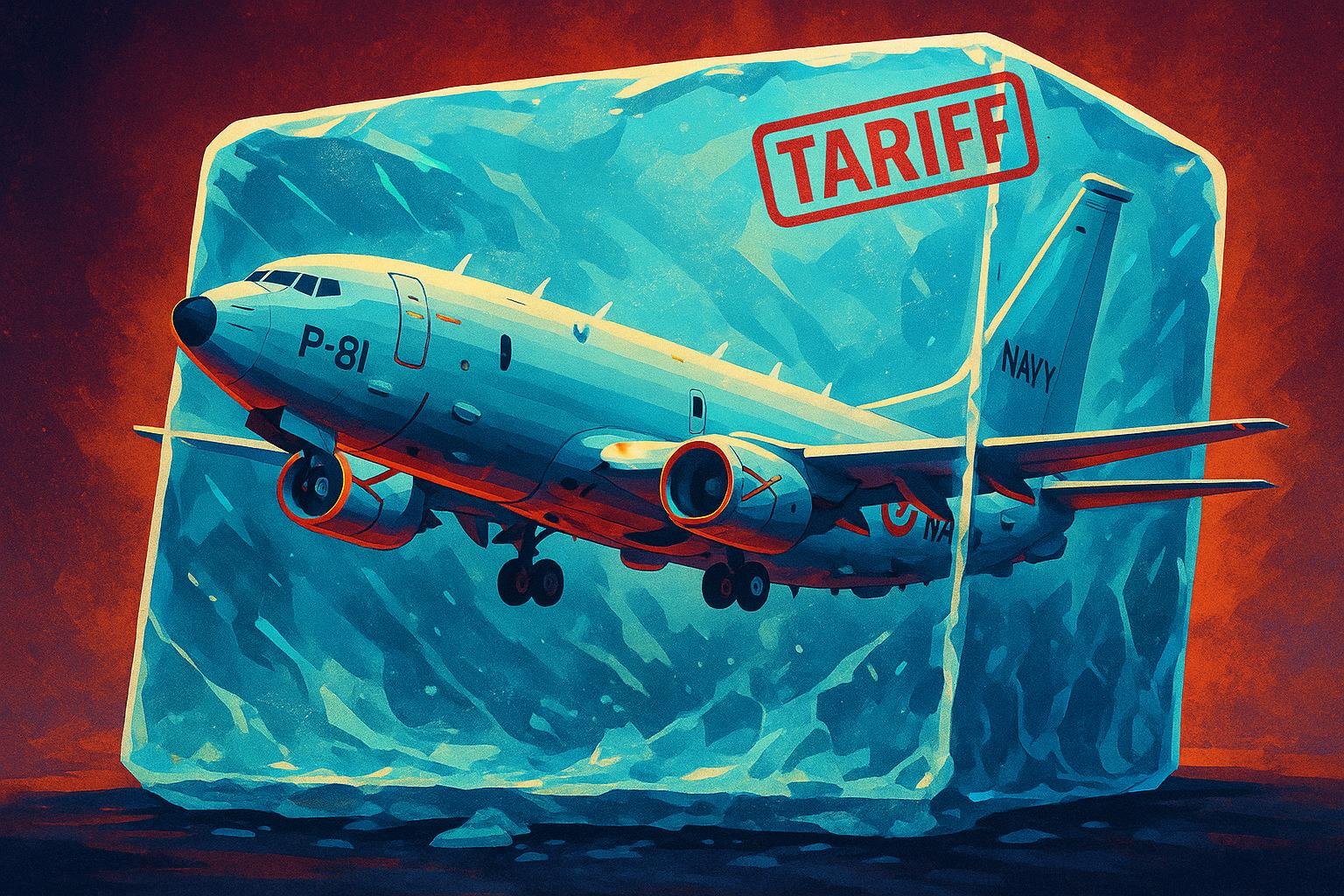
New Delhi has paused negotiations for a multi‑billion-dollar purchase of Boeing P-8I maritime patrol aircraft after supplier recalculations raised the estimated cost from about $2.42bn to $3.6bn. Officials say newly imposed US duties on components and wider supply‑chain pressures have prompted a strategic review of the package — and affected other US defence talks — as India seeks clarity, exemptions or alternative sourcing.

India has put negotiations for a multi‑billion‑dollar package of Boeing P‑8I maritime patrol aircraft on ice after a sharp rise in costs tied to newly imposed US tariffs and wider supply‑chain pressures, according to Indian defence sources and multiple international reports.
The proposed sale — first notified to the US Congress in April 2021 and approved by the State Department as a possible Foreign Military Sale at an estimated cost of $2.42 billion for six aircraft and associated systems — has been recalculated by the supplier to around $3.6 billion, defence sources told media. They said the escalation reflects both the burden of newly announced US duties and knock‑on effects across the P‑8I supply chain. Reuters reported the pause and described it as temporary while New Delhi seeks clarity on the tariff regime and its implications.
The tariff measures announced by the US administration have been central to the dispute. The Washington Post reported that President Donald Trump moved in August 2025 to raise duties on a broad swathe of Indian imports, initially imposing a 25 per cent levy and signalling a further increase to 50 per cent on some lines. Those duties, applied to parts and components that form part of the P‑8I’s multinational bill of materials, have been cited by Boeing and Indian suppliers as increasing production costs and complicating final assembly economics.
The P‑8I programme has a well‑established cross‑border industrial footprint. The Defence Security Cooperation Agency’s April 2021 notice set out typical inclusions for such a sale — engines, sensor suites, radios, missile‑warning sensors, navigation units, spares, training and contractor support — and explained the sale would bolster India’s maritime surveillance and anti‑submarine capabilities. Boeing’s India communications have emphasised the role of Indian suppliers and micro, small and medium enterprises in manufacturing mission‑critical components such as radar subsystems, datalinks, wiring harnesses and other systems that are shipped to the US for final integration. Earlier reporting by the Economic Times also documented contributions from Indian public sector firms such as Bharat Electronics Limited supplying items that are fitted during Boeing’s final assembly process.
Under the new tariff regime, those Indian‑origin components can attract duties when exported to the US and then re‑imported as part of a finished or partially finished aircraft — a development supply‑chain managers say has pushed up Boeing’s bill and, in turn, the price quoted to New Delhi. Boeing India’s public statements stress investments in local sustainment, maintenance and training, but media reporting and defence sources say that the company has passed through at least some of the tariff‑related cost increases to the Indian customer.
The hold affects more than the P‑8I package. Reuters reported that New Delhi also put on pause talks for armoured Stryker vehicles and Javelin anti‑tank missiles — elements of a broader review of US defence procurement prompted by the tariff decision. The same report said India cancelled a planned ministerial visit to Washington amid the standoff. However, New Delhi subsequently pushed back on some media accounts: Reuters noted the Indian government later described reports of a blanket suspension as “false and fabricated,” underscoring a degree of official sensitivity and signalling that the public posture remains fluid.
Indian defence officials cited by national outlets told Logistics Insider and other publications that the Ministry of Defence has opted for a detailed strategic review of the proposals, weighing rising acquisition costs against shifting geopolitical priorities and the desire to preserve strategic autonomy. That calculus is likely to factor in operational needs: analysts and industry reporting have pointed out that the Indian Navy is seeking to expand its P‑8I fleet to strengthen maritime domain awareness and anti‑submarine warfare capacity in an increasingly contested Indo‑Pacific maritime environment, and that delays or cancellations could create capability shortfalls.
The episode exposes the tensions that can arise when globalised defence supply chains intersect with abrupt trade policy changes. Boeing’s local supplier network and investments in Indian maintenance, repair and overhaul capacity are intended to shorten sustainment loops and lower lifecycle costs; yet those same cross‑border flows mean tariffs levied on inputs can ricochet back into programme affordability. Defence ministry sources told media the pause is aimed at understanding the precise cost drivers and exploring options, which could include price renegotiation, seeking exemptions, shifting sources, or accelerating indigenisation for some elements.
What happens next remains uncertain. Officials have characterised the decision publicly as a temporary hold while clarifications are sought. Washington and New Delhi both face incentives to resolve the matter: for India, to maintain its planned force modernisation; for the US and Boeing, to avoid a politically sensitive rupture with a major partner and customer. At the same time, the dispute has highlighted how commercial and trade policy moves can quickly assume strategic significance in an era where high‑end defence procurement relies on tightly integrated international industrial ecosystems.
For now, the P‑8I purchase sits in limbo. Indian defence planners and industry will be watching forthcoming diplomatic and trade exchanges closely, while the Indian Navy must weigh near‑term operational requirements against the longer‑term benefits of expanding its P‑8I fleet. According to the original DSCA notification and company releases, the programme’s systems and sustainment packages would have supported maritime surveillance and anti‑submarine warfare for decades ahead — the core capability New Delhi has said it still seeks to secure, even as the route to doing so becomes more contested.
Source: Noah Wire Services

