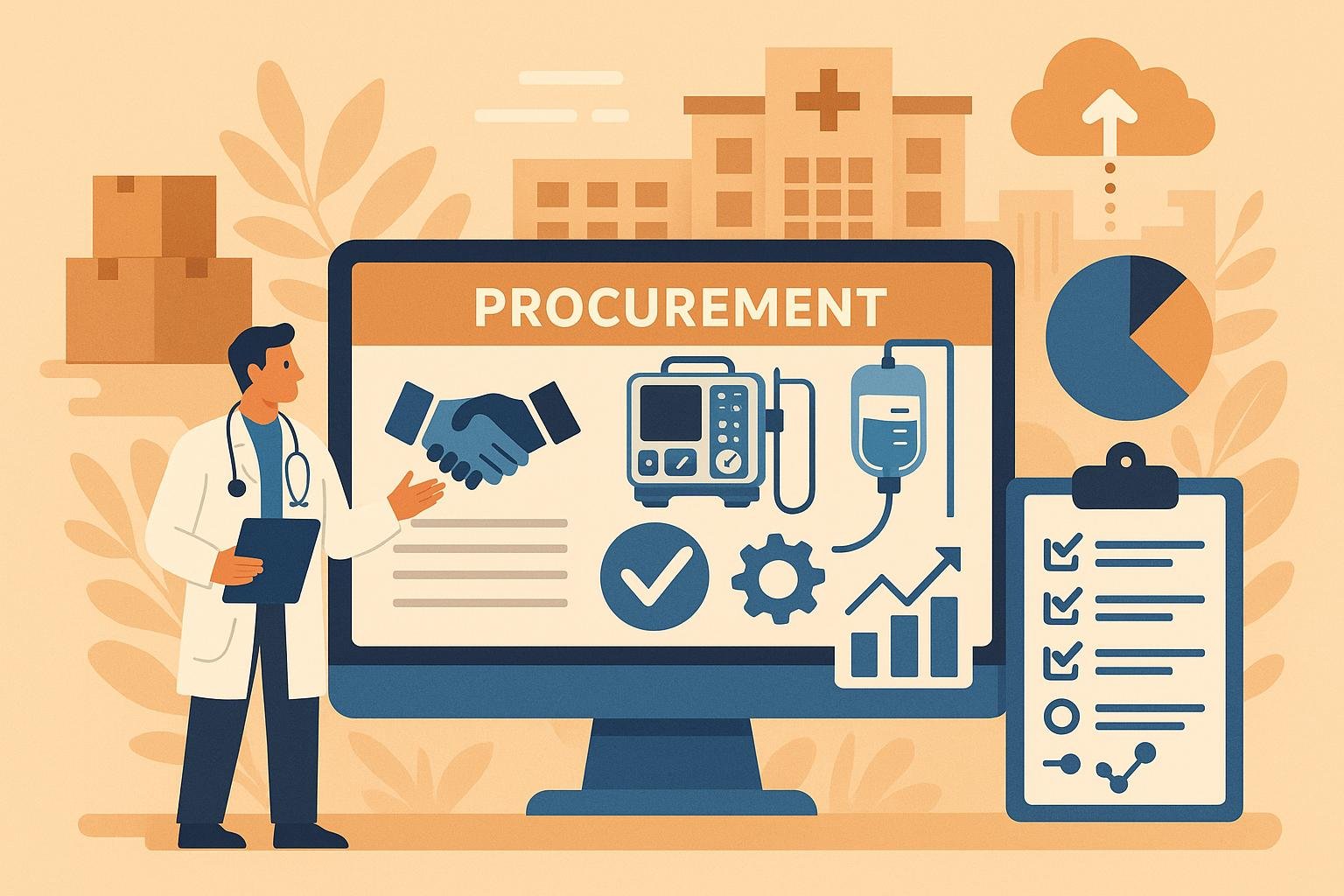
Hospitals are transforming their approach to medical device procurement by embracing strategic vendor management, standardisation, data analytics, and technology to improve clinical outcomes and financial sustainability in a complex marketplace.

Hospitals today treat the acquisition of medical equipment as a strategic endeavour that shapes clinical performance and institutional finances alike. Procurement teams are moving beyond one-off purchases to orchestrated program...
Continue Reading This Article
Enjoy this article as well as all of our content, including reports, news, tips and more.
By registering or signing into your SRM Today account, you agree to SRM Today's Terms of Use and consent to the processing of your personal information as described in our Privacy Policy.
The move towards strategic vendor management is central. According to GE Healthcare, adopting a vendor-agnostic approach and conducting rigorous, data-led vendor evaluations encourage competitive pricing and spur supplier innovation. Procurement leaders are prioritising suppliers that combine dependable delivery records with strong clinical-support services and demonstrable product development roadmaps. Industry advisers say routine performance audits and structured feedback loops help transform suppliers into longer-term partners,allowing hospitals to pre-empt supply problems and negotiate service-level guarantees. DataCalculus highlights that predictive analytics can further sharpen supplier oversight by forecasting likely performance issues and informing contingency plans.
Standardising device fleets remains one of the most effective levers for cost containment and operational simplicity. Multiple sources note that reducing product variation across departments cuts training burdens, simplifies maintenance and increases purchasing leverage. Needle.tube emphasises that collaborative purchasing with peer institutions and Group Purchasing Organisations increases scale and yields deeper discounts,while Number Analytics points out that multi-year contracts with volume commitments can produce meaningful savings on recurring categories. Yet experts caution against rigid standardisation; a value-based lens is required to ensure clinical outcomes are not sacrificed for unit-price reductions.
That value-based perspective is prompting a shift from lowest-price buying to total cost of ownership evaluation. Procurement teams increasingly account for acquisition price, consumables, maintenance, training and disposal,as well as clinical impact on length of stay and complication rates. Industry research indicates devices that raise upfront costs but shorten hospital stays or reduce complication rates may deliver superior financial and patient outcomes over their lifecycle. Simbo.ai and others recommend embedding clinical efficacy data into procurement scorecards so decisions reflect both cost and care quality.
Supply-chain resilience has become an imperative after recent global disruptions. Procurement functions are balancing just-in-time efficiencies with just-in-case preparedness for critical items. Hospitals are diversifying supplier portfolios to avoid single-source vulnerabilities and investing in advanced inventory systems that provide near-real-time visibility of stock and lead times. Several practitioners report implementing real-time location systems to track mobile assets such as ventilators and infusion pumps, freeing capital otherwise tied up as safety stock and ensuring equipment is available at the point of care.
Technology is remaking the procurement workflow itself. Cloud-based platforms replace legacy ERPs to automate purchase orders, approvals and invoice reconciliation, freeing teams to focus on strategic sourcing. There is growing interest in blockchain to strengthen traceability and verify device provenance,while predictive modelling and machine learning are being used to forecast utilisation,optimise reorder points and reduce waste. Simbo.ai and GE Healthcare both highlight the value of combining historical consumption data with predictive analytics to avoid both overstocking and stockouts.
Compliance and risk management remain non-negotiable. Procurement must operate within a complex regulatory environment that includes conflict-of-interest rules, anti-kickback statutes and data-protection obligations. Robust documentation, transparent vendor interactions and tight coordination with clinical engineering and risk departments are essential to ensure purchased devices meet safety standards and that lifecycle maintenance is planned and funded.
Group Purchasing Organisations continue to play a prominent role,but their function is evolving. Beyond negotiating prices,GPOs increasingly supply analytics and benchmarking tools that help hospitals identify savings opportunities and monitor clinical performance against peers. Simbo.ai and Needle.tube note that integrating GPO data into a hospital’s procurement platform can provide a broader market view and help spot anomalies in pricing or utilisation.
To translate strategy into savings and improved care, hospitals are adopting a mix of tactics: standardisation where clinically appropriate; vendor diversification and audits to secure supply; predictive analytics and RTLS to sharpen inventory control; and TCO-based, value-focused procurement to align spending with outcomes. As Number Analytics reports, combining evidence-based value analysis with volume-based contracting has yielded substantial, recurrent savings in multiple health systems.
The procurement professional’s remit has therefore expanded from transactional buyer to strategic steward of clinical tools and institutional capital. By blending rigorous vendor oversight, adoption of enabling technologies and a disciplined focus on total value rather than purchase price alone,hospitals can better safeguard both patient care and financial sustainability in an increasingly complex medical-device marketplace.
Source: Noah Wire Services
Subscribe to Industry Updates