For companies developing Class II and Class III medical devices, the most expensive mistakes often arise from a familiar timing problem: suppliers are brought in after the design has already hardened. By that point, the engineering team is usually working from idealised assumptions, while the people who will actually make the component can reveal far less forgiving realities about tolerance, material variation and process capability.
That mismatch tends to surface late, when ve...
Continue Reading This Article
Enjoy this article as well as all of our content, including reports, news, tips and more.
By registering or signing into your SRM Today account, you agree to SRM Today's Terms of Use and consent to the processing of your personal information as described in our Privacy Policy.
rification is underway and regulatory expectations are already high. A dimension that shifts, a resin that behaves differently from the brochure data, or a forming process that cannot consistently achieve the intended wall thickness can all force a rethink. In practical terms, that may mean additional testing, fresh validation work, updated risk documents and weeks added to the schedule.
The underlying problem is not new, and it is rarely a mystery to the supplier. More often, it is simply that nobody asked early enough for the information that could have shaped the design from the outset.
On complex products such as catheters, ablation devices and other high-precision disposables, late changes are especially painful. A seemingly small adjustment can ripple across completed verification work and reopen questions about biocompatibility, process validation or device performance. The result is a programme that is still compliant, but only after compromises that could have been avoided.
In that sense, the cost is not just time. When design teams discover manufacturing constraints too late, they tend to respond under pressure: tolerances are broadened, inspection is tightened and the final device may drift away from the original intent. The product may reach market, but not in the form the team had envisioned.
The better approach is straightforward, even if it is not yet universal: involve the right suppliers during concept and feasibility, not after design freeze. That means identifying the vendors whose processes carry the most risk, such as extrusion, moulding, machining or sterilisation partners, and bringing them into the development conversation while the design is still fluid.
According to the broader guidance on early supplier involvement, the point is not to invite every vendor into every meeting. It is to focus on the suppliers that can materially affect design outcomes. Their value lies in data that brochures do not capture: actual process capability, real tolerance limits, feature-specific performance and the failure modes they have seen before.
That information is often easier to obtain than teams expect, particularly when there is an early agreement about how it will be used. The most useful exchange may be one line of pushback from a supplier: the tolerance in the concept design cannot be held reliably, but a different geometry or feature location would work. That is a modest conversation during feasibility and a very expensive one after verification.
A supplier should not be handed design authority, but it should be given a genuine channel to challenge assumptions. The design team still owns the requirements. What changes is the order in which information arrives.
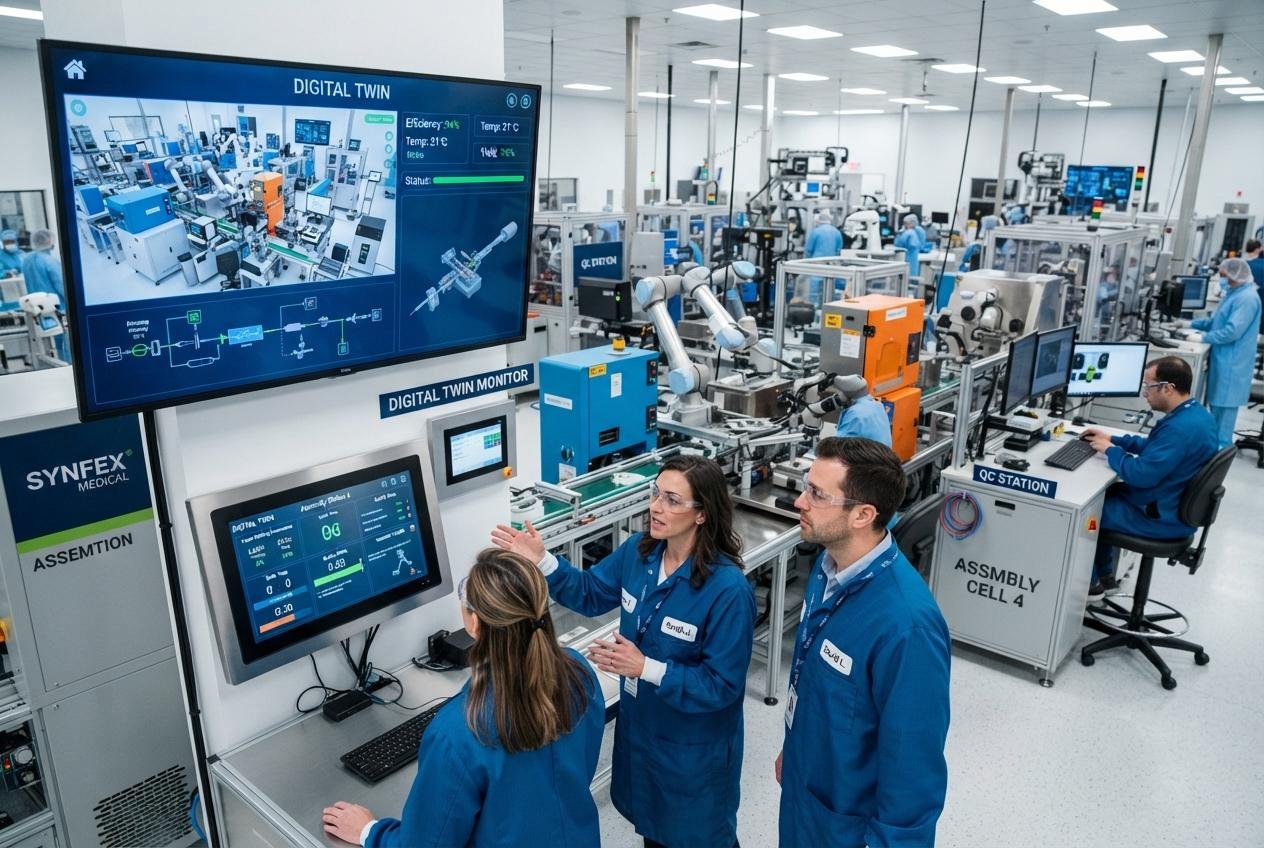
This is where digital twin methods can add real value. If the model is built around nominal textbook data, it is only as useful as the assumptions behind it. But if the engineering team feeds it with supplier-specific material properties, demonstrated capability data and actual process distributions, the simulation becomes a much sharper decision tool.
That shift can be decisive for medical devices. A shaft geometry or moulded feature that looks acceptable at nominal values may fail when tested against the true edges of a supplier’s process window. Discovering that on a screen costs little. Discovering it in a prototype build costs more. Discovering it during verification is worst of all.
Used well, the digital twin becomes a shared language between the design team and the supplier. Instead of arguing over tolerances in the abstract, both sides can see how changes affect performance and manufacturability. The conversation moves from defending positions to solving the same problem.
There is, however, an important caution: a model is only as good as the data that feeds it. If the supplier inputs are unverified, the digital twin merely helps teams reach the wrong answer faster. Early qualification work therefore becomes part of the method, not an optional extra.
That discipline also has regulatory value. Under ISO 13485 and the FDA’s quality system expectations, design control and purchasing control are not new burdens; they are existing obligations. The advantage of early supplier involvement is that it generates stronger evidence sooner, while the product is still evolving.
Requirements tied to demonstrated manufacturing capability are easier to defend than assumptions copied from a datasheet. Simulation outputs become part of the design record. Supplier qualification starts earlier and runs deeper. Design transfer is smoother because manufacturing reality has already been built into the product concept.
The current regulatory climate places even greater weight on this kind of connected evidence. Risk-based thinking now runs through the full development record, not just the final submission package. A programme that links requirements, supplier data and simulation results is better placed to show why decisions were made and how risks were managed.
For teams wanting to begin, the first step is not a wholesale redesign of the development process. It is a targeted change in habit. Choose the two or three suppliers most likely to affect design risk. Put data-sharing arrangements in place early. Ask for real process capability and material data rather than nominal values. Then feed that information into the team’s existing modelling tools before the first prototype is built.
The final step is to measure what changes. Track supplier-driven design revisions after freeze, the number of prototype cycles and the time between design freeze and transfer to manufacturing. Those figures often already exist, and they are the clearest way to show whether early supplier involvement is actually shortening development.
The recurring pattern in medical device NPI persists because no one is explicitly responsible for breaking it. Design teams assume procurement will manage supplier timing. Procurement assumes engineering will handle the technical relationship. In reality, the fix is organisational as much as it is technical: bring the people who will make the device into the room while it is still being imagined.
Source: Noah Wire Services