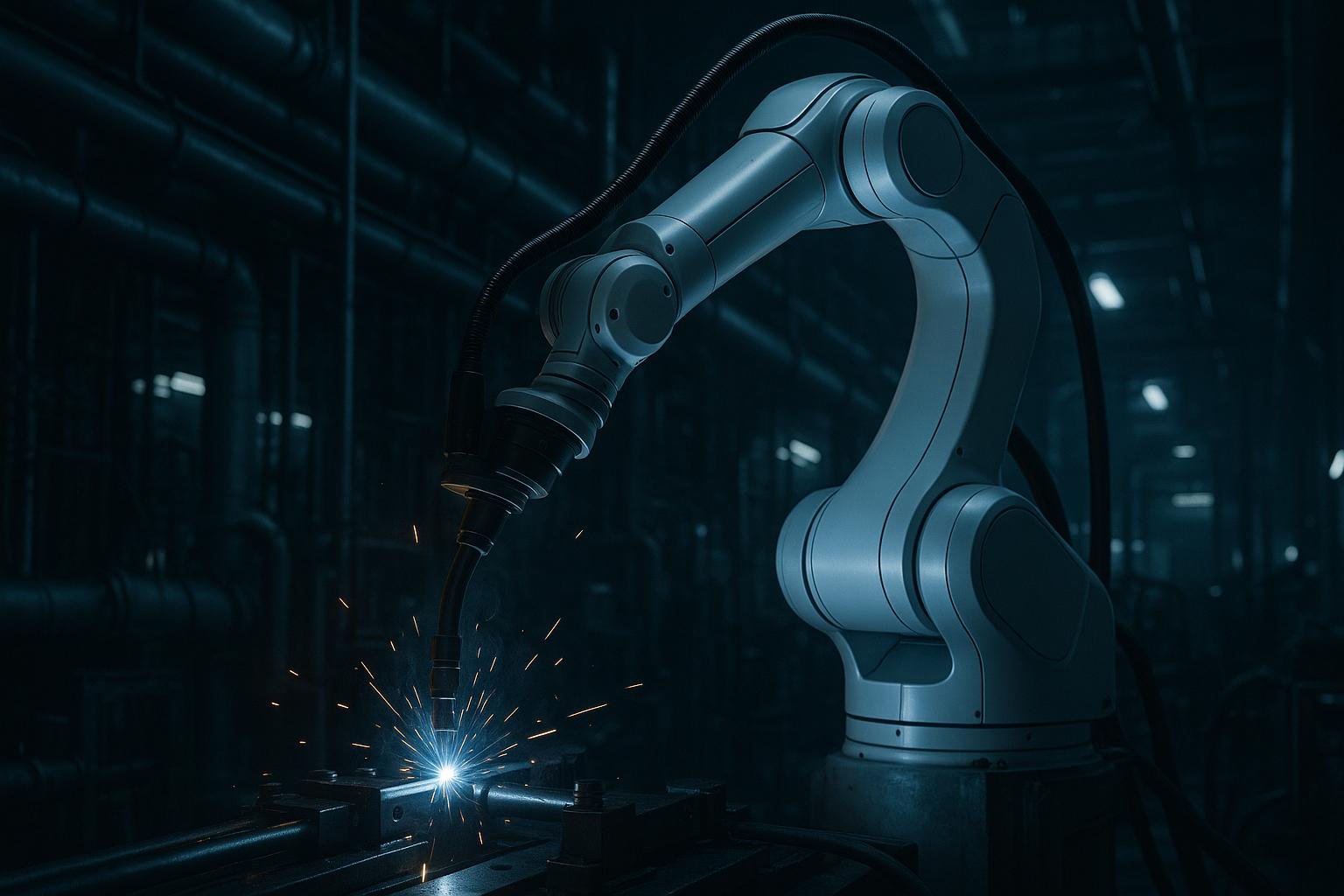
China continues to dominate global industrial robotics with a rapid increase in deployment driven by government-backed investment, yet the push for automation faces challenges from smaller firms favouring gradual adoption and hybrid workflows.

In a light-filled workshop in eastern China, a robotic arm nudged a partially assembled autonomous vehicle as technicians calibrated its cameras , a commonplace scene in a country racing to automate large swathes of manufacturing ...
Continue Reading This Article
Enjoy this article as well as all of our content, including reports, news, tips and more.
By registering or signing into your SRM Today account, you agree to SRM Today's Terms of Use and consent to the processing of your personal information as described in our Privacy Policy.
According to the original report, China is already the world’s largest market for industrial robots, and Beijing is directing billions of dollars into robotics and artificial intelligence to deepen its presence in the sector. At Neolix, a maker of small van-like driverless delivery vehicles, manager Liu Jingyao told AFP that humans remain “a crucial part of even technologically advanced manufacturing.” “Many decisions require human judgement,” Liu said. “These decisions involve certain skill-based elements that still need to be handled by people.” In Neolix’s testing area, newly built vehicles negotiated simulated puddles and bridges, while workers assembled and tested the machines’ “brains”.
Industry data shows the shift is rapid and broad. The International Federation of Robotics reported more than 2 million industrial robots were operating in China by September 2025, with annual installations reaching roughly 295,000 units in 2024 , more than half of global demand that year. Domestic suppliers have grown their share of the market markedly, reflecting an intense drive to indigenise robotic capabilities across sectors from electronics and automotive to food processing and textiles.
That expansion is being underpinned by state-backed capital and policy initiatives. Government initiatives and fresh venture funds established in 2025 aim to mobilise large sums , the March 2025 fund, for example, seeks to attract nearly RMB 1 trillion over two decades to support robotics, AI and smart manufacturing , signalling a sustained, top-down push to accelerate adoption and domestic innovation.
Yet the transformation is uneven. The original reporting described a “digital divide” between larger, well-funded enterprises and the vast network of smaller, often family-run workshops that underpin China’s manufacturing ecosystem. At Far East Precision Printing Company, just outside Shanghai, workers once tracked orders with pen and paper; “Things were, to put it bluntly, a complete mess,” owner Zhu Yefeng told AFP. The company has implemented QR-code tracking and production software as a first step, and is attempting to build an in-house robotic quality tester, but Zhu conceded “as a small company, we can’t afford certain expenses.”
Technology executives and academics argue many factories will remain hybrid rather than fully automated. Zhou Yuxiang, CEO of Black Lake Technologies , the start-up that supplied the software to Zhu’s factory , told AFP he thought factories would “always be hybrid.” “If you ask every owner of a factory, is a dark factory the goal? No, that’s just a superficial description,” Zhou said. “The goal for factories is to optimise production, deliver things that their end customers want, and also make money.”
That pragmatism sits alongside more ambitious experiments. Tech firms operate so-called “dark factories” and ventures are training AI-powered humanoid robots for tasks ranging from assembly to domestic chores, supported by heavy subsidies and investment. Reuters reporting shows startups and government-backed sites are accumulating task-based training data for humanoid platforms, and analysts project substantial long-term market growth if the technology scales.
The widening reach of advanced AI hardware is also altering the terrain. Reporting in December 2025 indicated elite Chinese universities, military-linked institutions and major data-centre projects have sought access to the most powerful AI accelerators, including Nvidia H200 chips, sometimes via indirect channels, to train larger models and support automation research. Those moves underscore the competition for cutting-edge compute behind next-generation robotics development.
Policy and social pressures are part of the calculus. Jacob Gunter of the Mercator Institute for China Studies told AFP that while companies will favour lower headcounts where feasible, “the government will not like that and will be under a lot of pressure to navigate this.” Beijing faces the twin aims of maintaining employment and advancing productivity as it confronts demographic headwinds and slowing economic growth. Jiaotong University mechanical engineering expert Ni Jun observed that China’s industrial AI focus makes full automation technically feasible in many sectors, but he warned that implementation must balance “technical feasibility, social responsibility, and business necessity,” speaking to AFP.
For many small and medium-sized manufacturers, the immediate challenge is affordability and the organisational change required to adopt automation incrementally. The original report highlights managers who have embraced digital tracking and robotics in limited areas to boost efficiency and win larger contracts, rather than pursue overnight replacement of labour. That incremental path is echoed in market analysis showing sustained growth: forecasts project China’s industrial robotics market will expand steadily through the next decade, driven by electronics, automotive and logistics demand.
China’s automation drive is thus both transformational and fragmented: a national strategy producing state-backed scale, world-beating installation rates and ambitious R&D, but one that will leave a patchwork of hybrid factories, startups and small workshops navigating transition pressures, social trade-offs and the practical limits of capital and skills. As firms seek productivity gains, policymakers will be compelled to reconcile industrial modernisation with employment and social stability , a balancing act that will shape the country’s manufacturing future.
Source: Noah Wire Services
Subscribe to Industry Updates