


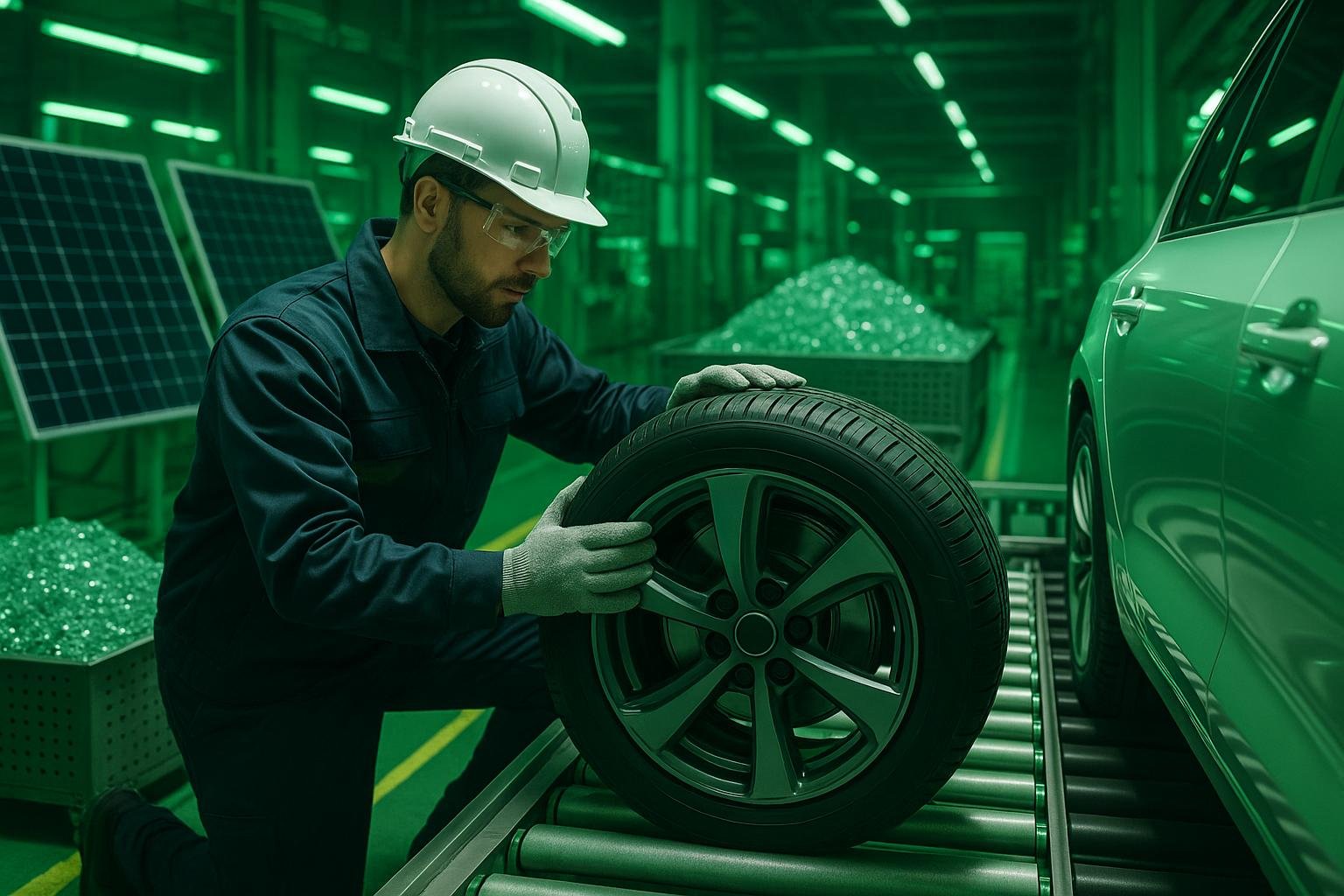
The Asia‑Pacific automotive tyre industry is undergoing rapid change driven by electrification, connected technologies, and sustainability mandates, positioning the region as a global innovation leader through 2035.

The Asia‑Pacific automotive tire market is entering a period of rapid reinvention, driven by the simultaneous rise of electrification, urbanisation, smart mobility and stronger sustainability mandates. According to the original MarketGenics report, these...
Continue Reading This Article
Enjoy this article as well as all of our content, including reports, news, tips and more.
By registering or signing into your SRM Today account, you agree to SRM Today's Terms of Use and consent to the processing of your personal information as described in our Privacy Policy.
China, India, Japan and South Korea remain the structural heavyweights shaping the market. Industry data shows APAC accounts for a disproportionate share of global automotive manufacturing and mobility consumption, with China leading EV adoption and manufacturing scale. Market research firms estimate the region will drive roughly 45% of automotive tyre market growth during forthcoming forecast periods, reflecting expanding vehicle parc, rising disposable incomes and intensifying replacement demand across passenger cars, two‑wheelers and commercial fleets.
Electrification is rewriting technical requirements. The MarketGenics analysis highlights EV‑specific tyres , engineered for higher load capacity, lower rolling resistance, improved heat dispersion and reduced noise , as the fastest‑growing premium segment in APAC. That trend is echoed across other reports, which note rapid EV uptake in China and Southeast Asia and growing fleet electrification among ride‑hailing and delivery services, accelerating demand for tyres optimised for torque‑heavy, heavy‑load, and low‑noise operation.
Connected and smart tyre technologies are moving beyond early adopters. The MarketGenics report and region‑wide mobility convenings cited by GSMA indicate telematics‑enabled tyres , offering real‑time pressure and temperature monitoring, predictive wear analytics and fleet integration , are transitioning from luxury EVs to mainstream fleet and logistics use. GSMA research put the APAC connected‑vehicles market at about USD 42.24 billion in 2024, underscoring the commercial opportunity for sensor‑integrated tyres as part of broader vehicle connectivity and autonomous readiness.
Sustainability and circularity are becoming mandatory imperatives rather than marketing differentiators. Government regulation and corporate commitments across APAC are driving low‑carbon manufacturing, recycled and bio‑based rubber adoption, extended producer responsibility schemes and investment in large‑scale devulcanisation and pyrolysis facilities. The MarketGenics report notes manufacturers are responding with bio‑rubber blends, energy‑efficient production lines and, in some cases, airless prototypes, while broader market reporting projects continued growth in sustainable tyre options as a material science battleground.
Replacement and logistics demand will sustain near‑term growth even as OEM demand shifts. MarketGenics projects the replacement tyre market to outpace OEM volumes through 2035, propelled by expanding vehicle ownership in India, Indonesia, Vietnam, Thailand and the Philippines, and by booming last‑mile logistics tied to e‑commerce. Separate market estimates place the global tyre market at about USD 200 billion in 2023 with a projected rise to roughly USD 273 billion by 2029, with APAC cited as the principal growth engine.
Country‑level dynamics vary. The report describes China as the powerhouse – the largest producer, consumer and exporter – with scale advantages in automation and smart manufacturing. India is characterised as a high‑growth frontier driven by passenger cars and two‑wheelers and an emerging EV two‑wheeler segment. Japan and South Korea are singled out for high R&D intensity and OEM partnerships that foster advanced formulations and smart tyre innovation. ASEAN markets are identified as the “mobility surge zone,” where replacement and fleet tyre demand are growing rapidly alongside MaaS and micro‑mobility adoption; mobility‑as‑a‑service research estimates the APAC MaaS market expanding strongly from a 2024 base.
The combined picture points to three durable shifts: tyres optimised for electrification will become normative; sensorised, connected tyres will move into fleet and autonomous ecosystems; and circular, low‑carbon production models will be increasingly enforced by regulators and buyers. According to the original report, these changes are not incremental but structural, requiring tyre makers to retool R&D, supply chains and recycling partnerships to compete.
For manufacturers, fleets and policymakers, the implication is clear: APAC is not merely a volume market any more but the laboratory where next‑generation tyre technology, business models and regulatory frameworks will be proven at scale. Industry observers say those who can align compound science, digital services and circular economics stand to capture the leading positions in what promises to be a technologically and commercially competitive decade for tyres.
Source: Noah Wire Services
Subscribe to Industry Updates

