


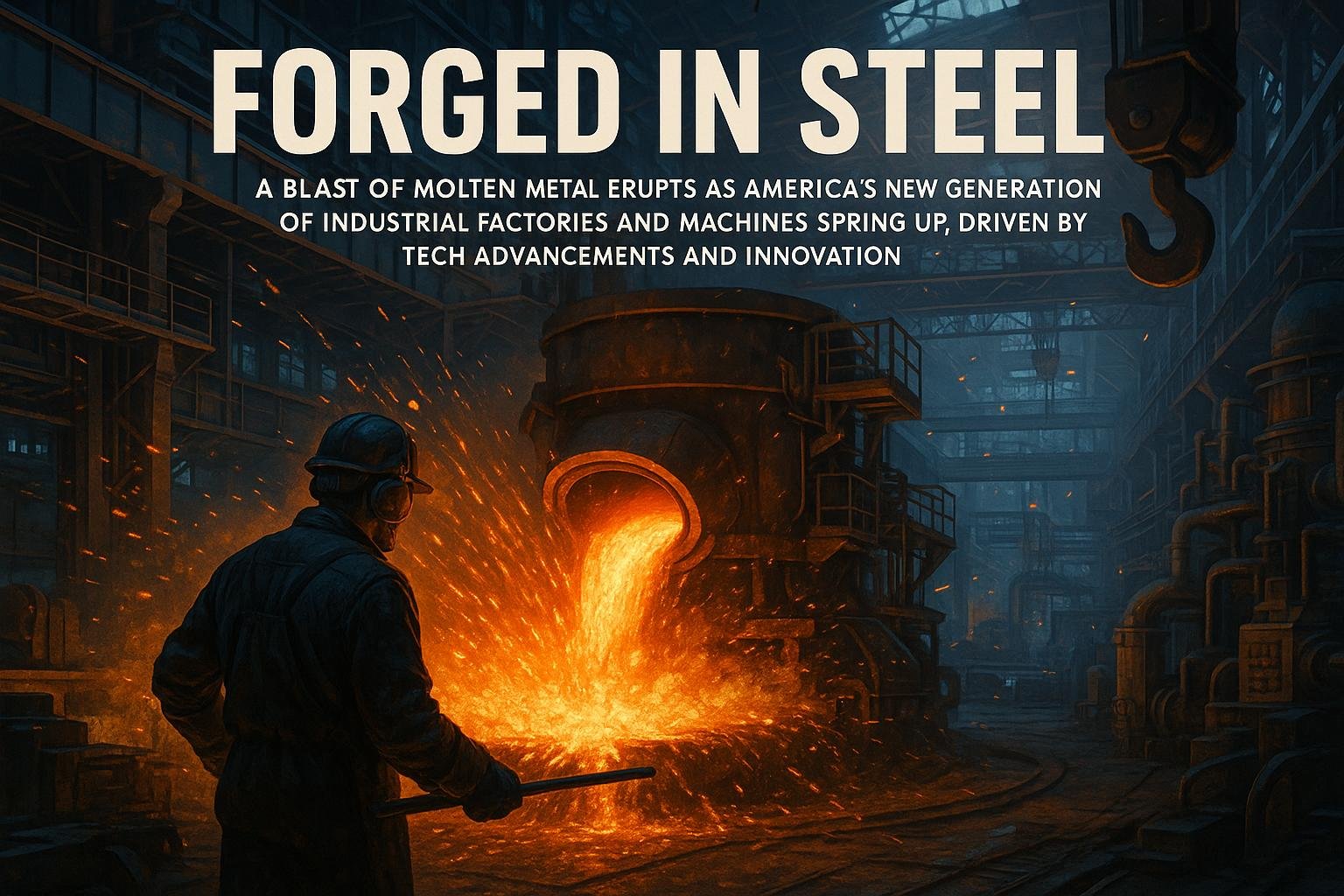
The US is witnessing a significant shift in manufacturing, driven by technological innovation, government incentives, and a desire for supply chain resilience, signalling a new industrial renaissance.

The resurgence of American manufacturing, often termed an “American Supply Chain Renaissance,” is shifting from rhetoric to tangible reality, driven by factors that fundamentally rewire how goods are made and moved. This revival is not merely about subsidies or...
Continue Reading This Article
Enjoy this article as well as all of our content, including reports, news, tips and more.
By registering or signing into your SRM Today account, you agree to SRM Today's Terms of Use and consent to the processing of your personal information as described in our Privacy Policy.
The global disruptions caused by the COVID-19 pandemic and ongoing geopolitical tensions have laid bare the vulnerabilities inherent in global supply chains that prioritised the lowest overseas labour costs. Business leaders have come to recognise the hidden, consequential costs of these extended supply chains: delays, lost sales, and excess inventory. The calculus has shifted decisively towards proximity to customers, where availability and rapid fulfilment, such as next-day delivery, outweigh the traditional focus on country of origin. As a result, production and logistics capabilities are increasingly regionalised or reshored, moving closer to where demand exists.
This resurgence is measurable and significant. Manufacturing and construction spending in the US has reached historic highs, with factory construction spending surging to a $223 billion seasonally adjusted annual rate by mid-2025, a sharp rise from the low double-digit billions less than a decade ago. Such investment signals a meaningful shift in production strategy, echoing the commitments of major corporations. Texas Instruments, for example, announced a $60 billion investment in semiconductor manufacturing facilities across Texas and Utah, aiming to create approximately 60,000 jobs. Other industry giants such as Nvidia, TSMC, IBM, and Apple have similarly pledged large-scale investments in US manufacturing capacity this year.
Employment patterns reflect this trend too. The nonprofit Reshoring Initiative reported that 244,000 jobs tied to reshoring and foreign direct investment were announced in 2024, with a cumulative total nearing 1.7 million since 2010. Notably, the reshoring surge is concentrated in high and medium-high technology sectors critical to national and economic security. About 88% of announced jobs in 2024 were within these sectors, led by semiconductors and computer/electronics, powered by federal incentives like the CHIPS Act. Electrical equipment manufacturing, including electric vehicle batteries and solar components, accounted for nearly a third of these jobs, with support from the Inflation Reduction Act (IRA) facilitating a domestic supply chain geared toward clean energy independence. Automotive and transportation manufacturing are also experiencing renewed growth, buoyed by upcoming tariffs and strategic onshoring decisions.
Investors are taking note, increasingly channeling capital into U.S. manufacturing-focused exchange-traded funds (ETFs). In 2024 alone, about $2.25 billion flowed into manufacturing-themed ETFs, pushing total assets under management to a record $9.67 billion by August. Funds like the Tema American Reshoring ETF and BlackRock’s iShares U.S. Manufacturing ETF have capitalised on reshoring momentum and prominent investments like TSMC’s $65 billion Arizona project and Century Aluminium’s $500 million smelter initiative. However, some caution persists due to rising valuations and economic headwinds, with skeptics highlighting the ongoing challenge of higher U.S. operating costs.
Crucially, advances in technology are underpinning this competitive renaissance. Domestic production, once perceived as a costly disadvantage, is now bolstered by a sophisticated technology stack that includes artificial intelligence, robotics, automation, digital twins, and real-time visibility at granular SKU or carton levels. AI dramatically accelerates logistics decisions, compressing routing cycles from hours to seconds, while digital twins enable simulation of thousands of supply network scenarios before committing investments. Robotics reduce extensive manual labour and human error in warehouses, and end-to-end transparency allows leaner inventory management without sacrificing control. According to Deloitte’s 2025 smart-manufacturing research, manufacturers are intensifying digital initiatives to overcome operational risks and labour shortages, with most already moving beyond pilot projects to full digital integration.
This transformation is also redefining logistics networks. The traditional model of mega distribution centres is giving way to modular, technology-orchestrated systems characterised by flexible fleets, dynamic cross-docks, and forward inventory deployment closer to demand centres. Such flexibility enables rapid reconfiguration in response to disruptions, reducing empty miles and idle time. Shippers are encouraged to start from the customer perspective, piloting near-market solutions to address stockouts and delivery delays without overhauling entire networks at once. Partnerships now demand more than legacy relationships; providers must be agile, tech-enabled, and capable of bespoke, rapid solutions integrated with live data.
Despite these promising trends, challenges remain. Manufacturing growth has become uneven amid tightening margins and softening consumer demand. Reported industrial output growth slowed substantially in 2025, with certain sectors stabilising while others contract. Consumer-driven categories, particularly nondurables like food and beverage, have seen demand retreat due to inflation and household budget constraints, effects expected to persist into 2026. Rising costs, including labour and inflation, collide with demand softening, prompting greater reliance on automation and AI to improve efficiency amid subdued investment growth.
Infrastructure is another potential bottleneck. The US power grid, largely designed in the mid-20th century, faces strain as new energy-intensive manufacturing facilities and AI data centres come online. Energy use from data centres alone is projected to double between 2022 and 2026, driven heavily by AI workloads. This situation calls for urgent upgrades and expansions in power generation, transmission, and grid modernisation, highlighting broader capital needs tied to the industrial renaissance.
Government incentives like the CHIPS Act and Inflation Reduction Act have reshaped strategic priorities beyond mere financial support , they have reprogrammed corporate boardroom strategies to align production and logistics domestically. Investors now favour technology solutions that demonstrably lower costs and improve service rather than superficial growth metrics. Logistics startups are seeing targeted funding, but the capital environment is disciplined, favouring enterprises that clearly advance the competitiveness of American manufacturing.
For companies considering reshoring, practical advice involves focusing on customer pain points, reducing stockouts, lead times, and delivery failures, and leveraging technology to cut waste rather than simply labour costs. Metrics such as on-time delivery, inventory turns, sell-through rates, cost to serve, and damage claims provide meaningful measures of success. Future-proofing supply chains requires partnerships with providers who can adapt swiftly to policy shifts, capacity constraints, or market volatility through dynamic, software-driven network optimisation.
In summary, the American supply chain renaissance is neither a nostalgic throwback nor a fleeting trend. It is a pragmatic, data-driven evolution shaped by customers’ demand for speed and reliability, enabled by advanced technology and bolstered by significant corporate and government commitments. Companies and investors aligning proximity with digital intelligence stand poised to lead the transformative decade ahead, redefining manufacturing and supply chain paradigms for a new era.
Source: Noah Wire Services
Subscribe to Industry Updates

