


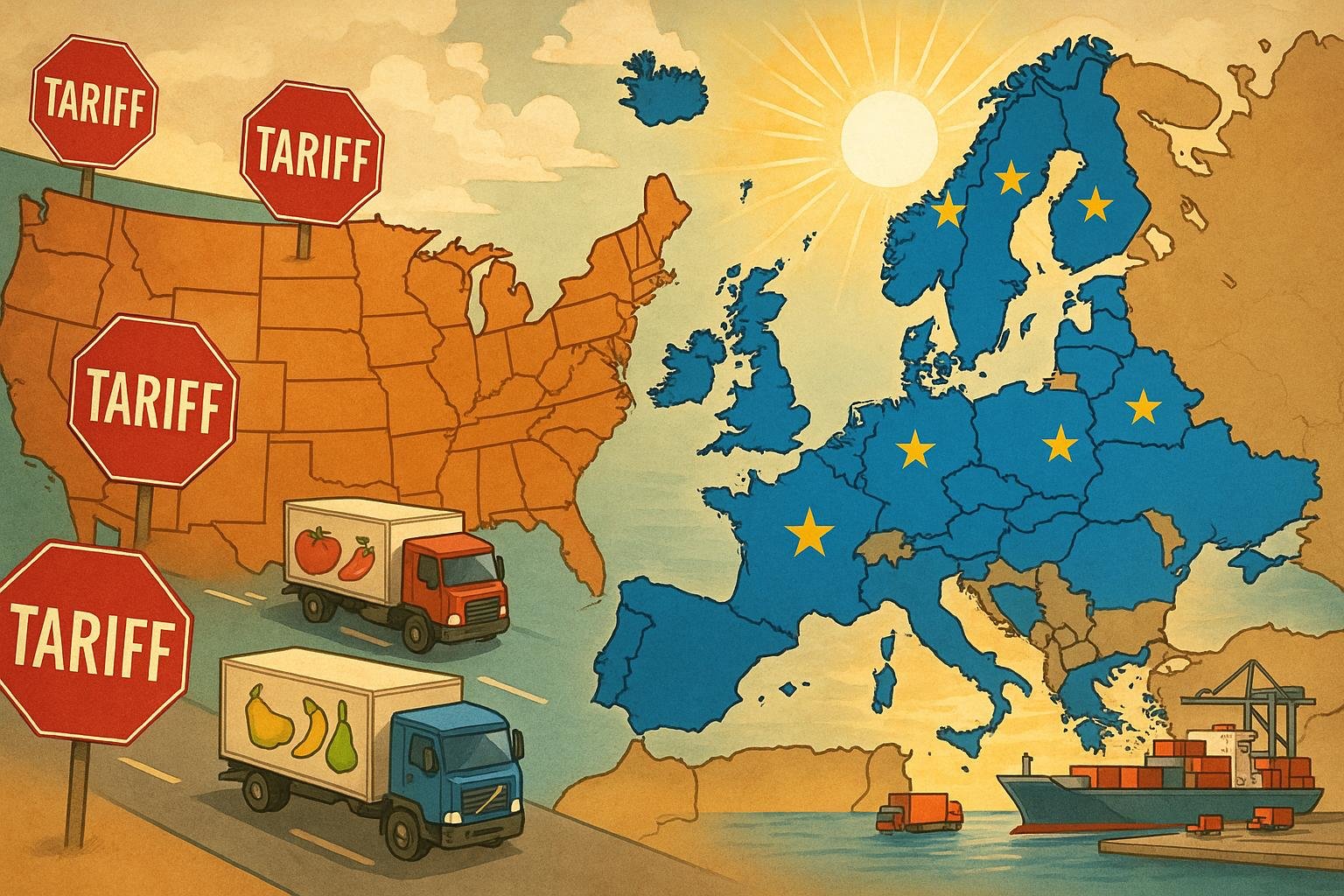
The Supreme Court’s decision restricting the US President’s authority to impose tariffs under the IEEPA opens limited opportunities for European food and drink exporters, but broader trade uncertainties persist as policymakers explore alternative measures.

The US Supreme Court’s February ruling that tariffs imposed under the International Emergency Economic Powers Act exceeded presidential authority has opened a narrow door for European food and drink expo...
Continue Reading This Article
Enjoy this article as well as all of our content, including reports, news, tips and more.
By registering or signing into your SRM Today account, you agree to SRM Today's Terms of Use and consent to the processing of your personal information as described in our Privacy Policy.
According to FoodNavigator, the judgment curtails the President’s ability to unilaterally deploy tariffs under the IEEPA and exposes many measures enacted under that law to legal challenge. That creates immediate, if limited, upside for some European suppliers who have been competing at a price disadvantage in the US market.
“On paper, European producers could regain margin and price competitiveness in the US market,” said Simon Geale, executive vice president at supply chain consultancy Proxima. “This would most likely show itself as a correction rather than a surge in new business. These brands are also fighting against consumer habits, which may have changed a little in the interim, so they could well come up short in terms of volumes and revenue.”
But industry analysts and legal commentators warn the decision does not mark the end of US tariff activism. According to The Guardian, President Trump condemned the ruling and signalled plans to pursue alternative trade measures. Reporting by Al Jazeera notes that other statutory avenues remain available to the administration, including instruments such as Section 232 of the Trade Expansion Act and powers in the Trade Act of 1974 that can be used to impose duties on different legal grounds.
Financial and trade analysts say that combination of a curtailed IEEPA and readily available alternative authorities translates into a patchwork of uncertainty rather than a clear rollback. “The ruling dismantles the legal scaffolding, not the building itself,” ING Bank’s Carsten Brzeski and Julian Geib observed, according to FoodNavigator, a formulation echoed by ING’s sector economist Thijs Geijer, who warned that tariff-related uncertainty for food exporters will remain high.
Practical consequences for European food businesses are already emerging. Some exporters could see price competitiveness partially restored if contested IEEPA duties are removed or held up in litigation, but any rebound is likely to be gradual and uneven. Proxima’s Geale cautions that even where duties are refunded, reimbursement processes favour the party that actually paid the duty, typically the US importer, so producers may not automatically recover costs unless contractual arrangements provide for that.
Legal claims seeking refunds are now more plausible. FoodNavigator reported that the ruling opens the US government to lawsuits from firms arguing the tariffs were unlawfully imposed. PwC’s analysis of the decision says it also clarifies constitutional limits on executive economic action and will prompt a reassessment across government and business of how trade measures are justified and implemented.
Supply chains will remain a source of instability. Rabobank’s Cyrille Filott warned that some flows of Chinese packaging into the EU, which had developed partly to avoid US duties, might reroute back to the United States if tariffs are unwound or if alternative measures change relative costs. That could reconfigure logistics and sourcing patterns already altered by recent tariff cycles.
Meanwhile, Washington’s swift adoption of a 10% global tariff under other statutory authority after the ruling, reported in industry coverage, illustrates how administrations can pivot to different tools. Such manoeuvres keep the prospect of future levies alive and complicate long-term planning for exporters and retailers.
For European exporters the immediate takeaway is mixed: potential short-term relief in price competitiveness and the opening of judicial remedies for some importers, counterbalanced by persistent legal and policy uncertainty. Industry advisers quoted by FoodNavigator recommend that food companies continue to design supply chains for volatility and to review contractual terms governing who bears and can reclaim tariff costs.
The Supreme Court’s decision thus resets part of the legal framework for US trade policy without resolving the underlying political choice to use tariffs as a tool. As The Guardian and Al Jazeera both highlight, administrations retain alternative statutory routes to impose duties, meaning exporters should expect an environment in which tariff risk is reduced in some respects but remains a prominent strategic consideration.
Source: Noah Wire Services
Subscribe to Industry Updates

