


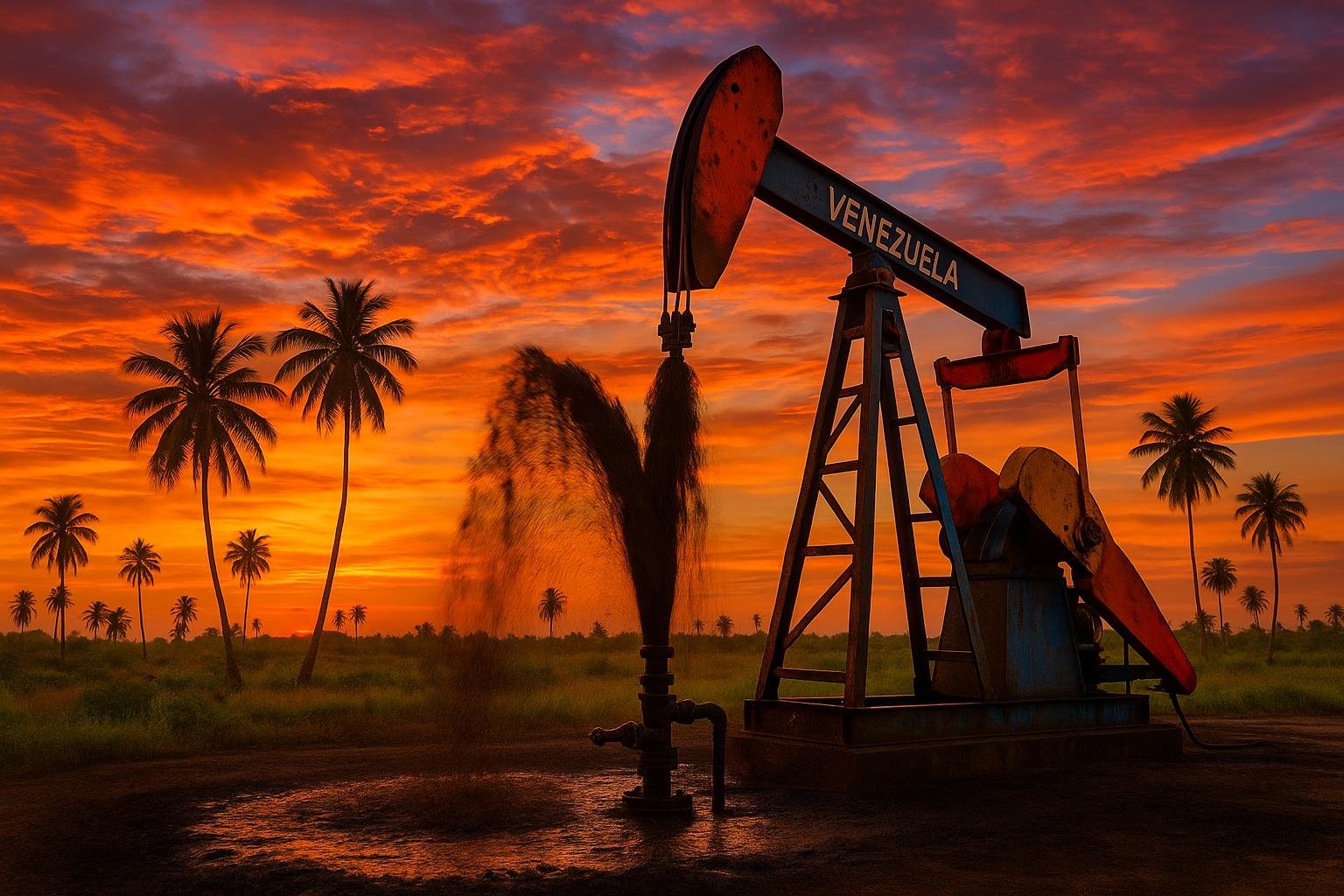
President Donald Trump announces plans for US firms to restore Venezuela’s oil sector following a military operation and the removal of Nicolás Maduro, signalling a significant shift in regional influence and energy strategy.

President Donald Trump has said the United States intends to reopen and rebuild Venezuela’s oil industry for American firms after U.S. forces removed President Nicolás Maduro, a plan that would bring Washington into direct control of one of t...
Continue Reading This Article
Enjoy this article as well as all of our content, including reports, news, tips and more.
By registering or signing into your SRM Today account, you agree to SRM Today's Terms of Use and consent to the processing of your personal information as described in our Privacy Policy.
“As everyone knows, the oil business in Venezuela has been a bust, a total bust for a long period of time,” Trump said during a Saturday morning press conference at Mar-a-Lago in Palm Beach, Florida, according to the Christian Post. “They were pumping almost nothing by comparison to what they could have been pumping and what could have taken place.” He added: “We’re going to have our very large United States oil companies, the biggest anywhere in the world, go in, spend billions of dollars, fix the badly broken infrastructure, the oil infrastructure and start making money for the country.”
The proposal follows a dramatic U.S. operation that, according to reporting by Time and the Associated Press, resulted in the capture and extraction of Mr Maduro and his wife, who now face narco-terrorism charges in federal court in the United States. Time described the operation as an “extraordinary military operation” and compared the intervention to past contentious U.S. actions in Latin America. AP reporting detailed that the raid produced casualties, including dozens of allied security personnel, and raised legal and political questions about the legality and long-term consequences of U.S. governance in Venezuela.
Venezuela’s oil sector, long mismanaged and riven by years of underinvestment, presents both a strategic prize and a significant practical challenge. Industry data show Venezuela holds the world’s largest crude reserves, and together with offshore discoveries near Guyana, access to those resources could materially expand U.S. leverage in global energy markets. According to AP, U.S. energy stocks surged on the announcement, with major refiners and oilfield service providers posting immediate gains, although global oil prices remained muted amid an existing oversupply.
At the same time, the U.S. has already tightened economic pressure on Maduro’s regime. AP reported that on December 31, 2025, the U.S. imposed sanctions on four companies in Venezuela’s oil sector and designated four tankers, Nord Star, Lunar Tide, Rosalind, and Della, as blocked property for allegedly supporting Maduro. Treasury and State Department officials framed the moves as part of a campaign to deny Maduro revenue streams they say fund drug trafficking and organised crime. The administration has accompanied sanctions with aggressive maritime operations, including the seizure and pursuit of tankers, and covert strikes targeting suspected drug-smuggling networks.
One such action, a CIA drone strike on a Venezuelan dock alleged to be used by cartels, was reported by AP as the first known direct U.S. strike on Venezuelan soil and part of a broader campaign of more than 30 military operations against suspected drug boats. President Trump has publicly justified such measures as necessary to curtail narcotics flows and criminal activity, while Venezuelan officials have largely denied the allegations.
The U.S. plan to place American firms at the centre of Venezuelan oil recovery has drawn a mix of rhetoric and caution. Secretary of State Marco Rubio, according to AP, has emphasised a narrower objective, enforcing an embargo and using economic levers to change Venezuelan policy, while interim Venezuelan President Delcy Rodríguez has issued conciliatory calls for cooperation, even as the ruling party remains positioned to retain legislative influence. Legal experts contacted by news organisations cautioned that the operation’s legality is debatable and compared it to past controversial interventions.
Restoration of Venezuela’s oil output will be costly and slow. AP analysts warned that decades of degradation in infrastructure mean that even with significant U.S. investment, bringing production back to prior levels, let alone expanding output, will take years and face political, logistical and market risks. Firms positioned to benefit include ExxonMobil and Chevron, but the administration’s desire for U.S. companies to “spend billions” must contend with persistent low oil prices, political instability and lingering sanctions constraints.
Mr Maduro’s public posture has also shifted. In a televised interview aired on New Year’s Eve, he expressed willingness to negotiate with the United States on drug trafficking and even hinted at potential oil investment cooperation “similar to the ongoing collaboration with Chevron,” according to AP, while simultaneously denouncing U.S. pressure. The U.S. has long accused Maduro of narco-terrorism; authorities doubled the reward for his capture to $50 million in recent months, and his indictment dates back to 2020, as previously reported by Time.
The unfolding situation leaves Venezuela subdued but institutionally intact in the short term, with its ruling party still able to exert political control, AP reports note. U.S. officials say they intend to oversee reconstruction and to ensure revenues are not diverted to criminal networks; critics warn of protracted occupation and international backlash. As trading floors reacted and analysts modelled geopolitical outcomes, the immediate financial market response, energy stock gains, contrasted with the far more complex, long-term task of rebuilding an oil sector that has been, in the president’s words, “a total bust.”
Source: Noah Wire Services
Subscribe to Industry Updates

