


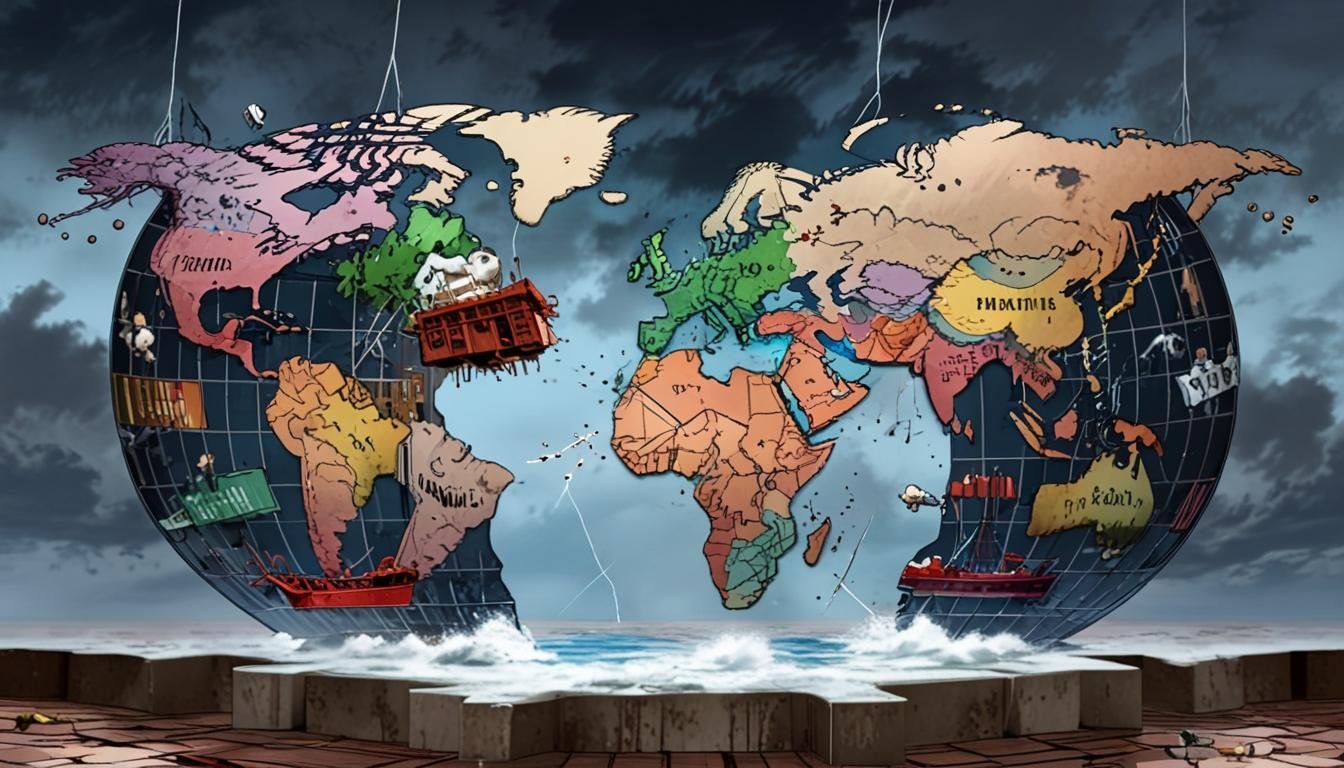
Frustration within global powerhouses like Brussels and Beijing is intensifying as President Donald Trump’s trade policies continue to disrupt established relationships and provoke reactions that expose underlying protectionist tendencies. The consequences of Trump’s tariffs, which he enacted following an aggressive stance on April 2, are unfolding dramatically across international lines, revealing the dynamics of a reshaped global order in which the United States appears to be asserting a position of strength.
Recently, Trump announced a significant trade agreement, with the United Kingdom as its inaugural signatory. This deal marks a decisive moment for transatlantic trade and signifies Britain’s intent to pivot amid the evolving economic landscape. A pivotal element of the trade negotiations was the U.S. dominance in ethanol — accounting for an impressive 52 percent share of the global market. The U.S. offered its ethanol advantage as leverage against China’s control of rare earth elements, positioning it favourably in discussions. In what seems a calculated move, Britain agreed to a 10 percent baseline tariff on American imports to secure continued access to U.S. agricultural goods, a decision that could exacerbate its existing trade deficit of $12 billion annually and reflects the tactical nature of Trump’s trade agenda.

Conversely, the U.S. extended a hand by lifting tariffs on British steel and aluminium, reflecting a broader strategy to rejuvenate domestic production capabilities at home while signalling potential reindustrialisation. For India, this realignment has not gone unnoticed; Prime Minister Narendra Modi has shown an inclination to engage in talks to remove reciprocal tariffs on critical goods. Such moves suggest that India is increasingly looking towards a tighter partnership with the U.S., possibly at the cost of its traditional ties within the BRICS framework, of which China is a dominant member. India’s strategic pivot illustrates how nations are recalibrating alliances amidst perceived shifts in global power balances.
In stark contrast to Britain and India, the European Union (EU) is adopting a more combative stance, signalling little interest in compromise. A recent proposal by the European Commission suggested potential retaliatory tariffs amounting to an additional €95 billion annually, should negotiations falter. This aggressive posturing highlights not merely a trade dispute but a struggle for economic freedom within the Eurozone, where bureaucratic constraints and excessive regulation have stifled growth. The EU’s ongoing deindustrialisation and economic malaise present challenges that starkly contrast with America’s push towards energy independence and a renewed focus on domestic manufacturing.
As the U.S. seeks to redefine its role in the global economic framework, China finds itself grappling with internal pressures exacerbated by Trump’s tariff strategies. The Chinese economy faces significant challenges, most notably within its property sector, which has seen values plummet. The turmoil presents a stark reminder of the fragility that underpin China’s export-driven model, amplified by recent aggressive tariffs that have led to sharp declines in producer prices. Amidst this chaos, the foundation of the myth of unyielding Chinese economic dominance is beginning to crack, with the Communist Party’s promises of perpetual growth facing an existential crisis.
With the U.S. Federal Reserve maintaining high-interest rates, China’s monetary response requires rapid liquidity infusions to stabilize its economy, drastically increasing the risk of a yuan devaluation. Additionally, the perception that China might be falling behind in the tariff war has led its neighbours, including India, Japan, and Vietnam, to pursue closer trade ties with the U.S., signalling a possible shift away from collective BRICS solidarity.
While Trump’s administration pushes for a recasting of the global economic order, the path ahead appears fraught with uncertainties and potential crises. The challenges imposed by stubborn state apparatuses, entrenched interests in Europe, and the potential for escalated conflicts over trade agreements suggest that the quest for a new equilibrium is perilous. Nations will need to confront uncomfortable truths about fiscal discipline and economic restructuring if they are to navigate the evolving geopolitical landscape effectively.
Ultimately, while Trump’s actions have illuminated existing fractures within the global order, the broader implications remain contentious. The question of which nations can absorb the shocks of such realignments — and whether they are prepared to rethink established domestic structures — will shape the future dynamics of global trade for years to come. True reform, as some observers suggest, demands an uncomfortable catharsis that is increasingly unavoidable in the face of mounting economic pressures.
Reference Map
- Paragraphs 1, 2, 3, 4
- Paragraphs 2, 3
- Paragraphs 5
- Paragraph 6
- Paragraph 5
- Paragraph 5
- Paragraph 5
Source: Noah Wire Services

