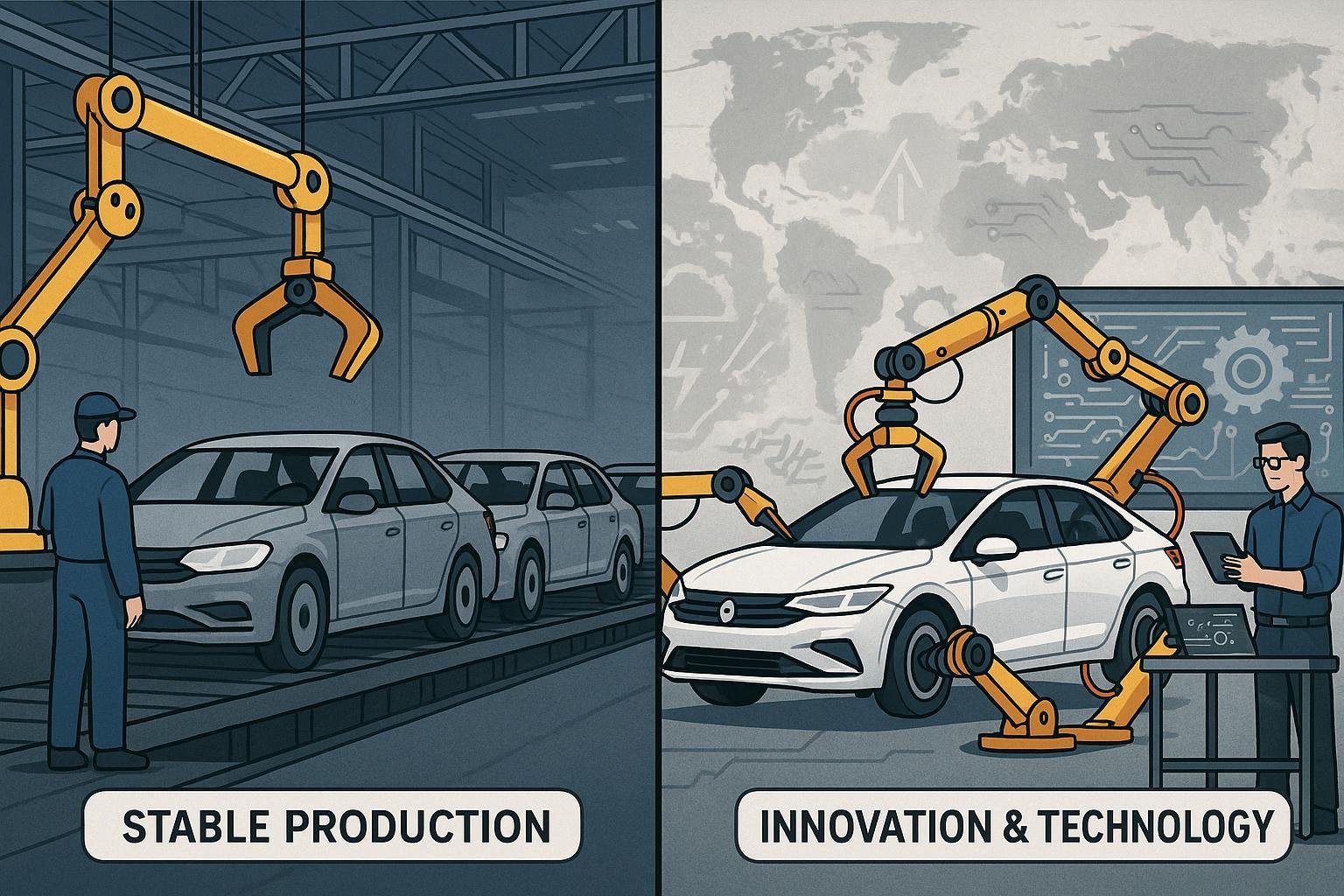
Toyota and Tesla occupy opposite corners of the automotive world not only in design and market strategy but in how they marshal the flow of parts, labour and technology that turn raw materials into cars. Each firm’s supply-chain choices reflect contrasting priorities: Toyota prizes stability and continual refinement; Tesla opts for control, speed and technological disruption. The interplay of those priorities has shaped how both companies weather shortages, scale production and purs...
Continue Reading This Article
Enjoy this article as well as all of our content, including reports, news, tips and more.
By registering or signing into your SRM Today account, you agree to SRM Today's Terms of Use and consent to the processing of your personal information as described in our Privacy Policy.
ue innovation.
Toyota’s model rests on decades of refinement of the Toyota Production System, a disciplined regimen that links production closely to customer demand while driving out waste. According to the Lean Enterprise Institute, the essence of Just‑in‑Time is not merely holding minimal stock but synchronising output with real demand to improve responsiveness and eliminate non‑value activities. Toyota’s long‑standing supplier networks, often described through the Japanese keiretsu concept, create interdependent relationships that prioritise quality, mutual problem‑solving and proximity to plants. That structure delivers high efficiency at scale and underpins the company’s global reputation for reliability.
Yet the lean approach is not without trade‑offs. A tightly tuned, low‑inventory system can be exposed when external shocks interrupt supply flows. Toyota felt that vulnerability during the semiconductor shortfalls that accompanied the COVID‑19 era, although industry commentary has repeatedly argued that lean practices themselves did not cause the broader crisis; rather, the disruption stemmed from extraordinary, external pressures on suppliers and logistics. Toyota’s response has typically blended tactical inventory buffers with deeper supplier collaboration, relying on established ties to restore continuity.
Tesla has pursued a markedly different route. The company has sought to internalise large swathes of the value chain, from battery packs to drive units and factory automation. Analyses in SupplyChain360 and Forbes explain that Tesla’s vertical integration gives it tighter quality control, potential cost advantages and the capacity to iterate designs rapidly. By bringing batteries, software and manufacturing under one roof, embodied in the Gigafactory concept, Tesla aims to reduce dependency on external vendors and to accelerate product cycles.
That inward focus also enables technological layering. SupplyChain360 highlights how Tesla leverages vertical integration to weave artificial intelligence, advanced robotics and additive manufacturing into production processes, using data from vehicle operations to refine manufacturing algorithms and parts design. The result is a closer feedback loop between vehicle performance and component engineering, which can speed improvements but also amplifies complexity across the supply chain.
Both approaches have proved resilient in different ways. Toyota’s networked supplier model fosters predictability and coordinated recovery when problems arise; Tesla’s model offers agility in sourcing alternatives and re‑engineering components when a bottleneck emerges. Industry commentaries note Tesla’s nimbleness during the chip shortage, where the company switched semiconductors and redesigned firmware to keep production moving. At the same time, Tesla’s concentration on key suppliers and concentrated manufacturing sites exposes it to geopolitical and regional risks as well as to the steep capital requirements of scaling in‑house capabilities. Recent industry analysis suggests that by localising production and critical inputs, Tesla reduces exposure to tariffs and political friction, but that strategy demands significant investment and managerial bandwidth.
The two philosophies also diverge in how they adopt new technologies. Toyota tends to introduce automation and digital tools incrementally, testing for robustness and alignment with quality standards. Tesla pursues broader, faster deployment of AI, robotics and 3D printing as strategic levers to shorten lead times and enable design changes at pace. Both paths carry upside: Toyota’s cautious rollout protects reliability; Tesla’s aggressive adoption can yield speed and differentiation. Each path also carries risk, over‑automation can create brittle processes, while incrementalism can slow responsiveness to rapidly evolving markets.
Looking ahead, elements of both schools are likely to converge across the industry. Automakers face mounting pressure to secure battery supply, to manage semiconductor availability, and to make supply chains more transparent and sustainable. Analysts argue that blending Toyota’s supplier partnerships and process discipline with Tesla’s integration of software, AI and robotics could offer a resilient template: close supplier collaboration to preserve capacity and quality, combined with selective in‑house capabilities that anchor critical technologies and shorten innovation cycles.
In short, Toyota’s supply chain is constructed around predictability, supplier trust and disciplined elimination of waste; Tesla’s is built around control, technological integration and rapid iteration. Each has delivered competitive advantage within a business model that favours it. As materials, markets and regulations shift, both companies will continue to adapt, borrowing practices from one another while safeguarding the strategic choices that have defined their growth.
Source: Noah Wire Services