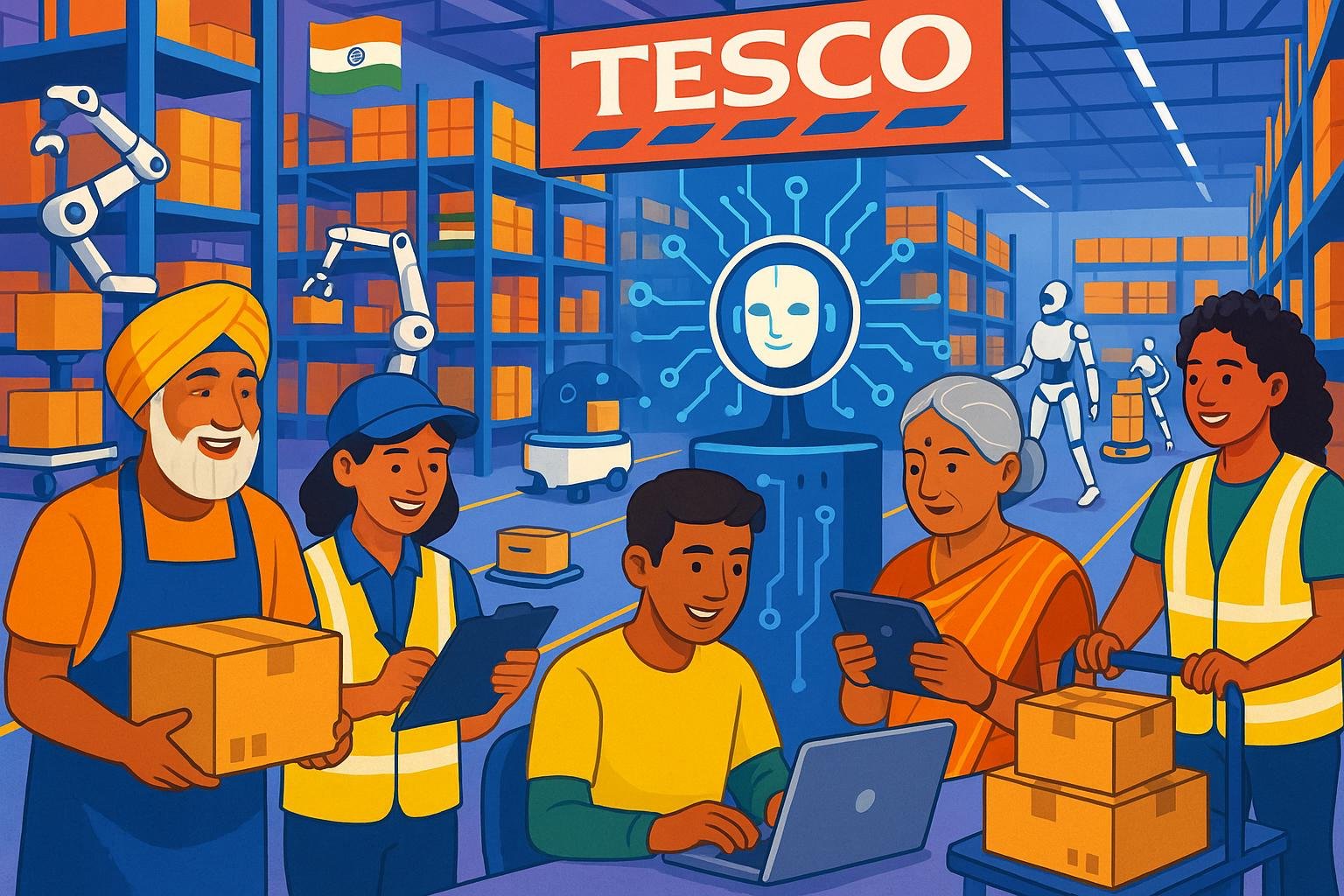
Tesco Business Solutions is redefining talent measurement and recruitment strategies to prioritise skills over employee numbers, as AI-driven automation reshapes jobs across its global operations, particularly in India.

Tesco Business Solutions is reworking how it measures and recruits talent as artificial intelligence alters everyday tasks and reshapes roles across the retailer’s global operations, its India chief executive Sumit Mitra said.
Mitra told The Hin...
Continue Reading This Article
Enjoy this article as well as all of our content, including reports, news, tips and more.
By registering or signing into your SRM Today account, you agree to SRM Today's Terms of Use and consent to the processing of your personal information as described in our Privacy Policy.
That shift is visible in Tesco’s India footprint. Mitra said the company’s total staff in India will remain around the 5,500–6,000 band even as it plans to hire more than 100 new roles this year, reflecting changing job content rather than large-scale expansion. He acknowledged that automation is taking on tasks such as reconciliation and supplier payments, but rejected the framing that such moves automatically eliminate positions. “Humans will become assurers. Their job will be to make sure AI is doing what it needs to do,” he added, arguing this generation will be the last in which work is carried out by humans alone.
Tesco’s Bengaluru Global Capability Centre has been central to the transition, serving technical and design functions that underpin the retailer’s roughly 5,000 stores and support openings of about 60 new outlets annually. According to reporting by Moneycontrol, the Bengaluru GCC has driven a roughly 35% improvement in efficiency attributable to AI, with engineers accounting for about 80% of the centre’s staff and the team credited with generating nearly £750 million in business value for Tesco’s UK business over several years. Mitra said Tesco deliberately built a captive model in India rather than relying on third-party vendors, investing in its own 15-acre campus to house that capability.
The broader labour market context supports Tesco’s approach. A McKinsey Global Institute report highlights a wider trend away from sheer employee numbers towards an emphasis on skill portfolios and firm–machine partnerships, noting that while AI can automate many activities, human expertise remains vital to validate outputs and manage systems. Cisco’s AI Workforce Consortium also found that a large majority of ICT roles now include AI technical requirements and that human skills are increasingly important to ensure responsible technology adoption.
Industry observers and analysts point to more nuanced workforce effects. Research reported by the Times of India suggests AI could displace about 5% of full-time technology roles each year over the next four to five years, while simultaneously creating more advanced roles focused on strategy, oversight and decision-making. Labour shifts in India’s IT sector , where leading firms recorded a net fall in staff in recent quarters compared with strong hiring a year earlier , illustrate how automation can compress routine headcount even as demand rises for specialised capabilities.
Tesco frames its own changes as evolution rather than contraction. Mitra said the company expects human workers to partner with machines, ensuring data quality, contesting erroneous outputs and validating AI-generated insight. He warned of the risk that automated systems may “hallucinate” and underlined the continuing need for human judgement.
The retailer’s India presence dates back to 2003, when it began assembling technical and operational capacity that now spans multiple functions including Tesco Business Solutions and Tesco Technology. According to Mitra, that early investment provided a foundation to develop in-house expertise rather than outsource critical architecture and store-support work.
As retailers and other industries adapt, Tesco’s plans reflect a broader strategic choice: to invest in the skills and governance required to extract value from AI while containing overall staff numbers. Company statements present this as a deliberate design to combine technological efficiency with human oversight; independent data and industry reports show the same dynamic unfolding across sectors, with automation lifting productivity even as it reconfigures the kinds of roles employers seek.
Source: Noah Wire Services
Subscribe to Industry Updates