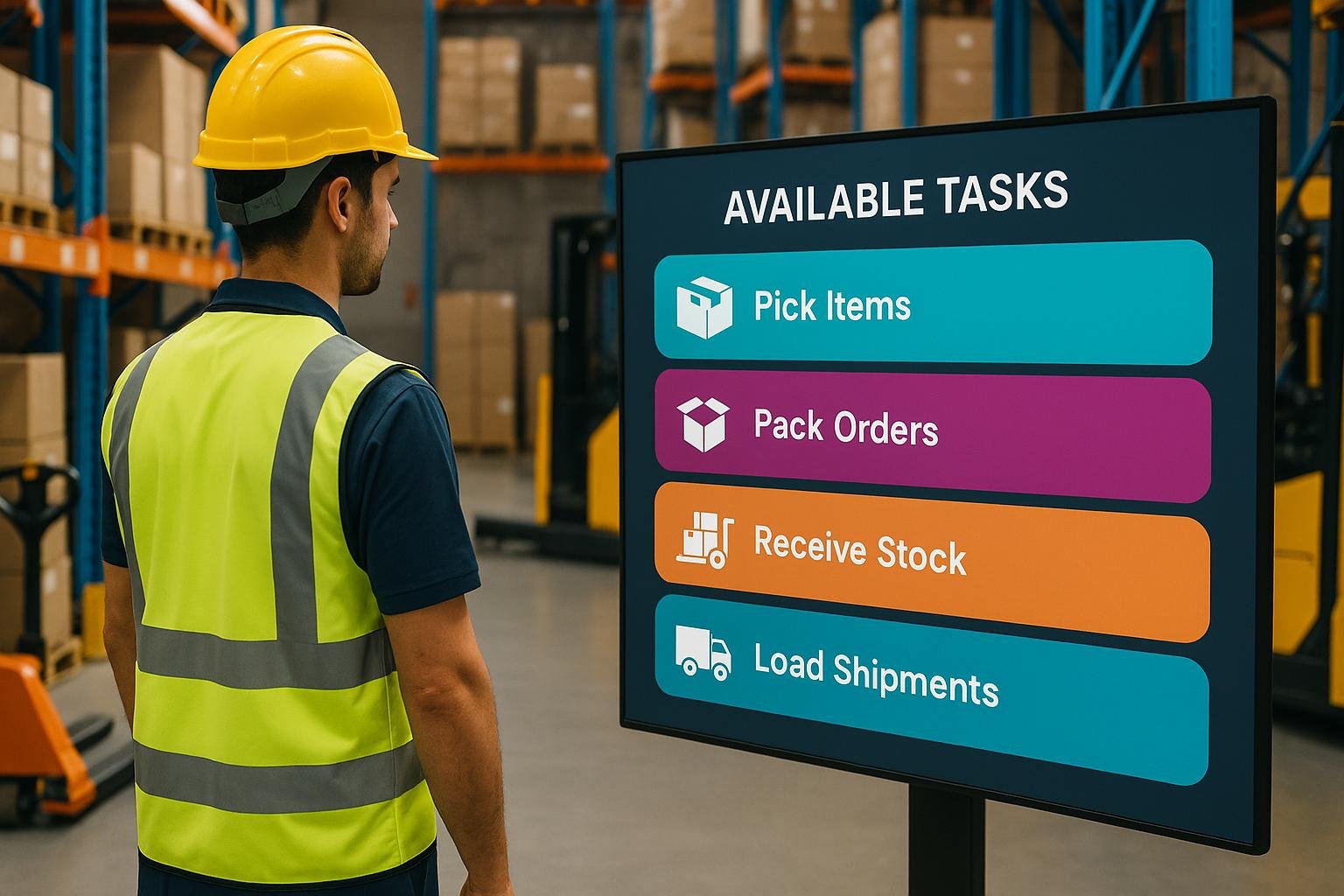
New research from Hasselt University and Erasmus University Rotterdam demonstrates that giving order pickers a curated set of task options can improve motivation and wellbeing while maintaining operational efficiency, offering a pragmatic solution to labour shortages and high turnover in logistics sectors.

Logistics operations wrestling with labour shortages and high turnover are finding a pragmatic lever in task-level autonomy for order pickers, new research shows. Tri...
Continue Reading This Article
Enjoy this article as well as all of our content, including reports, news, tips and more.
By registering or signing into your SRM Today account, you agree to SRM Today's Terms of Use and consent to the processing of your personal information as described in our Privacy Policy.
The experiments replaced the conventional single-next-task allocation with an interface that presented pickers a small menu of feasible jobs that complied with routing, safety and priority constraints. Workers could then claim the option that best matched their immediate preferences, lighter weights, shorter walks or tasks that avoided aerial platforms, while the warehouse management system preserved overall shift commitments. According to the HuLog project led by Hasselt University, the change was deliberately limited to allocation logic rather than altering order volume or service windows.
Researchers gathered a mix of objective and subjective measures: system throughput and pick counts, wearable-derived indicators of physical load, short frequent surveys and in-depth interviews. The findings were consistent across the live warehouse study and the Erasmus University Rotterdam lab replication, self-reported job satisfaction and motivation rose materially, yet aggregate productivity indicators remained comparable to baseline levels. Hasselt University’s Research Group Logistics provided theoretical framing and industry liaison to connect the trials to real-world decision problems.
For operations managers the appeal is practical rather than ideological. The prototype integrated with existing warehouse IT to identify tasks that met all operational rules and present a manageable number of options to workers. Design emphasis fell on which assignments to surface and how many choices to show, to preserve simplicity and avoid systematic avoidance of less-desirable work areas. The project team reports that some individuals chose to walk more for lighter loads while others preferred dense picks with fewer stops, but these individual behaviours balanced at scale.
The approach also carries ergonomic and retention advantages. Wearable data from the trials showed that introducing choice did not push physical exertion beyond acceptable ranges and allowed workers to distribute heavy and light tasks across a shift in a way that felt sustainable. Given rising costs linked to unplanned absenteeism and turnover in major logistics hubs, industry observers see modest human-centred system changes as a cost-effective complement to investments in automation.
The academic literature lends further support. The Erasmus University Rotterdam study of participatory order assignments found similar gains in psychosocial outcomes without a penalty to productivity, underscoring that worker agency can be treated as an operational parameter rather than a vague HR initiative. Meanwhile, research on robotic fleet and path-planning optimisation highlights a separate but related point: technological advances can raise overall system capability, yet the allocation layer that governs human work remains decisive for day-to-day performance and workforce stability. A recent MDPI paper on hybrid symbolic-control and metaheuristic methods for robot path planning illustrates how sophisticated optimisation can coexist with higher-level policies that accommodate human factors.
Translating trials into routine practice implies governance adjustments. Sites are advised to treat controlled choice as a measurable setting within labour standards and slotting strategies, running pilots by aisle, shift or work type and tracking retention, quality, safety and throughput in parallel. According to project partners in the HuLog consortium, this lets operators calibrate choice parameters and embed them into network-level rules rather than leaving them to ad hoc adoption.
The concept extends beyond picker-to-case operations. Any digitally orchestrated workplace where work units are fungible and constraints can be enforced by software, returns processing, kitting, certain admin workflows and parts of transport planning, could adopt structured task choice. Industry implementation will require careful interface design, constraint checking and monitoring to prevent gaming or skewed workload distribution, but the underlying mechanics are technically straightforward.
As warehouses pursue ever more automation, these studies suggest a pragmatic balance: deploy technology to remove drudgery and increase efficiency, while designing human–system interaction so that workers retain meaningful control over how they execute tasks. According to Hasselt University and the Rotterdam team, that balance can sustain operational performance while improving the human experience of warehouse work.
Source: Noah Wire Services
Subscribe to Industry Updates