


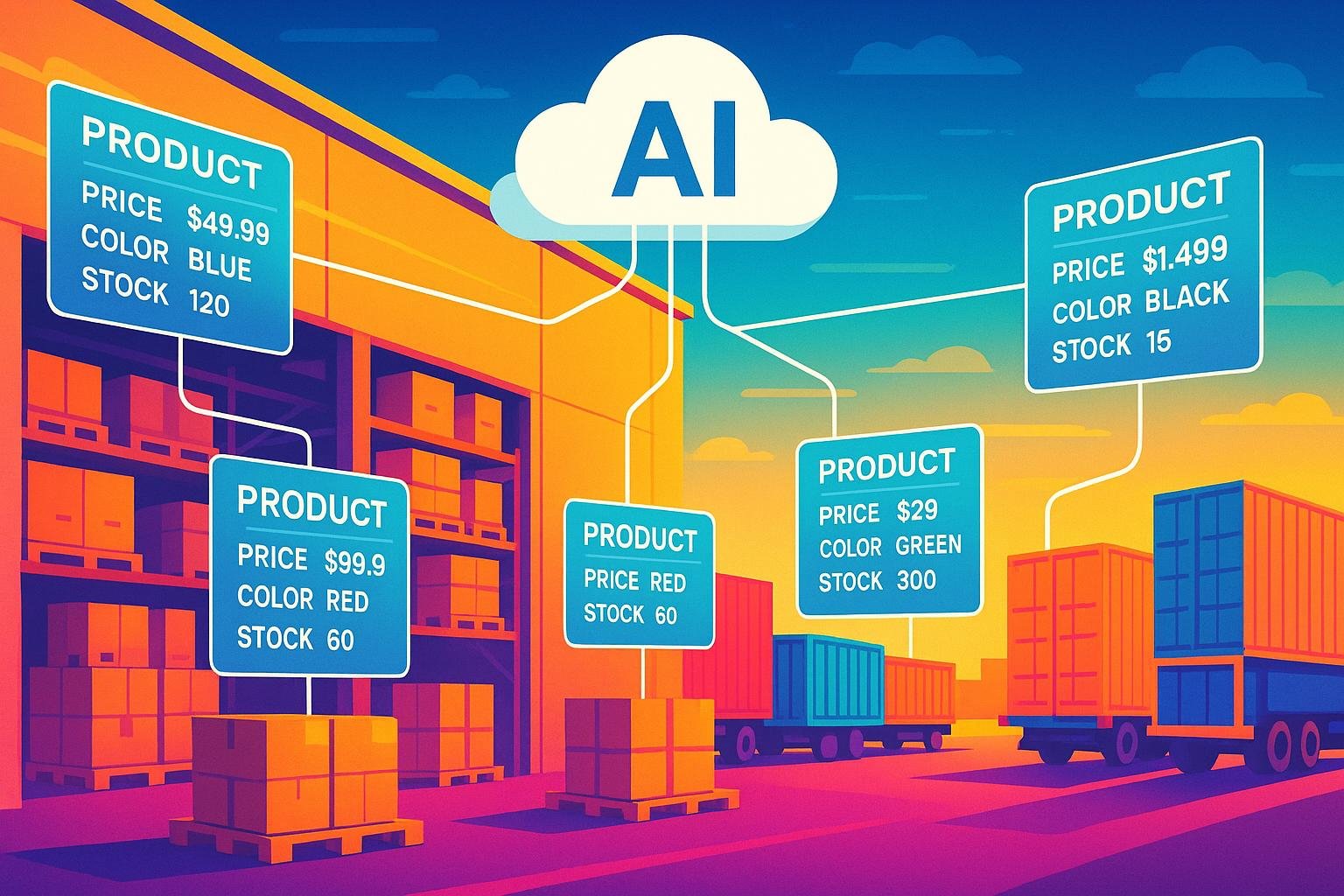
Supply-chain leaders are transforming product identification and labelling from administrative tasks into strategic advantages by adopting cloud platforms, AI, and connected packaging, enhancing compliance, traceability, and operational agility amid increasing disruptions.

Supply-chain leaders are increasingly treating product identification and labelling as strategic levers rather than back-office chores, using cloud platforms, AI and connected packaging to turn upstre...
Continue Reading This Article
Enjoy this article as well as all of our content, including reports, news, tips and more.
By registering or signing into your SRM Today account, you agree to SRM Today's Terms of Use and consent to the processing of your personal information as described in our Privacy Policy.
According to Loftware’s 2026 Trends Report, firms are abandoning siloed processes in favour of centralised, cloud-based labelling systems that standardise product data and push specifications out into supplier networks. That approach, the company says, eliminates rework, speeds supplier onboarding and raises compliance: in Loftware’s survey 69% of respondents reported that sharing label data and standards with trading partners helps their organisation manage compliance and respond more quickly to disruptions, and 63% of executives at billion-dollar companies told Loftware they struggle to adapt product information to shifting tariff and trade rules.
The emphasis on a single source of truth for product identity has practical trade implications. Accurate, up-to-date label and product data are vital for customs clearance, regulatory audits and meeting diverse buyer requirements when routes, tariffs or sourcing change. Loftware contends that connected labelling ecosystems let manufacturers and their suppliers synchronise information in real time, reducing delays when production is nearshored, materials are resourced from new regions or trade agreements are renegotiated.
Traceability and consumer engagement are further drivers. Loftware’s research of more than 400 professionals found 64% cited improved traceability as the principal benefit of connected packaging, while 44% highlighted stronger consumer engagement and 38% noted enhanced compliance. Dynamic identifiers such as QR codes, when coupled to cloud-hosted product records, can be updated by location, language or promotion and link the physical item to authoritative digital content , a capability that helps firms comply with regulation and reassure buyers about provenance and authenticity.
AI and automation are accelerating the shift from reactive to anticipatory operations. Industry research from IBM indicates organisations that deploy agentic AI in supply-chain workflows report substantially stronger top-line performance, with AI-focused operators posting 61% higher revenue growth than peers. IBM also found 62% of supply-chain leaders believe embedded AI agents speed decision-making by surfacing recommendations and automating communications.
Practical implementations are multiplying across procurement, manufacturing, warehousing and control towers. Analysts at Sutherland note AI tools are enabling smarter procurement and inventory management, self-healing digital twins in manufacturing, agentic warehouse robots capable of natural‑language tasks and AI-augmented control towers that spot and mitigate risks earlier. Enterprise case studies reported by BusinessWire likewise show companies modernising operations with AI-powered visibility and advanced analytics to handle multi-tier supplier complexity and localised demand signals.
The scale and cost of disruption underline why firms are investing. SageXGlobal reports that in 2024 major incidents surged, with 76% of organisations experiencing at least one significant event and the annual global bill for disruption topping roughly $180 billion. That backdrop makes the ability to sense and respond quickly , by combining standardised product data, cloud connectivity and predictive analytics , a boardroom priority.
Academic and technical work points to complementary architectures for preserving privacy while improving insight across extended networks. A recent ScienceDirect study found regional advances in AI markedly improve supply-chain resistance and recovery by optimising supply–demand matching and product quality, benefits that are strongest for high-tech and non-state firms. Research published on arXiv proposes federated learning paired with graph convolutional neural networks to reveal hidden relationships in supply‑chain knowledge graphs without exchanging raw data, a model that could help trading partners share intelligence while meeting privacy and compliance constraints.
For practitioners the immediate prescription is straightforward: centralise product and operational data, standardise formats, and make that information accessible to partners through cloud services that support real‑time updates. Loftware recommends treating compliance as an adaptive capability rather than a checklist and elevating product data management to a strategic function that links digital systems with physical operations.
Yet vendors’ claims should be viewed with editorial distance. While supplier ecosystems and intelligent labelling reduce many manual touchpoints, the technology is not a panacea; effective adoption still depends on disciplined data governance, partner incentives and change management. Moreover, integrating AI agents into mission‑critical workflows raises questions about model governance, explainability and the potential for new failure modes, issues that IBM and other analysts say organisations must address as they scale automation.
Still, the combined momentum of cloud labelling, smart packaging and AI-driven analytics is reshaping how companies manage upstream risk. By turning product identity into a shared, real‑time asset across trading networks, supply‑chain leaders are building not just greater compliance and visibility but the operational agility to reconfigure sourcing and routing as geopolitical and commercial conditions evolve.
Source: Noah Wire Services
Subscribe to Industry Updates

