


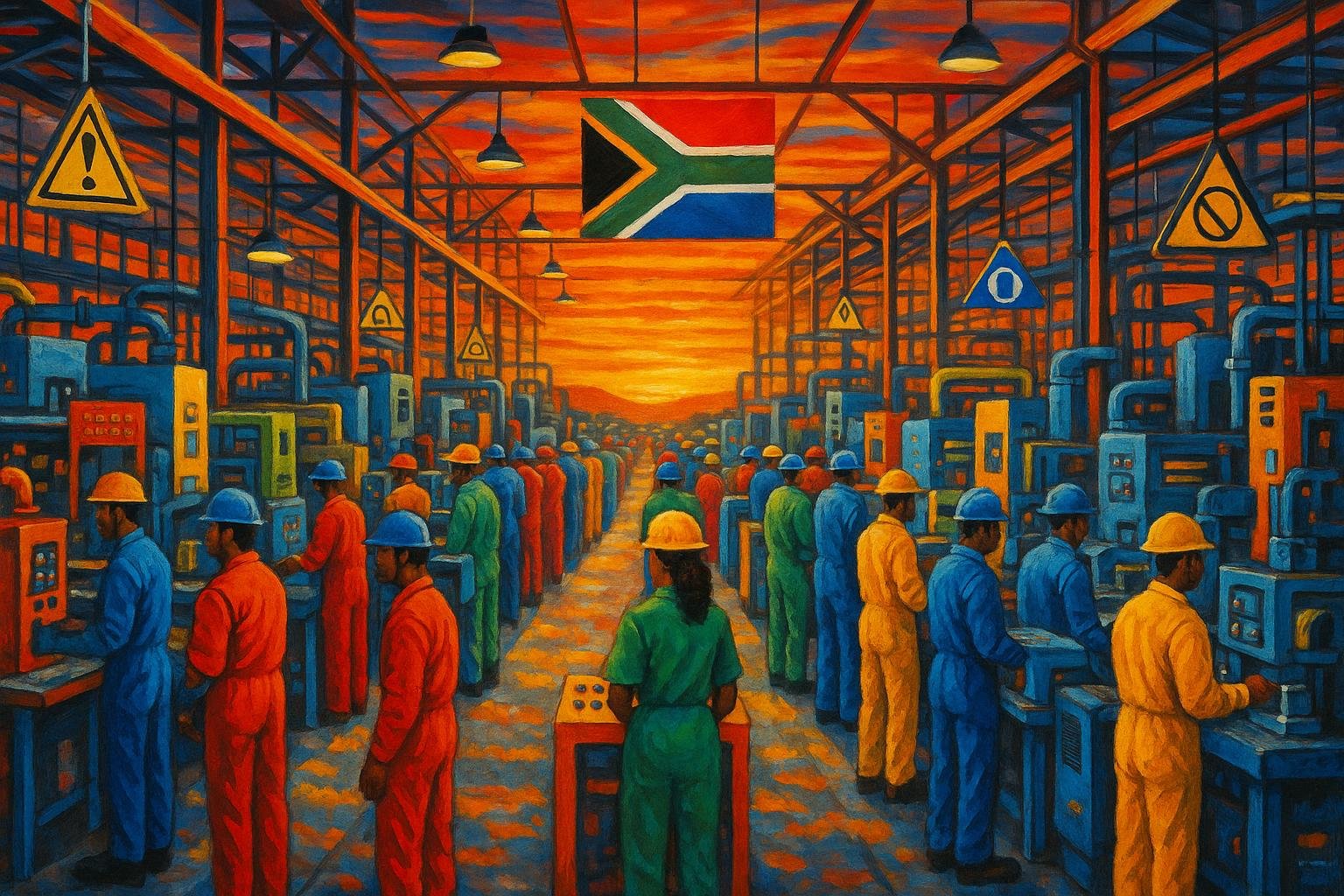
South Africa is accelerating its industrial renewal through strengthened policies, including the new Public Procurement Act and the strategic use of the National Industrial Participation Programme, to foster local manufacturing and create jobs.

South Africa is deepening its industrial revival through a strategic alignment of its preferential procurement policies, the National Industrial Participation Programme (NIPP), and a strengthened legislative framework embodied in...
Continue Reading This Article
Enjoy this article as well as all of our content, including reports, news, tips and more.
By registering or signing into your SRM Today account, you agree to SRM Today's Terms of Use and consent to the processing of your personal information as described in our Privacy Policy.
Central to the government’s procurement regime is the Preferential Procurement Policy Framework Act (PPPFA), anchored in the Constitution and designed to promote local content in the public procurement system. The origins of this drive trace back to a landmark Local Procurement Accord signed in 2011 by government, organised labour, business, and community representatives. This accord set ambitious targets to reach 70% local procurement by 2019, later referenced in industry strategies aiming for 75% localisation by 2020 as part of broader economic growth and job creation efforts.
Although this original target remains aspirational, the government continues to pursue localisation vigorously. The 2011 amendments to the PPPFA empower the DTIC to designate specific industries and sectors with minimum local content thresholds, thereby supporting domestic manufacturing and stimulating economic growth. Initial waves of designated products, announced in 2011 and 2013, included power pylons, rolling stock, buses, various agricultural products, clothing, textiles, footwear, leather goods, and components like valves and actuators. These designations explicitly target import substitution, reducing South Africa’s trade deficit and promoting industrial diversification.
The DTIC’s current designation list includes an array of products with mandated local content percentages, pumps, for instance, require at least 70% local content. Some companies, such as KSB Pumps and Valves, have exceeded this benchmark, achieving 100% local content and setting a new standard for the sector. In response to such industry performance, the department is considering upward revisions to these thresholds to encourage further localisation.
However, localisation success is not uniform across all sectors. Where local capacity remains limited, the National Industrial Participation Programme (NIPP) plays a vital role. Established in 1997, NIPP targets government or parastatal procurements involving imported inputs valued at $10 million or more. It mandates foreign suppliers to reinvest a portion of their contract value, typically 30% of the imported content, into the South African economy. This reinvestment might include technology transfers, skills development, local manufacturing, research and development, or broader economic transformation activities.
The NIPP has been particularly influential in sectors such as aerospace, energy, rail, automotive, and pharmaceuticals, where local production capacity often falls short of demand. By leveraging large-scale procurements, the programme effectively builds local industrial capacity and supports the transfer of critical skills and technologies.
A significant milestone in South Africa’s industrial policy landscape is the adoption of the 2024 Public Procurement Act. This legislation firmly embeds designation powers within law, transforming localisation from a regulatory preference to a statutory obligation for government procurement entities. The DTIC anticipates that this legal elevation will strengthen enforcement mechanisms, enhance policy coherence across government spheres, and improve compliance rates.
Speaking about the reforms, DTIC representatives emphasised that government alone cannot drive industrial growth and job creation; the private sector must lead the way, supported by an enabling governmental framework. The example of KSB Pumps and Valves exemplifies this collaborative vision. Their increasing local design and manufacturing initiatives, in partnership with DTIC, underscore the tangible progress in South Africa’s reindustrialisation efforts.
Overall, South Africa’s preferential procurement system, NIPP, and revamped Public Procurement Act together create a robust ecosystem for industrial renewal. By combining legal mandates, strategic designations, and conditional reinvestment policies, the government is laying foundations for sustainable economic growth, enhanced local manufacturing, and meaningful job creation, one locally manufactured pump, valve, or other product at a time.
Source: Noah Wire Services
Subscribe to Industry Updates

