


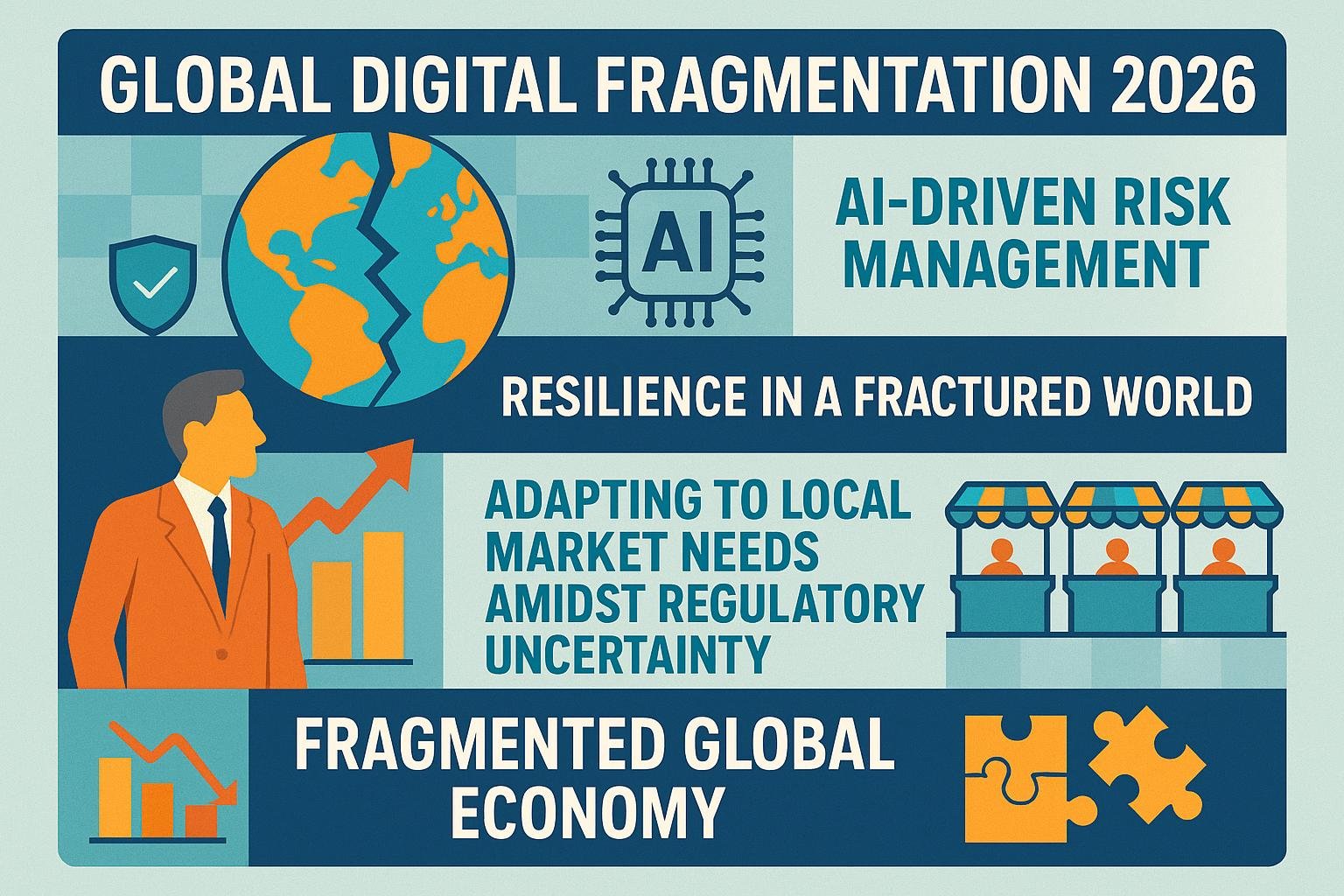
Businesses must adapt to a rapidly fragmenting digital landscape by prioritising resilience, localised operations, and AI-driven risk management amid geopolitical tensions and regulatory upheaval.

In 2026, businesses are being forced to rewire their assumptions about global operations as political friction and regulatory fragmentation reshape the technology landscape. Where cost-minimising models and global uniformity once dominated boardroom strategy, executives increa...
Continue Reading This Article
Enjoy this article as well as all of our content, including reports, news, tips and more.
By registering or signing into your SRM Today account, you agree to SRM Today's Terms of Use and consent to the processing of your personal information as described in our Privacy Policy.
The move toward nationalised control of data and compute has accelerated the fragmentation of previously global platforms. According to Gartner, spending on sovereign-cloud infrastructure-as-a-service is set to reach US$80 billion in 2026, a jump of more than a third on the prior year, driven largely by governments, regulated sectors and critical infrastructure providers seeking digital autonomy. Market players are responding: CrowdStrike announced new in-country cloud deployments for Saudi Arabia, India and the United Arab Emirates to provide local data residency while preserving a unified global security model, and Microsoft has expanded in-country data processing options for its Copilot AI to additional markets as part of a broader push to keep AI data handling within regional boundaries. Those moves reflect an industry trend away from one global stack toward a patchwork of compliant, local environments.
For multinational organisations the consequence is architectural complexity rather than simplicity. A single, centralised IT estate no longer guarantees regulatory compliance or operational continuity. Leading firms are adopting multi-local platforms that instantiate region-specific variants of core services so legal, privacy and AI governance requirements can be met without catastrophic disruption. This localisation is costly and technically demanding, but industry analysis suggests a substantial portion of workloads will migrate from global hyperscalers to local providers as sovereignty demands increase, making the investment a strategic hedge against regulatory lockouts.
Supply-chain resilience is following a similar logic. The era of tightly optimised “just-in-time” logistics has given way to redundancy and distributed sourcing. Companies are integrating digital twins of their logistics networks to run rapid contingency modelling; when a port closure or sanction materialises, AI-driven simulations identify alternatives, estimate financial impact and trigger operational switchover in hours rather than weeks. That simulation-first posture turns disruption into a manageable variable rather than an existential threat.
The changing operational environment is mirrored by evolving expectations of leadership. Long-range strategic plans are being replaced by iterative, short-cycle decision processes that continuously reassess geopolitical signals. Internal audit and risk teams are raising geopolitical and digital-disruption risks; a report from The Institute of Internal Auditors found marked increases in how practitioners rate those exposures, with cybersecurity remaining a top concern. Boards are therefore demanding greater optionality from executives, capacity to exit markets, pause products or reroute investments with minimal organisational friction, requiring cultures that reward candid risk reporting and rapid course correction.
Artificial intelligence is being repurposed as a front-line risk-management tool. Predictive risk platforms now ingest vast, diverse signal sets, from satellite AIS feeds to foreign-language social media sentiment, and produce operational risk scorecards for business units. Those systems can automatically cascade alerts to legal, compliance and marketing teams so campaigns and market activity can be dialled down in unstable jurisdictions and redeployed elsewhere. The effect is to fuse near-real-time intelligence with tactical execution, compressing decision cycles across the enterprise.
Macro indicators present a mixed picture that reinforces the need for resilience. The World Bank’s Global Economic Prospects in January 2026 noted an unexpectedly robust performance in some major economies and only modest softening of global growth over the near term, yet it also highlighted persistent divergence among developing economies. At the same time, measures of global uncertainty have spiked: the World Uncertainty Index reached unprecedented levels in February 2026, eclipsing the peaks seen during previous systemic crises. Such divergence, simultaneous economic durability in some regions and extreme policy risk in others, means firms must design strategies that can exploit growth where it exists while insulating core operations from political shocks.
Collectively, these trends imply that resilience is no longer merely a facet of risk management but a central competitive attribute. Companies that treat sovereignty requirements as an operational constraint to be absorbed through multi-local platforms, that decentralise manufacturing with digital-first contingency planning, and that embed AI-powered risk awareness into routine decision-making will be best placed to maintain continuity and capture opportunity amid ongoing fragmentation. Those that cling to globally standardised efficiency models risk being sidelined by regulatory breakpoints and sudden geopolitical shifts.
The business imperative for 2026 is clear: build systems and leadership capable of rapid pivoting, accept the costs of redundancy as insurance against disruption, and treat sovereign technology and AI-driven intelligence as foundational elements of corporate strategy rather than optional enhancements. In a world where policy tides can change overnight, strategic resilience has become the defining edge.
Source: Noah Wire Services
Subscribe to Industry Updates

