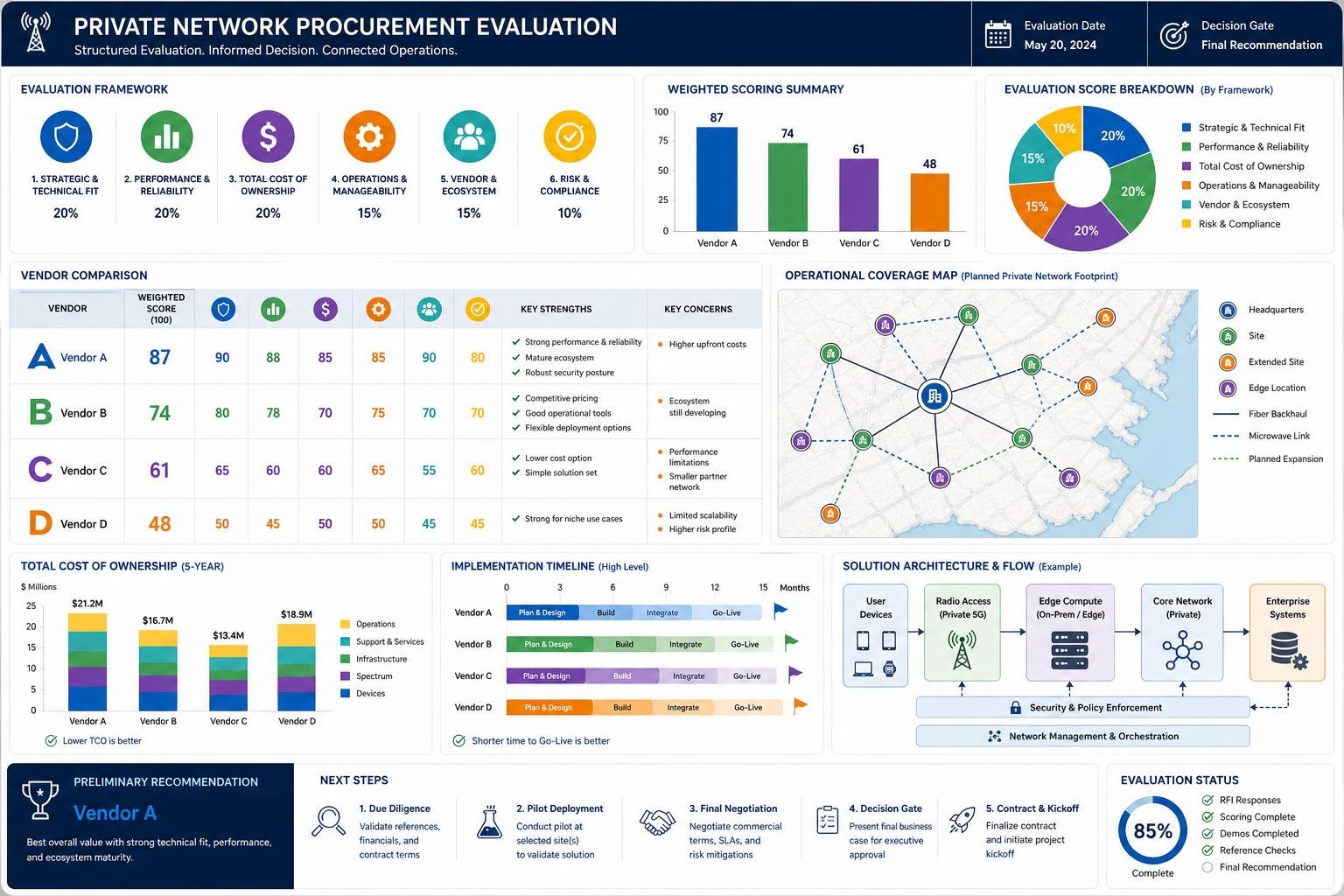
A private network procurement exercise works best when it is treated as a scored business decision rather than a technical beauty contest. TeckNexus positions its SLA Mapper around that idea: a structured framework that ties vendor assessment to vertical, use cases, architecture, compliance obligations and delivery timetable. In practice, the strongest evaluations combine weighted scoring, evidence-based validation and a clear exit path if the preferred supplier cannot prove its claim...
Continue Reading This Article
Enjoy this article as well as all of our content, including reports, news, tips and more.
By registering or signing into your SRM Today account, you agree to SRM Today's Terms of Use and consent to the processing of your personal information as described in our Privacy Policy.
s.
A sensible scorecard starts with business fit, then moves through architecture, security, delivery and commercial risk. The weights below are calibrated for a typical enterprise or industrial buyer and can be adjusted, but they provide a defensible baseline.
Suggested weighted scorecard
| Criterion |
Weight |
What good looks like |
| Use-case fit and operational outcome |
20% |
Vendor can map the network to the named workflows, latency targets, mobility needs and site constraints |
| Architecture suitability |
15% |
Proposed model matches ownership, control and operating preference without hidden dependencies |
| RF and site design capability |
10% |
Vendor demonstrates spectrum planning, coverage modelling, indoor/outdoor design and interference mitigation |
| SLA and service assurance |
15% |
Clear service credits, measurable KPIs, monitoring visibility and incident response commitments |
| Security and compliance |
15% |
Evidence of relevant standards, controls, audit support and incident handling |
| Deployment capability |
10% |
Proven rollout method, local resources, inventory readiness and cutover plan |
| Integration and interoperability |
8% |
Works with OT, IT, identity, devices and existing networks without fragile custom workarounds |
| Commercials and TCO |
5% |
Transparent pricing, lifecycle cost clarity and no surprise charges |
| Vendor viability and roadmap |
2% |
Financial stability, product roadmap and commitment to long-term support |
For regulated or critical environments, increase the weight of security, auditability and service assurance. For immediate deployments, raise delivery readiness and local support. For multi-site programmes, give more weight to programme management and standardisation.
Vendor question bank
Use-case fit
- How have you delivered this exact use case before?
- What measurable business outcome did the customer achieve?
- Which device classes, traffic patterns and mobility profiles did you validate?
Architecture
- Who owns the spectrum, RAN, core and management plane?
- What dependencies exist on third-party operators or subcontractors?
- How difficult is exit, migration or transition to another provider?
RF and design
- How do you handle indoor propagation, underground coverage, dense metal environments or high-interference zones?
- What planning tools and survey methods do you use?
- How do you validate coverage before go-live?
SLA and operations
- What are the guaranteed availability, latency, packet loss and fault response commitments?
- Is there a named NOC, and what are its hours and escalation paths?
- How are SLA breaches measured, reported and credited?
Security and compliance
- Which certifications, audit reports or assurance artefacts can you provide?
- How do you segregate user, device and management traffic?
- What is your incident notification timeline and forensic support process?
Commercials
- What is included in the base fee, and what is billed separately?
- What assumptions drive price changes over time?
- What happens if scope, site count or traffic volumes change?
Required proof points
- Reference architectures and detailed design packs
- Live customer references in the same vertical or a close analogue
- SLA dashboard samples and service reports
- Security certification evidence and recent audit summaries
- Implementation plan with milestones, resources and dependencies
- Support model, escalation matrix and named accountability
- Bill of materials, licensing schedule and full TCO model
- Exit, data handover and transition assistance terms
Red flags
- Vague answers about ownership, responsibility or subcontracting
- SLA language that excludes the very failures you care about
- Claims of “fully managed” service with no clear NOC or escalation model
- No evidence of comparable deployments in similar environments
- Heavy customisation that creates lock-in
- Security assurance based on statements rather than artefacts
- Pricing that looks simple until add-ons, support and professional services are included
Evaluation process guide
- Define the operating problem first. Write down the sites, workflows, performance thresholds, compliance duties and deployment deadlines.
- Fix the architecture preference. Decide whether you want full ownership, managed service, hybrid or a network-slice model.
- Weight the scorecard. Rebalance criteria to match the vertical, scale and urgency.
- Run an evidence-led RFP. Ask for documents, not promises.
- Score independently. Let technical, security, operations and procurement teams score separately before reconciling.
- Stress-test the shortlist. Use workshops, site walks and reference checks to challenge assumptions.
- Negotiate the contract last. Lock in SLAs, remedies, change control, exit rights and support obligations before award.
The central discipline is simple: if a vendor cannot show how its private network will support your specific environment, then it should not score well, however polished the proposal. A good procurement process rewards proof, clarity and operational fit, not marketing language.
Source: Noah Wire Services